
REVIEW · WALKING TOURS
Botero Walking Tour: experiencing Medellin through the eyes of an artist
Botero makes Medellín look wonderfully strange. This three-hour walk links the artist’s biggest local collection with the bronze statues that fill the city center, giving you both museum time and street-level context. I like the 108 Botero paintings at the Museum of Antioquia, and I like the chance to see the damaged and restored Birds of Peace at Parque San Antonio. The main drawback is that guide quality can vary, especially if you want a serious lesson on Botero’s career and technique.
The tour costs $56 per person, before any optional gratuity and possibly a $10 hotel transportation charge. That is fair if your guide is strong and your group wants a private introduction to central Medellín, but it is less attractive if you mainly want to see Plaza Botero, which is free and easy to visit independently.
In This Review
- Key points at a glance
- Why Botero belongs to Medellín
- Inside the Museum of Antioquia
- Plaza Botero and its 20-plus bronze figures
- The two Birds of Peace at San Antonio Park
- What the three-hour format feels like
- Price, transportation, and practical value
- The guide can make or break the art discussion
- Who will enjoy this Botero walk
- Should you book the Botero Walking Tour?
- FAQ
- Where does the tour begin?
- Where does the tour end?
- How long does the experience last?
- Is admission to the Museum of Antioquia included?
- How many Botero works are at the museum?
- Is Plaza Botero free to enter?
- Is the tour private?
- Is hotel pickup included?
Key points at a glance
- 108 Botero paintings at one museum: The Museum of Antioquia gives you the largest block of Botero works on this walk, with admission included.
- More than 20 bronze statues outdoors: Plaza Botero lets you see the artist’s rounded figures in an open public square where people can walk around and interact with the art.
- A serious memorial at San Antonio Park: The damaged Pájaro de Paz remains beside Botero’s undamaged donated replica.
- A private experience: Only your group participates, so the guide can adjust the pace and answer your questions.
- A city walk as well as an art tour: The route connects the museum, plaza, and park through central Medellín.
- English and Spanish support: The bilingual guide is meant to lead the experience in English and Spanish.
Why Botero belongs to Medellín
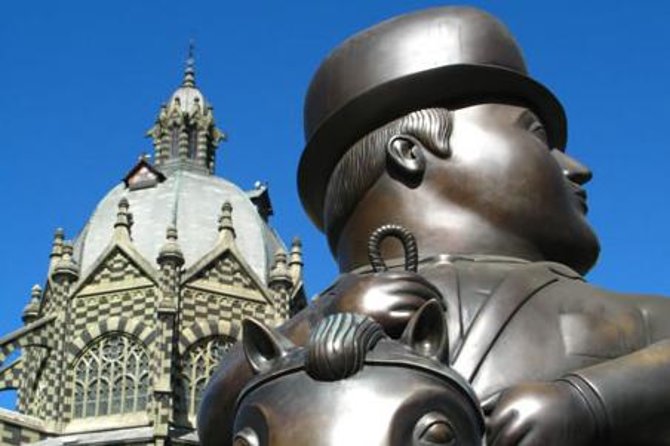
Fernando Botero was born in Medellín, and his work is woven into the city center. His subjects have exaggerated proportions, rounded bodies, and a visual humor that can seem playful at first glance. Look longer, though, and you find irony, social criticism, and a careful reshaping of familiar people, animals, and objects.
This tour works because it places the art in three different settings. You begin inside a museum, where you can study paintings. Then you step into Plaza Botero, where oversized bronze figures share space with ordinary city life. At San Antonio Park, Botero’s work becomes part of a painful civic memory rather than simply a photo opportunity.
I would not treat this as a specialist art seminar. The experience is better understood as a guided introduction to Botero and Medellín, with a useful museum visit at its center. One guide received high praise for making the tour informative and enjoyable, while other reports point out that some guides know more about the city than about art. That difference matters if Botero is your main reason for booking.
More Walking Tours in Medellin
- Medellin Historic Walking Tour with Expert Guide
★ 5.0 · 399 reviews - Comuna 4 Walking Tour Medellin
★ 5.0 · 217 reviews - Medellin Historic Walking Tour
★ 4.9 · 86 reviews
Inside the Museum of Antioquia
The tour begins at the Museum of Antioquia on Calle 52, in the La Candelaria area. You receive an admission ticket, and the museum visit lasts about 45 minutes. That is enough time for a focused introduction, though not enough for a slow examination of every work in a large museum.
The museum holds 108 paintings by Botero, making this the strongest part of the experience for anyone who wants to see more than the famous outdoor statues. You can compare the artist’s treatment of people, animals, still lifes, and public figures. The exaggerated forms are not simply a joke about size. They are part of Botero’s way of changing familiar subjects until they feel both recognizable and unexpected.
A good guide should help you notice how Botero’s work uses volume, calm expressions, and controlled compositions. The faces often appear serene even when the subject or setting suggests something more complicated. Ask directly about Botero’s use of proportion, his humor, his criticism, and how his work changed over time.
That last point is worth stressing. One of the weaker experiences reported on this tour involved a guide who was not well prepared to discuss Botero’s art or career. The museum staff offered useful explanations in that case, but you should not have to rely on chance. If you book, ask the provider in advance for a guide with strong Botero training. The company has said it was adding Botero instruction for its guides, which is an encouraging sign, but it is still sensible to confirm.
The museum is also valuable because it gives you a break from the street. Plaza Botero can feel visually crowded with statues, people, and city movement. Inside, you can concentrate on the details and see how the public sculptures relate to the artist’s wider body of work.
Plaza Botero and its 20-plus bronze figures
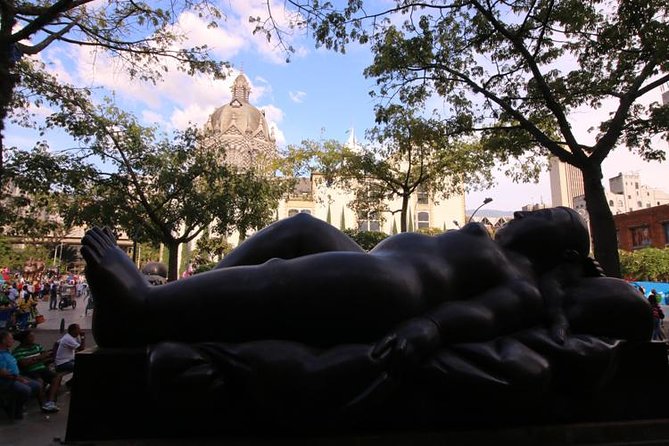
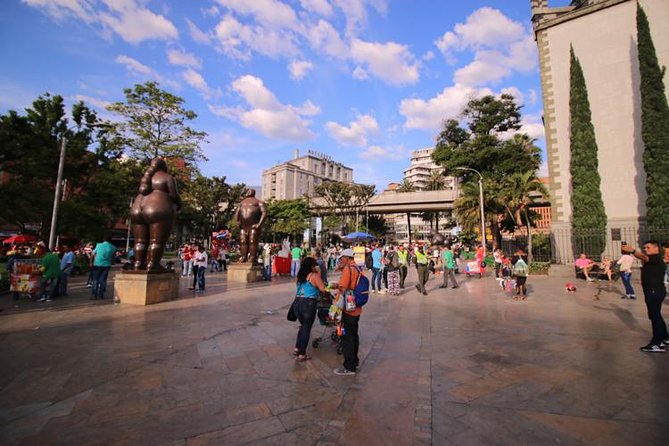
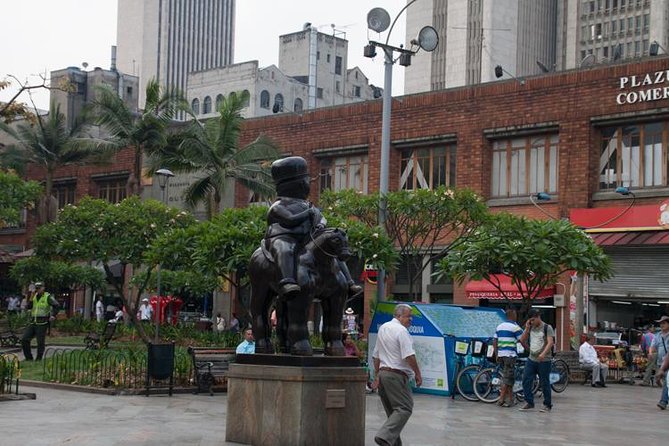
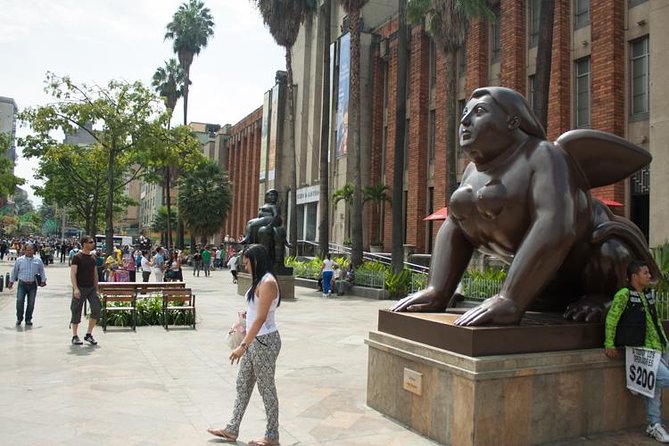
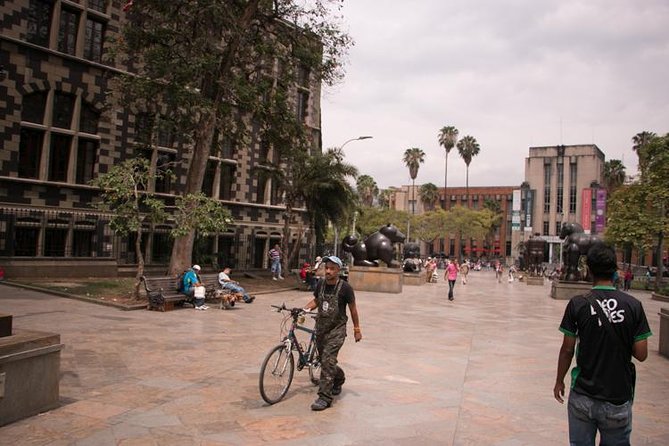
From the museum, the route continues to Plaza Botero, an open-air display with more than 20 bronze sculptures. The square was redesigned as part of a 2004 renovation program, and the statues were placed there for public interaction.
This is where Botero’s art becomes especially approachable. You do not need an art degree or a long attention span. Walk around the sculptures, look at the smooth bronze surfaces, and notice how the scale changes your view of the people and animals represented. The open setting makes the works feel less formal than they would inside a gallery.
Your guide can also explain why the plaza matters to Medellín. The square is not an isolated sculpture garden. It is part of the city center, and the art is meant to be encountered during daily life. That public setting is one of the tour’s best ideas. You see how Botero’s work moved beyond museums and into the identity of his hometown.
Allow about 30 minutes here. That is enough for an introduction and photographs, but you may want longer if sculpture is your main interest. Since admission is free, you can return on your own later if the tour feels rushed.
The plaza is also the point where expectations need a little adjustment. The tour title suggests a focused Botero experience, and the museum and plaza do deliver that. Still, the walking portion can include broader discussion of downtown Medellín, local stories, and the area around the route. That can be a strength if you want city context. It may disappoint you if you expect every minute to focus on artistic technique.
The two Birds of Peace at San Antonio Park
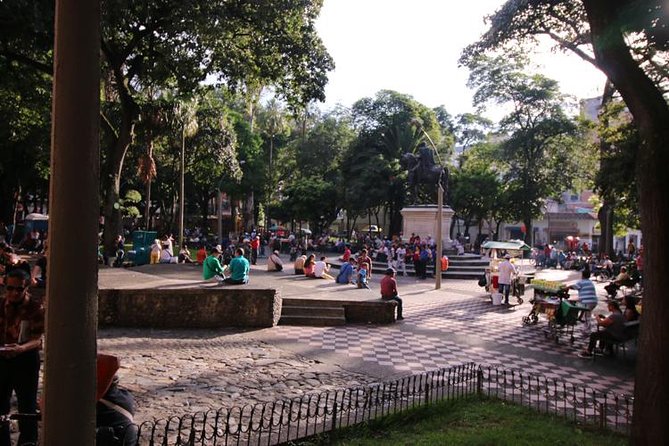
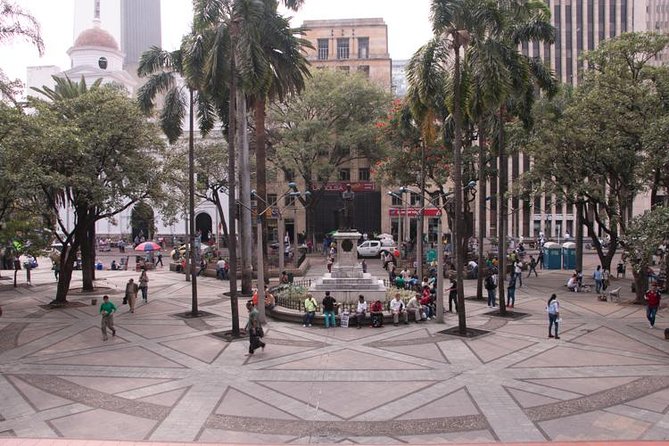
The final stop is Parque San Antonio, about 20 minutes. Here you see Pájaro de Paz, or Bird of Peace, in a setting that calls for more than a quick photograph.
A FARC bomb destroyed the original sculpture in 1995 and killed innocent people. Botero later donated an exact, undamaged bronze replica. He also insisted that the broken statue remain in place as a memorial, with the victims’ names carved into its base.
The result is two related works with different meanings. The intact bird represents peace and renewal. The ruined sculpture records violence and loss. Together, they show how public art can carry memory, not just decoration.
Your guide should give this stop the time and care it deserves. Twenty minutes is brief, but the story is powerful and easy to understand when explained clearly. This is the most emotionally serious part of the route, and it gives the tour a purpose beyond collecting photographs of large bronze figures.
At the end, the guide can help arrange transportation back to your hotel, to another destination, or to a nearby lunch spot. The stated end point is the original meeting point, so clarify your plans before the tour finishes.
A completely different kind of day:
- Medellin: Comuna 13 Graffiti Tour, Cable Car & Street Food
★ 4.8 · 9,046 reviews - Comuna 13 Graffiti Tour with Street Food
★ 5.0 · 7,503 reviews - Museo Pablo Escobar
★ 5.0 · 7,242 reviews - Guatapé Tour: Piedra del Peñol with Boat Tour, Breakfast, Lunch
★ 5.0 · 7,035 reviews
What the three-hour format feels like
The schedule adds up to about 95 minutes at the three main stops, leaving roughly an hour for walking, introductions, and transitions. That is a sensible length for a morning or afternoon in central Medellín. You get enough structure to learn something, but the experience should not consume your entire day.
Wear comfortable clothing and walking shoes. The route involves a museum, a public plaza, and a park, with time spent moving through the city center. The tour operator notes that outside conditions can require changes, and you should receive advance notice if the route needs to shift.
This is a private tour, meaning only your group participates. That is a real advantage. You can ask a question without holding up a large crowd, request more time at a painting, or tell the guide if you want more city history and less art discussion. It also makes the $56 price easier to justify for a small group, especially if the cost is shared among several people.
The listing says group discounts are available. Check the final price carefully because the per-person rate and any discount may depend on group size.
Price, transportation, and practical value
At $56 per person, the tour is not the cheapest way to see Botero in Medellín. The plaza itself is free, and the museum is the main included admission. You are paying for the guide, the private format, the planned route, and the interpretation that connects the three stops.
I think the price works best for first-time visitors who want an organized introduction and feel more comfortable exploring with a guide. It is also useful if you want to combine art with an explanation of Medellín’s central area. If you already know Botero well, you may get better value from visiting the museum and plaza independently, then spending your money on a more specialized art guide.
There is an important transportation detail to settle before booking. The overview says hotel pickup and drop-off are included, while the inclusion details list hotel pickup and drop-off at $10 per person. The stated meeting point is the Museum of Antioquia, and the stated end point is back at that meeting point. Because these details do not match, contact the provider and ask exactly what transportation is included in your price.
The listed provider is Impulse Travel. Confirmation is provided when you book, and the experience is offered in English with a bilingual English and Spanish-speaking guide. Optional tips, personal expenses, and any extra transportation cost are not included.
The guide can make or break the art discussion
The strongest praise for this experience centers on the guide’s ability to make the walk informative and enjoyable. One particularly good account describes a small-group, personalized tour with a guide who offered strong explanations of Botero’s life and work. That is the ideal version of this experience.
But you should keep the weaker possibility in mind. One guide arrived 90 minutes late after a bicycle accident and then spent much of the opening discussing family and local experiences. Those personal stories gave useful insight into the area, but the guide did not have enough expertise in Botero. Another account similarly found the tour excellent as a Medellín walking tour, but less successful as a dedicated art tour.
The practical lesson is simple: ask for the guide’s Botero background before the day begins. Tell the provider that the artist is your main interest. During the museum visit, ask specific questions rather than waiting for a lecture. A private format gives you room to steer the discussion.
The overall rating of 3.8 from six ratings suggests a generally positive but uneven experience. The high marks praise the museum, the plaza, the enjoyable pace, and strong guiding. The lower marks focus on late arrival and limited art expertise. I would book this with realistic expectations, not as a guaranteed master class.
Who will enjoy this Botero walk
I would recommend the tour to you if:
- You are visiting Medellín for the first time.
- You want Botero explained in relation to his hometown.
- You prefer a private guide to exploring the city center alone.
- You enjoy both museum art and public sculpture.
- You want a short experience that leaves time for lunch or other sightseeing.
- You are comfortable with a tour that may include Medellín history and local stories beyond Botero.
I would hesitate if you want a highly academic art tour. The guide may be excellent, but the available information shows uneven depth in Botero scholarship. A specialist-led museum tour would be a better fit if technique, chronology, and career analysis matter most to you.
The experience is also less suitable if you dislike walking or want hotel transportation without extra cost. Confirm the pickup details before paying, especially because the transportation information is inconsistent.
Should you book the Botero Walking Tour?
Book it if you want a friendly, private introduction to Fernando Botero and Medellín in one compact outing. The Museum of Antioquia’s 108 paintings, the free outdoor sculpture plaza, and the two Birds of Peace create a strong sequence. The final memorial also gives the day emotional weight.
Before booking, confirm three things: the guide’s Botero expertise, the exact hotel pickup charge, and whether your group qualifies for a discount. If those details are clear and you value personal guidance, $56 can be reasonable. If you mainly want the public statues, visit Plaza Botero independently and spend more time at the museum instead.
FAQ
Where does the tour begin?
It begins at the Museum of Antioquia, at Cl. 52 #52-43 in La Candelaria, Medellín.
Where does the tour end?
The stated end point is back at the original meeting point.
How long does the experience last?
The tour lasts approximately three hours.
Is admission to the Museum of Antioquia included?
Yes. Entry tickets to the attractions mentioned are included, including the museum.
How many Botero works are at the museum?
The museum visit includes access to a collection of 108 Botero paintings.
Is Plaza Botero free to enter?
Yes. Admission to Plaza Botero is free.
Is the tour private?
Yes. Only your group participates in the activity.
Is hotel pickup included?
The information gives conflicting details. One section says pickup and drop-off are included, while another lists them at $10 per person. Confirm this with Impulse Travel before booking.
Just added in Medellin
- Walking Tour, Cable Car & Fruit Tasting★ 5.0 · 1 review
- Pablo Escobar and Griselda Blanco Tour★ 5.0 · 1 review
- City tour, Commune 13, Metro Cable, Botero Park and more. Private★ 5.0 · 34 reviews
- comuna 13 tour★ 3.5 · 6 reviews
- 3 days private mountain tour, nature and culture near Medellin★ 5.0 · 22 reviews
- commune thirteen transformation story★ 4.5 · 14 reviews
- fruits tour★ 5.0 · 2 reviews
- Paragliding and hammocks zipline over waterfalls private tour★ 5.0 · 6 reviews
Walking Tours, compared.
Historic Center and Getsemaní Shared Walking Tour
Read our review →
Private Walking Tour in Cartagena Walled City & Getsemaní
Read our review →
Graffiti Tour: a fascinating walk through a street art City
Read our review →

Medellin Historic Walking Tour with Expert Guide
Read our review →
Bogotá Tour: Monserrate, Food, City Walk & Botero Museum
Read our review →Browse the lists this tour appears in