
REVIEW · GRAFFITI AND STREET ART TOURS
Graffiti Tour: a fascinating walk through a street art City
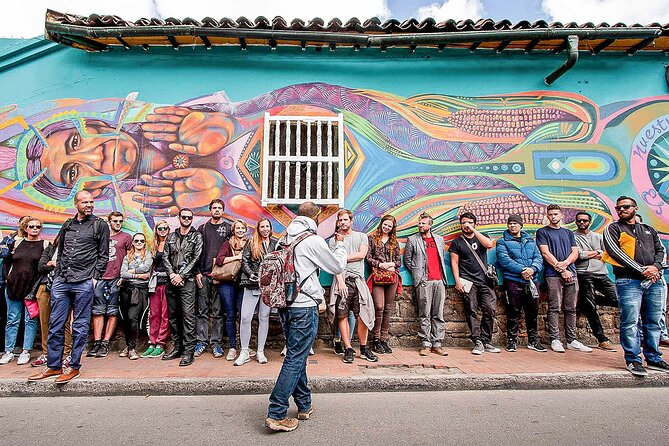
Bogotá tells its story on walls. This $15 walking tour links major murals, small stencils, political posters, and working artists’ spaces across the city center. You get much more than a photo walk: the art becomes a way to understand Colombian politics, migration, Indigenous rights, music, environmental concerns, and the long argument over what belongs in public space.
I especially like the small group limit of 15 people and the guides’ connection to the local art scene. Guides such as Cami, Jay, Marco, and Camilo have been praised for explaining both technique and social context in clear, lively terms. The main consideration is physical: this is a 2.5-hour walking tour with many brief stops, and it is not recommended for people with mobility restrictions.
In This Review
- Key points to know before you book
- Starting near the Gold Museum
- Social leaders and human rights at Procuraduría
- Migration, salsa, and Bogotá’s mixed voices
- Torre Bakatá and the question of illegal graffiti
- Aerosol, vinyl, and Indigenous identity
- Three murals at Parqueadero Moto
- Venezuelan migration and the language of graffiti
- Political posters near Torre Ventto
- The Amazon and Indigenous cosmovision
- Comuna 13, Operation Orion, and public memory
- The Hitnu leader and the cost of development
- An abstract lettering game at COOTRADIAN
- Four political murals on Cl 20
- The country’s tallest wall and the finish at Ocio Gallery
- What $15 gets you
- Who will enjoy this walk most
- Should you book the Bogotá Graffiti Tour?
- FAQ
- How long is the Bogotá Graffiti Tour?
- How much does the tour cost?
- Where does the tour begin?
- Where does the tour end?
- How many locations does the tour visit?
- Are admission tickets included?
- What is the maximum group size?
- Is the tour offered in English?
- Can I cancel for a full refund?
Key points to know before you book
- Seventeen stops in about 2.5 hours: You see a wide sample of Bogotá’s public art rather than spending a long time at only one or two murals.
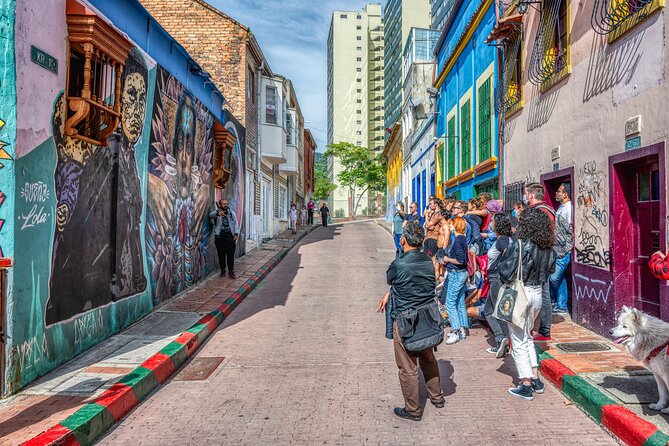
- Art with a social message: Murals address migration, political violence, Indigenous culture, the Amazon, parenting, freedom, and sustainable development.
- A useful lesson in technique: Guides explain the difference between graffiti and muralism, along with aerosol, vinyl, stencils, posters, and abstract lettering.
- Small groups help the experience: The maximum group size is 15, making it easier to hear explanations and ask questions.
- A strong value at $15: Every listed stop is free, and the fee pays for guiding rather than admission tickets.
- The tour ends at an art gallery: Ocio Gallery displays work by more than 100 artists, giving you a natural final stop for browsing local art.
Starting near the Gold Museum
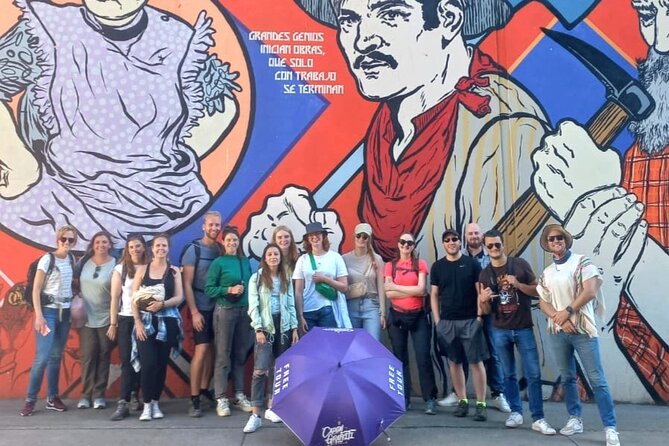
The tour begins at Capital Graffiti Tours, at Cra. 6 #15-88 in Santa Fé, Bogotá. The first meeting point is described as being in front of the Gold Museum, where your guide welcomes the group and explains the purpose of the walk.
That opening matters. Bogotá’s street art can feel like visual overload when you first arrive. Every block seems to carry another painted wall, stencil, tag, or poster. The guide gives you a framework so you can tell the difference between a large commissioned mural, an illegal piece, a political stencil, and a quick graffiti signature.
You should expect the opening stop to be brief, about 10 minutes. The Gold Museum itself is not included in this experience, and there is no admission charge for the tour’s stops. If you want to visit the museum, plan that as a separate activity.
More Graffiti and Street Art Tours in Bogota
- Graffiti Tour in La Candelaria Bogotá
★ 5.0 · 315 reviews - Bogotá: La Candelaria Graffiti & Urban Art Guided Tour
★ 4.7 · 250 reviews - Fun Graffiti Workshop: The Art of Aerosol and Color
★ 5.0 · 73 reviews
Social leaders and human rights at Procuraduría
At the Procuraduría General de la Nación, the group examines a large mural made with social leaders and human rights defenders. Its subject is serious: the threats faced by people working for food sovereignty and community rights.
The artwork uses metaphor rather than presenting a simple news report. Artists with backgrounds in social communication helped represent the work and values of the people portrayed. This is one of the tour’s strongest examples of how public art can function as civic speech.
The stop lasts about 10 minutes. That is enough time for a guided explanation and photographs, though not enough for a slow, private study of every detail. If political art interests you, listen closely here. It sets the tone for much of the rest of the walk.
Migration, salsa, and Bogotá’s mixed voices
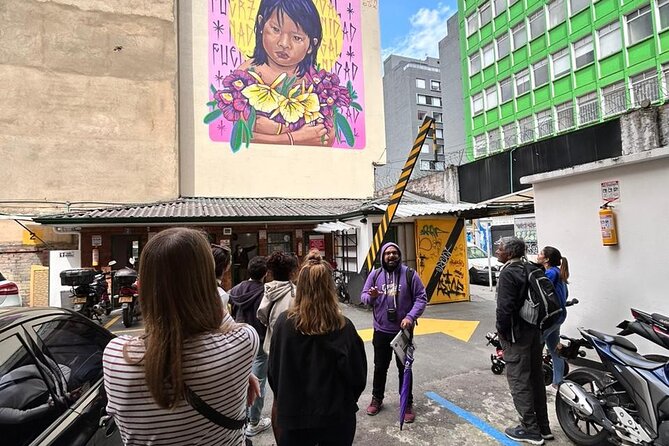
The next group of stops shifts between migration and popular culture. At a public parking area, you see a mural about the difficulties of migration, centered on the portrait of an Indigenous girl from a nomadic tribe. The piece was commissioned by the Peruvian embassy and painted by women artists from Bogotá and Lima.
That detail gives the mural a broader regional frame. The tour is not limited to Colombian identity in a narrow sense. It also looks at movement across borders, cultural memory, and the way artists respond to social change.
At Casa Quiebra Canto, a famous salsa club, two murals explore different sides of salsa culture. One refers to Lágrimas Negras, or Black Tears. The other shows a lively dance scene inside a well-known salsa nightclub.
These stops last only about five minutes each, so you will need to move quickly from explanation to photography. Still, the pairing is smart. It shows that Bogotá’s wall art is not only about protest. Music, nightlife, emotion, and neighborhood identity also have a place on the street.
Torre Bakatá and the question of illegal graffiti
At Torre Bakatá, the subject is scale. The semi-abandoned skyscraper carries what is described as the tallest illegal graffiti in Colombia.
This is a useful point for discussing the difference between commissioned street art and unauthorized graffiti. Size does not settle the argument. A huge piece can still raise questions about ownership, permission, risk, and who gets to decide how a city should look.
The stop is short, about five minutes. The guide’s explanation is likely more important than the amount of time you spend standing in front of the building. This is one place where a good guide helps you see the public debate behind the paint.
More Walking Tours in Bogota
- Bogotá: Guided La Candelaria Walking Tour
★ 4.8 · 1,229 reviews - Walking Tour in La Candelaria Bogotá
★ 5.0 · 859 reviews - Bogotá Tour: Monserrate, Food, City Walk & Botero Museum
★ 5.0 · 328 reviews - Bogotá: True Colombian Walking Tour + Local Snacks
★ 5.0 · 291 reviews
Aerosol, vinyl, and Indigenous identity
At Viuda Negra Tattoo Gallery, the mural presents an Indigenous person beneath the watchful gaze of a hooded woman. The artwork also offers a chance to compare aerosol and vinyl techniques.
That technical contrast may sound small, but it changes how you read a wall. Aerosol produces one set of textures, edges, and visual effects. Vinyl allows another kind of finish and control. The guide connects those methods to the final appearance rather than treating technique as art-school jargon.
The image itself is more psychological than decorative. You are asked to consider who is watching, who is being watched, and how Indigenous identity is presented in public art.
Three murals at Parqueadero Moto
Parqueadero Moto is one of the more varied stops, with three murals and about 15 minutes of discussion.
The first was created by a prominent Spanish artist who became well known in the 1990s. The second connects photography and stencil work. A respected photographer turns portraits from travels into stencils, bringing faces from different places into a new public setting.
The third mural considers parenting and freedom, with a more inward and psychological mood. Together, the three pieces show how broad the term street art can be. You move from an established international artist, to travel-based portraiture, to a work about family and personal choice.
This is also a good moment to ask your guide questions. The guides are praised for explaining how the local art scene works, including the cooperative relationships among artists. Marco, who has a sociology background, has been especially appreciated for linking the images to political and economic issues.
Venezuelan migration and the language of graffiti
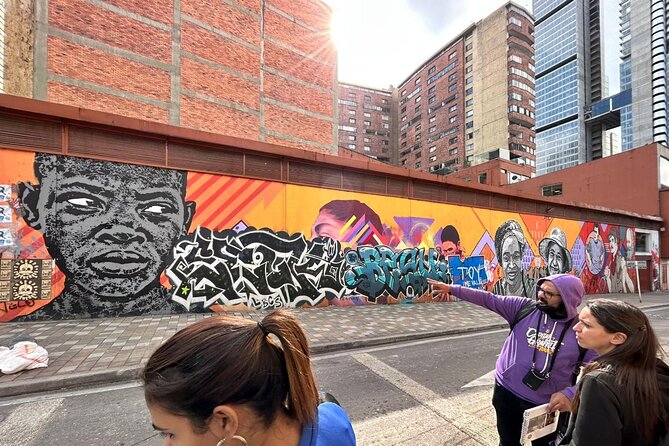
At Litografía CH, a stencil focuses on Venezuelan migrants. The piece is small compared with the major murals, but that is part of the lesson. Public art does not need a giant wall to make a social point.
The next stop, Park motos smoke shop CENTRAL, turns toward graffiti itself. The wall includes letters and characters that invite a discussion about the origins of graffiti and the difference between graffiti writing and muralism.
The guide may connect public-space art to a much older human habit, marking walls and leaving images for others to see. The comparison reaches from cave art to modern city walls. It is a simple idea, but it helps explain why graffiti is more than random decoration or visual clutter.
If you are new to graffiti, this explanation is one of the tour’s most useful parts. You learn to look at lettering, characters, scale, placement, and intention instead of judging a piece only by whether you like its colors.
Political posters near Torre Ventto
Around Torre Ventto, political posters and stencils address current social issues. This stop continues the tour’s focus on public art as a form of communication.
Posters and stencils have a different character from large painted murals. They can be reproduced, layered, removed, or replaced more easily. That gives them a sense of immediacy. They often respond to events while those events are still being argued about.
The stop lasts about five minutes, so expect a concise explanation rather than a long political lecture. Jay has been praised for providing strong context about Bogotá’s recent political and social tensions while keeping the discussion accessible.
The Amazon and Indigenous cosmovision
At Alianza Francesa Bogotá, the group sees a collaborative work joining art, science, and environmental concerns. The mural warns about threats to the Amazon rainforest.
This is an important change of scale. Earlier works focus on individuals, communities, or specific political struggles. Here the subject is an entire ecosystem and the responsibility people have toward it. The collaboration also shows how public art can bring together fields that usually operate separately.
At Superdorado de Aves, the theme shifts to Indigenous cosmovision and cultural heritage. The mural pays respect to an Indigenous worldview, offering a chance to think about cultural traditions as living systems rather than museum objects.
These two stops work well together. One asks what is happening to the natural world. The other asks how people understand their place within it.
Comuna 13, Operation Orion, and public memory
At Parqueadero Público la 3, a mural addresses Comuna 13 and Operation Orion. The artwork draws on powerful photographs by journalists and presents the resilience of the community in the face of false positives.
This is among the tour’s most historically and politically weighty stops. The guide helps connect the imagery to violence, official power, journalism, and the ability of communities to preserve their own memory.
The mural is also described as part of a collaboration between the tour’s agency and artists. That gives the stop a practical dimension. The walk is not only about looking at art. It also supports a system in which artists receive a public platform for their work.
The Hitnu leader and the cost of development
At Cafetería La Ventantia, a stencil portrays the last Indigenous leader of the Hitnu culture. The image raises tensions between development and cultural preservation.
A stencil is a fitting technique for this subject. It has a direct, graphic quality, and the image can be understood quickly from a distance. Yet the story behind it asks for more time. Development may bring roads, buildings, and economic activity, but it can also threaten language, land, tradition, and community continuity.
The tour does not present street art as a solution to every problem. Instead, it shows how artists can place difficult questions in front of people who might otherwise walk past them.
An abstract lettering game at COOTRADIAN
COOTRADIAN brings a lighter, more interactive moment. You take part in a game involving abstract letters made by well-known graffiti writers.
This activity helps you look at lettering as design rather than trying to read every piece as ordinary handwriting. It also connects with the tour company’s aerosol workshops, which are presented as open to everyone.
That makes this stop useful for people who want more than background information. You are not simply told how graffiti works. You get a small chance to think about letter shapes, movement, balance, and style.
Four political murals on Cl 20
At Cl 20 #430, four respected political artists from Bogotá present murals about the foundations of society and its social struggles.
The four-work grouping gives the guide room to compare styles and messages. You can see how different artists approach similar questions through composition, symbols, portraiture, and text.
By this point, the earlier stops begin to connect. Migration, Indigenous rights, violence, ecology, music, and family life are not separate subjects. They all show how artists use public walls to discuss the forces shaping everyday life.
The country’s tallest wall and the finish at Ocio Gallery
The final major mural is at The Spot Bogotá Centro. It is described as the tallest wall in the country and focuses on diversity, a better future, sustainable social development, and the role of sustainable tourism.
A huge final wall gives the tour a fitting sense of scale. You have spent the afternoon looking at individual faces, small stencils, local political messages, and technical details. The last work asks you to consider what kind of city and society might come next.
The walk ends at Ocio Gallery, at Cra. 5 #26b-26. More than 100 artists exhibit work there, so you can continue looking at local art after the street portion ends. Food and tips are not included, but the gallery gives you a natural place to browse and decide if you want to buy something directly from an artist.
What $15 gets you
At $15 per person, this is excellent value if you want an informed introduction to Bogotá’s street art. There are no admission fees at the listed stops, so the price is mainly for the guide’s time, local knowledge, route planning, and interpretation.
The experience is especially good value because it covers 17 locations in about two and a half hours. You could find many of these walls independently, but you would miss the connections among them. The guide explains which works concern migration, which use particular techniques, and how public art relates to Colombia’s political life.
The tradeoff is pace. Most stops last only five minutes, with a few lasting 10 or 15. If you want to photograph every detail or sketch each mural, you may feel hurried. If you want a strong overview with context, the steady pace works well.
The tour is generally booked about 13 days ahead, so booking early is sensible if your Bogotá schedule is fixed. Confirmation arrives when you book, and cancellation is free up to 24 hours before the start time. Changes or cancellations inside that window are not accepted for a refund.
Who will enjoy this walk most
I would choose this tour if you:
- Like public art, photography, design, or urban culture
- Want an introduction to Colombian politics through accessible visual examples
- Prefer a local guide to an unguided photo walk
- Enjoy learning about technique, not just taking pictures
- Want a small group rather than a large bus tour
- Are comfortable walking for about 2.5 hours
It is also a good first-day activity because it helps you understand the city’s public spaces and gives you subjects to notice during the rest of your stay.
I would hesitate if you have significant mobility restrictions. The experience includes many stops across central Bogotá and is specifically not recommended for people with mobility limitations. Service animals are allowed, and the route is near public transportation.
Should you book the Bogotá Graffiti Tour?
Yes, if you want street art explained as part of real social life rather than treated as colorful background. The strongest features are the guides’ passion, the range of subjects, and the direct connection between the artwork and Bogotá’s recent political and cultural struggles.
Book it for the stories behind the walls, not just the walls themselves. Cami, Jay, Marco, and Camilo have each been praised for bringing personal enthusiasm and clear explanations, and one guide is also a street artist. At $15, with a maximum of 15 people and a gallery finish, this is one of the better-value ways to understand why Bogotá’s public art matters.
FAQ
How long is the Bogotá Graffiti Tour?
The tour lasts approximately 2 hours and 30 minutes.
How much does the tour cost?
The price is $15 per person.
Where does the tour begin?
The meeting point is Capital Graffiti Tours, Cra. 6 #15-88, Santa Fé, Bogotá. The opening welcome takes place in front of the Gold Museum.
Where does the tour end?
The tour ends at Ocio Gallery, Cra. 5 #26b-26, Bogotá.
How many locations does the tour visit?
The route includes 17 listed stops, including the Gold Museum, major murals, political stencils, graffiti walls, and Ocio Gallery.
Are admission tickets included?
The listed stops have no admission charge. Food and tips are not included.
What is the maximum group size?
The tour has a maximum of 15 people.
Is the tour offered in English?
Yes. Experienced English-speaking guides are included.
Can I cancel for a full refund?
Yes, if you cancel at least 24 hours before the experience’s start time. Cancellations or changes made less than 24 hours before the start are not refunded.
Just added in Bogota
- Tour of Zipaquirá: Visit the Salt Cathedral and the main squares★ 4.5 · 55 reviews
- Catedral de Sal desde Bogotá en Tren★ 5.0 · 5 reviews
- Zipaquirá and Salt Cathedral Muisca Heritage with Guide – Private★ 4.5 · 23 reviews
- Botanical Garden Bogotá Private Tour (4 Hrs.)★ 5.0 · 13 reviews
- Zipaquira Salt Cathedral★ 4.5 · 12 reviews
- LOCAL GUIDE Zipaquirá PRIVATE TOUR – Salt Cathedral and Salt Oven★ 5.0 · 24 reviews
- Private Zipaquira Salt Cathedral and Guatavita Lagoon Tour from Bogota★ 4.5 · 44 reviews
- Zipaquira Salt Cathedral★ 5.0 · 4 reviews
Graffiti and Street Art Tours, compared.
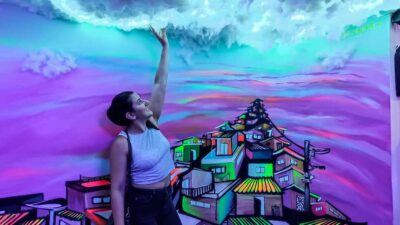
Comuna 13 Graffiti Tour, Cable Car & Street Food
Read our review →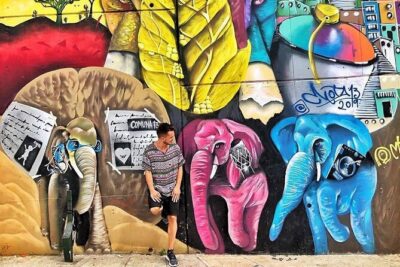
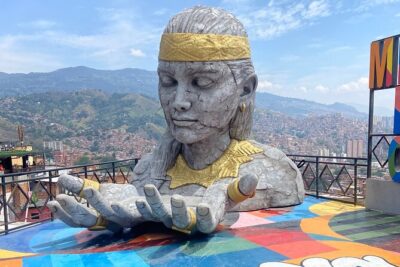
Comuna 13 Tour with Snacks And Your Own Graffiti
Read our review →
Comuna 13 and Graffiti Guided Tour with a Local
Read our review →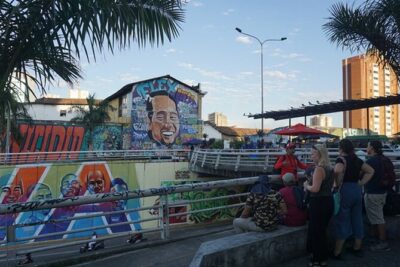
Historical Shared Tour Salsa, Graffiti & Resistance in Cali
Read our review →Browse the lists this tour appears in