
REVIEW · HISTORICAL TOURS
Medellin Historic Walking Tour with Expert Guide
See Medellín through its downtown streets. This three-hour walk connects the city’s railway beginnings, public art, political history, and urban renewal in one well-paced route. I especially like the way the tour links places that can seem unrelated at first, such as Botero’s sculptures, the Metro, and the rebuilt Plaza de las Luces.
I also like the human touch provided by guides such as Germán, Carolina, Julio, Sussie, and Julie, who bring humor and clear explanations to difficult subjects. The main consideration is that downtown Medellín can be lively and crowded, and one past participant found a guide’s accent a little hard to follow.
In This Review
- Key points at a glance
- Why this downtown walk matters
- From the railway to La Alpujarra
- Plaza de las Luces and the city’s urban renewal
- Palacio Nacional, coffee, and local art
- Veracruz Church and Plaza Botero
- Parque Berrío and the Metro story
- Parque San Antonio and the Birds of Peace
- What the $16 price really buys you
- Pace, comfort, and guide quality
- Who should book this walk?
- Should you book it?
- FAQ
- How long does the Medellín Historic Walking Tour last?
- How much does the tour cost?
- Where does the tour begin?
- Where does the tour end?
- Are admission tickets included?
- Is lunch included?
- Is the tour available in more than one language?
- How large is the group?
- Can I cancel for a full refund?
Key points at a glance
- Medellín’s transformation takes center stage: You see how former industrial and neglected areas became public spaces, pedestrian streets, and cultural sites.
- Botero appears in several important places: The tour explains Fernando Botero’s connection to Medellín and visits his sculptures, including the Birds of Peace.
- The route covers 13 major stops: You begin near the old train station and finish at Parque San Antonio, with no admission fees listed for the stops.
- The story includes difficult subjects: Your guide discusses violence, inequality, political change, and the city’s recovery without presenting Medellín as a simple success story.
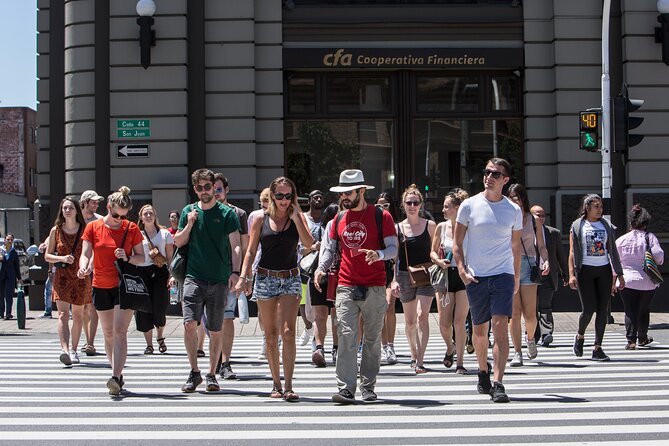
- The group is limited to 18 people: That is small enough for questions and easier street movement than a large coach group.
- The price is low for three hours: At $16 per person, the walk offers strong value if you want orientation, context, and practical recommendations early in your stay.
Why this downtown walk matters
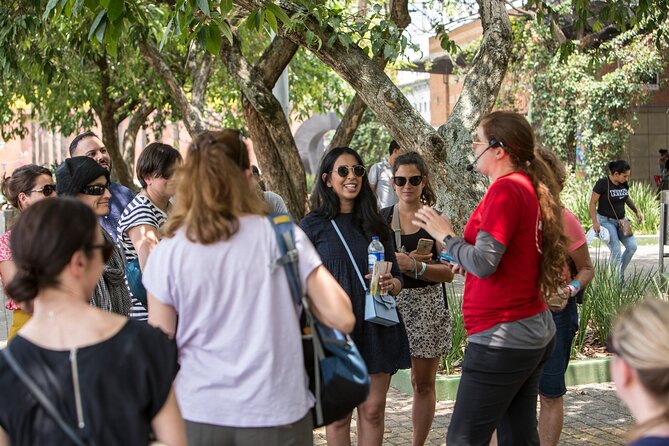
Medellín is a city that makes more sense when you walk through its center. The buildings, plazas, public art, police presence, vendors, and Metro stations all tell part of the story. This tour gives you a framework for understanding those details instead of treating downtown as a string of photo stops.
I like that the route focuses on public places. You are not spending the morning inside a succession of ticketed attractions. Instead, you move through the city itself, using streets and squares as the classroom.
The tour is also useful because it explains the idea of social urbanism, Medellín’s approach to using public works, transit, plazas, and cultural spaces to change how people experience the city. That theme appears repeatedly, from Plaza de las Luces to Paseo Carabobo and Parque San Antonio.
The guides appear to be central to the experience. Germán is praised for combining humor with difficult historical context. Carolina is described as open about her opinions while making clear when she is expressing a personal view. Julie is praised for her passion and for laying out information in a way that is easy to follow.
That variety matters. The route includes subjects that can become dry or heavy in less capable hands. A good guide keeps the facts connected to the places around you.
More History Tours in Medellin
- Pablo Escobar Tour : Museum, History and Beer
★ 5.0 · 867 reviews - Shared Tour Historic Center of Medellin with Audio System
★ 5.0 · 523 reviews - Medellín Essential: history & local life on E-bike
★ 5.0 · 459 reviews
From the railway to La Alpujarra
The walk begins at the old Medellín train station, the Edificio del Ferrocarril de Antioquia. You spend only about five minutes here, but the stop establishes the city’s modern starting point.
The station represents Medellín’s industrial and commercial growth. It is a useful first image because the rest of the walk asks you to compare that earlier city with the Medellín you see today.
Next comes Centro Administrativo La Alpujarra, where the guide gives broader context about Medellín and the paisa people. Expect this to be one of the more talk-heavy parts of the tour, with about 20 minutes devoted to explanation.
This is where a strong guide makes a real difference. You are not simply learning dates. You are getting a cultural and political introduction before moving deeper into downtown.
The Monumento a La Raza follows. This large concrete and bronze work by Rodrigo Arenas honors the people of Antioquia. The stop lasts about five minutes, so the focus is likely on understanding the monument’s meaning rather than studying every visual detail.
I appreciate that the tour uses monuments as conversation starters. Public art can seem imposing but unclear when you encounter it alone. A short explanation can help you notice its symbols and its role in local identity.
Plaza de las Luces and the city’s urban renewal
Plaza de las Luces is one of the clearest examples of the tour’s central theme. Its 300 pillars light up at night, and the guide explains why this place mattered in Medellín’s transformation.
You spend about ten minutes here. That is enough time to understand the square’s purpose and to see how public design can change the feel and use of an area.
The nearby Vásquez and Carré buildings add architectural context. Along with the square, they are presented as part of Medellín’s urban renewal and as examples of social urbanism.
This section should appeal to you if you enjoy cities as much as monuments. The point is not only that old buildings were preserved or new spaces were created. It is how those changes affected movement, public life, and the image of downtown.
The route then turns onto Paseo Carabobo. This former polluted and noisy street is now a pedestrian boulevard with greenery, color, vendors, and steady foot traffic. You spend about 15 minutes here while walking toward the center of downtown.
This is one of the most useful parts for first-time visitors because it helps you read the city at street level. You see how a traffic-heavy corridor can become a place for people, commerce, and public activity.
Still, this is a walking tour in an active city center, not a quiet museum visit. Keep your belongings secure and stay close enough to hear the guide when the street becomes noisy.
Palacio Nacional, coffee, and local art
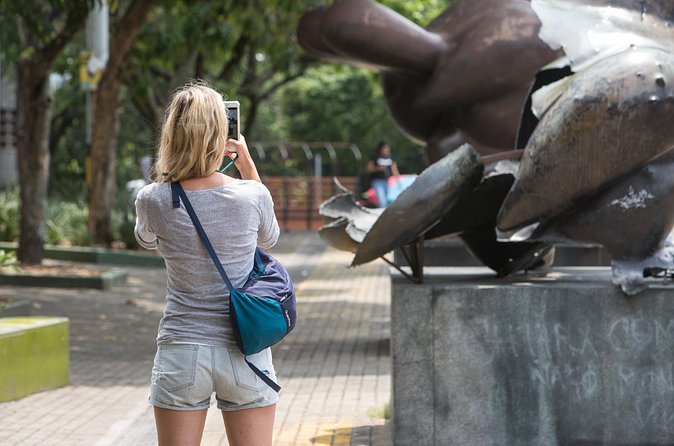
The Palacio Nacional offers a change of pace. Built in the 1920s, it once held courts and a jail. Today, it operates as a shopping center, with art galleries on its upper floors.
The group spends about 25 minutes here, including a break for coffee and the toilet. That pause is well placed. Three hours on city streets can feel long without a chance to sit or refresh yourself.
The building’s change from courthouse and jail to commercial and cultural space fits the larger story of Medellín. The city’s past is not hidden away. It remains visible in buildings that now serve new purposes.
The Palacio Nacional art gallery follows, with about ten minutes devoted to what is described as the city’s largest collection of local art. I would treat this as an introduction rather than a full gallery visit. Ten minutes gives you a look and some context, but not time for a slow examination of a large collection.
That is a recurring feature of the tour. You see many places, but the stops are short. This is a broad city orientation, not a specialist art tour or an architectural study.
More Walking Tours in Medellin
- Comuna 4 Walking Tour Medellin
★ 5.0 · 217 reviews - Medellin Historic Walking Tour
★ 4.9 · 86 reviews - 2-Hours Street Art Walking Tour in Medellin Comuna 13
★ 5.0 · 54 reviews - Arvi Park Walking tour and city views from Metrocable.
★ 4.6 · 13 reviews
Veracruz Church and Plaza Botero
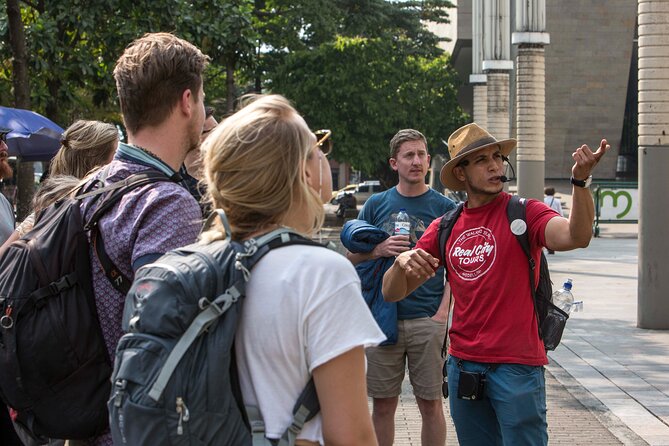
At Iglesia de la Veracruz, the guide discusses the contrasts of modern Colombian society. The church is often described as one of the city’s oldest, but the point here is not simply its age.
The stop looks at what happens in the space in front of the church and how that setting reflects wider social realities. The discussion lasts about five minutes, so expect a concise explanation rather than an extended historical lecture.
Plaza Botero receives about ten minutes and is one of the route’s main cultural highlights. Fernando Botero donated 23 sculptures to Medellín, and the guide explains both the art and the artist’s importance to the city.
This is especially helpful if you know Botero mainly for his rounded figures but are unsure how to read the work. The tour gives you a way to connect the sculptures to Medellín’s cultural identity and civic recovery.
You also see the main art museum in Medellín and learn why Botero matters so much locally. Another stop explains a building that appears unfinished and connects it with a Belgian architect.
The supplied route does not give the names of these two additional stops, so you should expect them as part of the Botero and downtown art section rather than plan around a separate museum admission. No admission charges are listed for the stops.
Parque Berrío and the Metro story
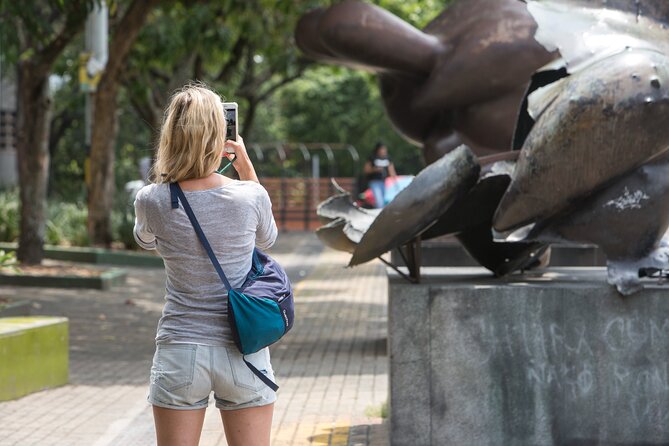
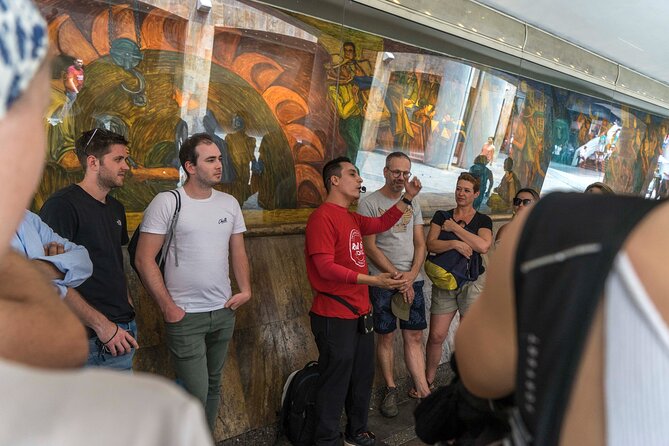
Near the Parque Berrío police station and Metro station is a set of frescoes painted by Pedro Nel Gómez. The tour describes these paintings as a less obvious cultural feature of the area.
You spend about ten minutes here. The guide also explains the importance of the Metro system to the paisa people.
This is valuable because Medellín’s Metro is more than a way to get across town. On this walk, it becomes part of the story of civic pride and the city’s changing public life.
Parque Berrío is the oldest square in Medellín, though it is no longer a colonial square. The guide explains how its older local character continues through folk music.
The five-minute stop is brief, but it gives you another way to understand the center. The square is not presented as a perfectly preserved historic scene. Instead, it is a living urban place shaped by music, transit, commerce, and daily routines.
That practical honesty is one of the tour’s strengths. You are shown a city that has changed, not a staged version of the past.
Parque San Antonio and the Birds of Peace
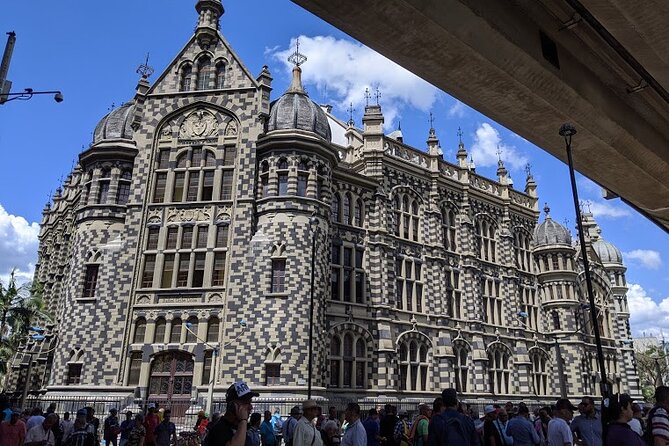
The walk ends at Parque San Antonio after about three hours. Here, you see Fernando Botero’s Birds of Peace and hear how they became symbols of resilience after the 1995 bombing.
This is the route’s emotional closing point. The sculptures carry both the weight of violence and the city’s effort to move forward. The guide uses them to connect art with memory and public recovery.
You spend about 20 minutes in the park, making it one of the longer stops. That gives the guide time to explain the bombing, the meaning of the sculptures, and the way the city has chosen to remember.
The ending is also practical. Parque San Antonio has a police station, making it easy to request an Uber. You can also reach the San Antonio Metro station from there.
Because the tour ends in a central location, you can continue exploring, return to your accommodation, or use the Metro. The guide also provides restaurant and activity recommendations, which can help you decide what to do next.
What the $16 price really buys you
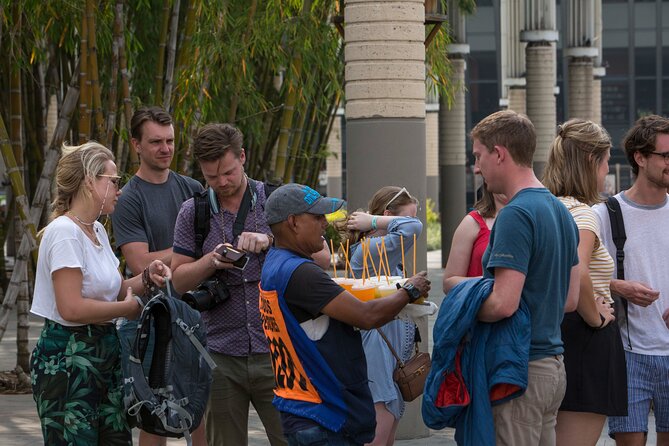
At $16 per person, this is a strong-value introduction to Medellín. You are paying for roughly three hours with a bilingual guide, a planned route through major downtown sites, a group picture, and practical suggestions for food and activities.
The stops are free, so the value comes from interpretation and organization. If you walked this route alone, you could see many of the same buildings and sculptures. You would not automatically understand how the railway, urban renewal projects, Metro, Botero, public art, and difficult social questions fit together.
That distinction is important. This is not a ticketed attraction with elaborate production or exclusive access. It is a guided city walk. The price is appealing because it gives you context at a modest cost.
A group limit of 18 people keeps the experience reasonably small. It is not private, and you will not receive constant individual attention, but the group should be manageable for a downtown walk.
The tour is often booked about ten days ahead. That does not prove every departure sells out, but it is a useful signal to reserve early if your schedule is fixed.
Pace, comfort, and guide quality
The route takes about three hours and includes frequent stops. You should be prepared to walk through central Medellín, remain alert around busy streets, and listen outdoors.
The Palacio Nacional break is a practical advantage. You have time for coffee and a toilet, rather than pushing through without pause.
Guide quality appears to be the biggest factor in how much you enjoy the experience. Germán is praised for storytelling and humor. Carolina is valued for her emotional connection to the city and for separating personal opinions from historical explanation. Julio and Sussie receive praise for clear, helpful presentations, while Julie is singled out for passion and structure.
One person found an accent slightly difficult to understand, though the comment still described the explanation as clear and persuasive. If you are sensitive to accents, choose a guide who speaks at a comfortable pace when possible, and stand close enough to hear clearly.
The tour handles serious subjects, including Colombia’s difficult past and present social contradictions. The best experience will come if you are willing to listen to more than a polished recovery story.
Who should book this walk?
I would recommend it to a first-time visitor who wants to understand Medellín’s center before exploring it alone. It is also a good choice if you like public art, city planning, architecture, local identity, and history presented together.
You will get the most from it if you enjoy moving between short stops rather than spending an hour in one museum. The route suits people who want a broad introduction to downtown and prefer a guide who can explain why ordinary streets and plazas matter.
It may be less suitable if you want a slow photography walk, a private tour, or a detailed museum visit. The pace covers a lot of ground, and some stops last only five or ten minutes.
The bilingual format helps make the tour accessible to a wider audience. Service animals are allowed, the route is near public transportation, and the activity states that most participants can take part. Still, you should judge your own comfort with a three-hour city walk.
Should you book it?
Book this Medellín historic walking tour if you want strong context for a low price and are comfortable exploring downtown on foot. The route gives you a useful first look at the city’s industrial roots, public art, Metro system, social changes, and hard memories.
I would especially choose it early in a Medellín stay. The guide’s restaurant and activity suggestions can help shape the rest of your visit, while the central ending makes it easy to continue by Metro or car.
Skip it only if you prefer a private, slower, or narrowly focused experience. For most visitors seeking an honest introduction to Medellín, $16 is a sensible investment.
FAQ
How long does the Medellín Historic Walking Tour last?
The tour lasts approximately three hours.
How much does the tour cost?
The listed price is $16 per person.
Where does the tour begin?
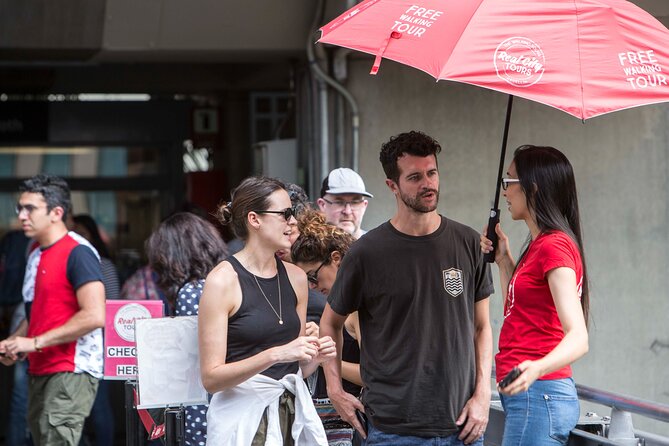
It begins at Free Walking Tour Medellin, Real City Tours, at Cra. 51 #41-76 in La Candelaria, Medellín.
Where does the tour end?
The tour ends at Parque San Antonio, near Cl 44 #50 in La Candelaria.
Are admission tickets included?
The listed stops have free admission, and no separate admission costs are included in the tour details.
Is lunch included?
No. Lunch is not included, though restaurant recommendations are provided.
Is the tour available in more than one language?
Yes. A bilingual tour guide is included.
How large is the group?
The group can have a maximum of 18 people.
Can I cancel for a full refund?
Yes, if you cancel at least 24 hours before the experience start time. Cancellations made less than 24 hours before the start time are not refunded, and changes within that period are not accepted.
Just added in Medellin
- Tour Peñol-Guatape privado: con desayuno, almuerzo y bote★ 5.0 · 1 review
- Silletero Tour – From Medellín★ 5.0 · 1 review
- Tour Medellín: Commune13 and Pablo Escobar + Rooftop★ 5.0 · 2 reviews
- Tour Medellín: Pablo Escobar and Commune 13★ 5.0 · 3 reviews
- Medellin: Tour Pablo Escobar Privado Con Guia Local★ 5.0 · 1 review
- Tour Guatapé – Piedra del Peñol with departure from Medellín★ 5.0 · 24 reviews
- Tour Guatapé: luxury yacht to the stone of Peñol.★ 5.0 · 2 reviews
- Tour Guatapé con visita a Granja de las Llamas y las Alpacas★ 3.5 · 11 reviews
Historical Tours, compared.
Historic Center and Getsemaní Shared Walking Tour
Read our review →
Shared Tour of the Historic Candelaria in Bogotá
Read our review →
Historic Center & Getsemaní Shared Tour in Cartagena
Read our review →
Shared Tour Historic Center of Medellin with Audio System
Read our review →
Medellín Essential: history & local life on E-bike
Read our review →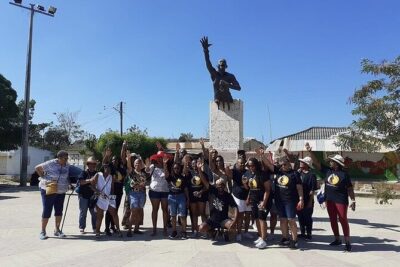
Bogota Shared Gastronomy Tour in the Historic Center
Read our review →
Shared Tour of the Historical and Cultural Center of Cali
Read our review →Browse the lists this tour appears in