
REVIEW · HISTORICAL TOURS
Private Walking Tour Through Medellín’s Historical Center
Medellín’s past is written in its public squares. This private walk links Parques del Río, Plaza Botero, and San Antonio Park, showing how the city has used parks, art, and memorials to reshape its downtown. I like the private format, which lets your group ask questions and keep the pace manageable. I also like the mix of famous sights and less polished city streets, including Carabobo, where daily commerce gives the walk some local pulse.
The main consideration is the downtown setting. Parts of the route can feel crowded, commercial, or uncomfortable, especially around La Veracruz Church, where prostitution has occurred in the surrounding area. At $60 per person, the tour offers good value for a small private group that wants context and door-to-door help, but it may cost more than a basic group walking tour.
In This Review
- Key points at a glance
- Why this walking tour helps you read Medellín
- Starting beside the Medellín River at Parques del Río
- Government, justice, and memory at La Alpujarra
- Parque de las Luces and the busy Carabobo corridor
- Palacio Nacional, one block from Plaza Botero
- La Veracruz Church and the complicated side of downtown
- Plaza Botero and 23 oversized bronze sculptures
- San Antonio Park and Botero’s Bird of Peace
- What the private format adds
- Timing, pickup, and practical planning
- Who will get the most from this tour?
- Should you book the Medellín historical center walk?
- FAQ
- How long does the private walking tour last?
- How much does the tour cost?
- Is the tour private?
- Is the tour offered in English?
- Where does the tour begin?
- Where does the tour end?
- Is hotel pickup available?
- Which places are visited?
- Are admission tickets included?
- Can I cancel for a full refund?
Key points at a glance
- A city story told through public spaces: See how Medellín has reshaped former problem areas with parks, art, and memorials.
- Six central stops in 3 to 4 hours: The route covers Parques del Río, La Alpujarra, Parque de las Luces, Palacio Nacional, Plaza Botero, and San Antonio Park.
- Fernando Botero appears twice: His oversized bronze sculptures add humor at Plaza Botero, then a more serious note at San Antonio Park.
- A private guide makes a difference: Only your group joins, so you can ask about Colombia’s politics, art, violence, and urban change.
- Hotel pickup may simplify the morning: Pickup is offered in El Poblado, Laureles, and other areas inside Medellín.
- A flexible choice for families: Most people can participate, and group discounts may reduce the per-person price.
Why this walking tour helps you read Medellín
Medellín can be hard to understand from a car window. The city’s center contains government buildings, churches, public art, shopping streets, memorials, and signs of social change within a short distance of one another. This tour puts those pieces together on foot.
You begin at the river and finish at San Antonio Park. Along the way, your guide can explain how public space has been used to bring people downtown, honor victims, and support a more hopeful civic identity. The experience is not only a checklist of monuments. It is a lesson in how Medellín presents itself today.
That makes the tour especially useful early in your visit. You get a basic map of central Medellín, see several major landmarks, and gain background that can make later independent exploring more meaningful.
The advertised price is $60 per person. The value depends on your group size. For one or two people, it is a fairly substantial cost for a half-day walk. For a family or group, the private arrangement, possible group discount, pickup, and personal attention can make the price easier to justify.
More History Tours in Medellin
- Pablo Escobar Tour : Museum, History and Beer
★ 5.0 · 867 reviews - Shared Tour Historic Center of Medellin with Audio System
★ 5.0 · 523 reviews - Medellín Essential: history & local life on E-bike
★ 5.0 · 459 reviews
Starting beside the Medellín River at Parques del Río
The first stop is Parques del Río, a major urban project along the Medellín River. You spend about 15 minutes here, taking in the park and its public spaces before moving toward the city center.
The park represents an effort to reclaim the riverbanks for recreation, relaxation, and community use. It also reflects Medellín’s interest in greener city planning, with renewed public areas intended to support plants, wildlife, and a healthier urban environment.
Do not expect a long nature walk. This is a short orientation stop. Its value is the wider idea: Medellín is trying to make the river part of everyday city life instead of treating it as a neglected edge.
I would use this opening to ask your guide about the city’s urban changes. The private format is useful here because you can pause for a clear explanation rather than simply take a few photographs and move on.
Government, justice, and memory at La Alpujarra
A short ride brings you to Centro Administrativo La Alpujarra, the government center in downtown Medellín. You spend about 30 minutes here, with time to see public buildings, monuments, Plaza de la Libertad, and the Old Train Station.
This area gives the tour a useful civic frame. The complex includes government and municipal offices as well as the Palace of Justice. It is not just a collection of official buildings. The public spaces and monuments show how Medellín connects its political life with its public identity.
The Old Train Station adds an important contrast. It recalls a period when rail transport helped support the region’s economic growth. Seeing it beside modern administrative buildings lets you compare different chapters of the city’s development without leaving the same district.
You will not be touring every government office. This is an exterior-focused stop, with the guide supplying the meaning behind the buildings and monuments. That is a good use of time on a walking tour, since the context matters more than entering each structure.
Parque de las Luces and the busy Carabobo corridor
Across the street is Parque de las Luces, one of the city center’s best-known public spaces. Its tall light structures give the park a strong visual identity, and it has become a symbol of Medellín’s efforts to renew downtown.
The park also carries a serious purpose. It was created as a place to remember people affected by violence and to reclaim an area associated with the city’s main market center. Today, it can host cultural events, concerts, strikes, and other gatherings, so the atmosphere may change from day to day.
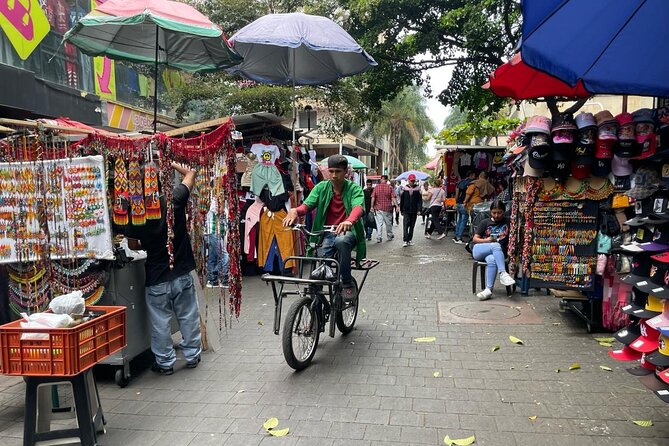
You will have time for photographs before walking along Carabobo Street. This is where the polished story of urban renewal meets everyday downtown life. Shops, pedestrians, commerce, and street activity replace the open space of the park.
That contrast is worth noticing. Medellín is not a museum city, and the center does not feel arranged solely for sightseeing. Carabobo gives you a look at the working city, though you should stay aware of your belongings in any crowded commercial area.
More Walking Tours in Medellin
- Medellin Historic Walking Tour with Expert Guide
★ 5.0 · 399 reviews - Comuna 4 Walking Tour Medellin
★ 5.0 · 217 reviews - Medellin Historic Walking Tour
★ 4.9 · 86 reviews - 2-Hours Street Art Walking Tour in Medellin Comuna 13
★ 5.0 · 54 reviews
Palacio Nacional, one block from Plaza Botero
The next stop is Galería de Arte Palacio Nacional, about a block from Plaza Botero. You spend roughly 30 minutes here, and admission is free.
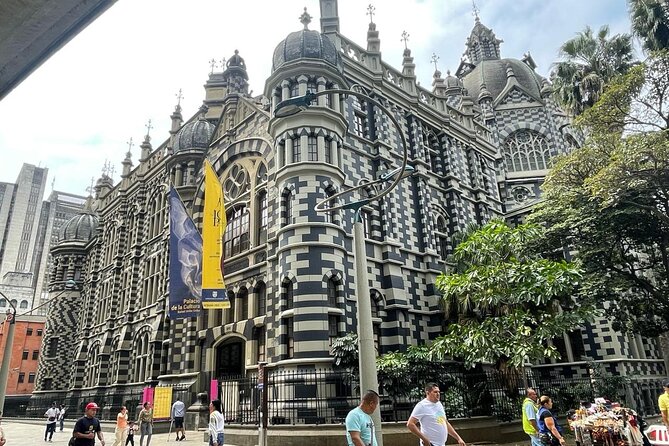
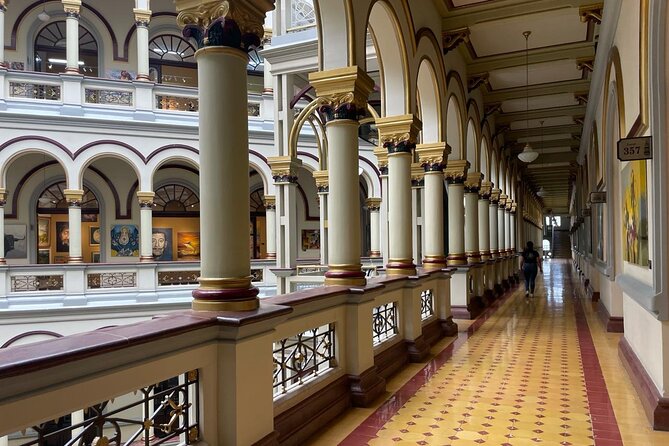
The building was constructed in a neoclassical style in the early 20th century. Its large facade, columns, and decorative details give it a formal presence that differs from the open-air art spaces nearby.
It was originally built for government offices. Today, it functions as a cultural center and museum with exhibitions connected to Colombia’s political, social, and artistic development. The exact display may vary, but the building itself helps show how old civic structures can take on new public uses.
This is one of the tour’s better stops for anyone who enjoys architecture. Plaza Botero receives more attention, but Palacio Nacional offers a quieter look at the city’s institutional past. Ask your guide how the building’s role changed over time, and allow a few minutes to look beyond the grand entrance.
La Veracruz Church and the complicated side of downtown
The walk then passes Iglesia de la Veracruz, one of Medellín’s oldest churches. The church dates to the 16th century and has a colonial-style facade with Baroque and Renaissance influences.
The stop lasts about 10 minutes, so think of it as a brief visit rather than a full church tour. The building remains an active place of Catholic worship, with religious services and ceremonies.
The surrounding area requires a frank explanation. Sex work has occurred near the church, partly because this central district has long included commerce and nightlife. That fact does not define the church, but it is part of the setting, and a responsible guide should explain it without reducing the people or the neighborhood to a stereotype.
I appreciate that this stop recognizes the city’s complications. Medellín’s downtown contains beauty, faith, business, poverty, memory, and nightlife close together. You may find the area less comfortable than the major plazas, but that is also why a local guide can be helpful.
Plaza Botero and 23 oversized bronze sculptures
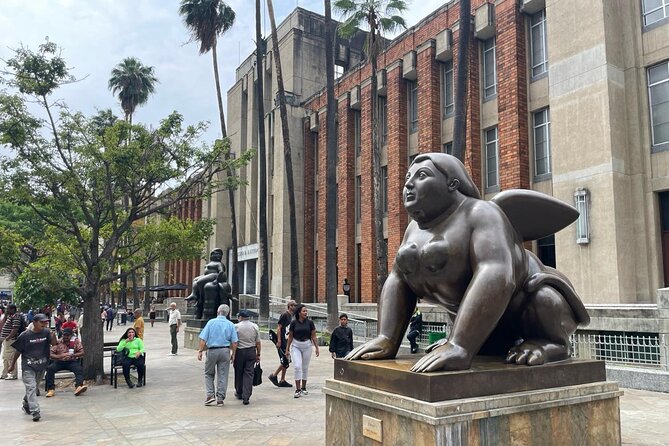
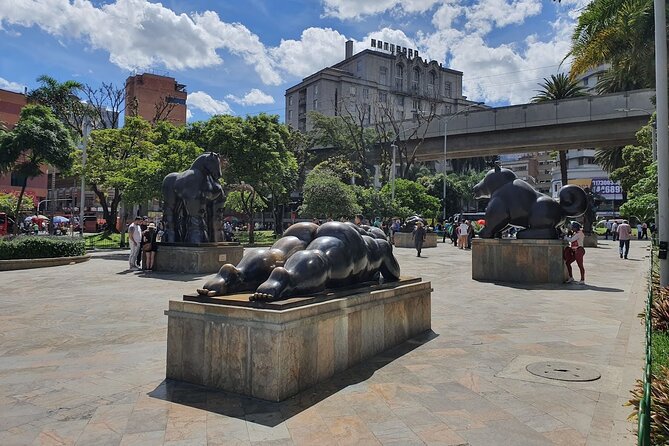
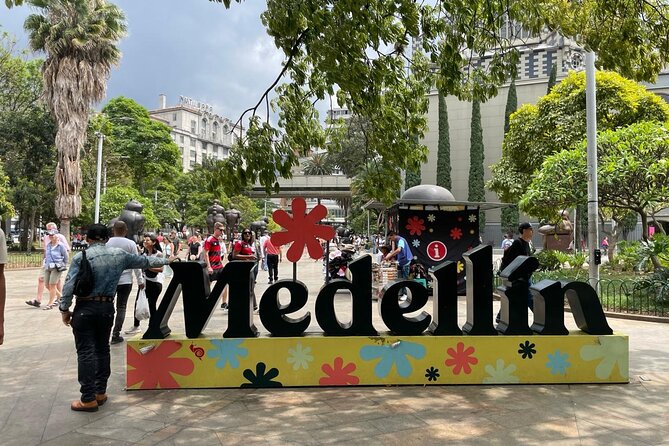
Plaza Botero is the tour’s most recognizable stop. The square contains 23 large bronze sculptures by Fernando Botero, the Colombian artist known for his rounded, exaggerated figures.
The sculptures are designed for public viewing, not a hushed gallery. You can walk around them, examine the surfaces, and take photographs from different angles. Their size and playful forms often bring a smile, even when you know little about art.
The plaza opened in 2002 as part of Medellín’s effort to reclaim public space and promote social inclusion. The choice to place Botero’s work in the center makes art part of ordinary city life. You do not need an art degree to enjoy it, though a guide can explain recurring features in Botero’s work and why his sculptures matter in Colombia.
You spend about 20 minutes here. That is enough for a first look, but art lovers may wish the schedule allowed longer. If you want detailed discussion of every sculpture, tell your guide at the start or ask if the route can be adjusted.
Plaza Botero also works as a useful pause in the walk. After government buildings, memorial spaces, and busy streets, the sculptures bring humor and visual relief. Yet their location also gives them weight. They are not separated from city life. They share the square with residents, workers, vendors, and passing crowds.
San Antonio Park and Botero’s Bird of Peace
The final stop is San Antonio Park, about 20 minutes on the schedule. This downtown plaza serves as a gathering place and includes more work by Fernando Botero.
The most important sculpture here is Botero’s Bird of Peace. The park also remembers the victims of a bombing in 1995. That combination of public art and mourning gives the stop a different tone from Plaza Botero.
The damaged sculpture associated with the bombing is an especially powerful part of the city’s memory. Botero later gave another Bird of Peace, creating a pair that presents destruction and renewal side by side. The tour description specifically identifies the sculpture as a reminder of Medellín’s pursuit of peace and reconciliation.
This is a good place to ask questions about how the city remembers violence. The subject can be difficult, but it helps explain why Medellín’s plazas and sculptures carry more meaning than their appearance suggests.
The activity ends back at the original meeting point. You therefore finish in central Medellín rather than at a separate attraction or hotel.
What the private format adds
Only your group participates, which changes the feel of the experience. You can ask for more time at Plaza Botero, request extra explanation at La Alpujarra, or keep moving if your family has had enough of downtown walking.
The tour is offered in English. That matters because many of the key subjects, including violence, government, urban renewal, religion, and Colombian art, benefit from clear explanation rather than a quick translation.
The strongest praise connected with Andes Adventure Travels focuses on personal service. Andres has been singled out for arranging several trips and helping with airport transportation, while guides JuanP and Carlos have been praised for both driving and guiding. Daniel is described as punctual, highly enthusiastic, and deeply connected to Medellín, with the kind of positive energy that can make a difficult subject easier to discuss.
That does not guarantee which guide you will receive. Still, if Daniel, JuanP, Carlos, or another guide from the same team is assigned, you can reasonably expect the company to value punctuality and personal attention.
Timing, pickup, and practical planning
The walk lasts about 3 to 4 hours. The listed sightseeing stops total about two hours, leaving time for transfers, explanations, photographs, and the walking between districts.
Pickup is offered if your hotel is in El Poblado, Laureles, or another area inside Medellín. If you are staying outside Medellín, the meeting arrangement is at Poblado Park. The stated starting address is Cra. 52 #4363 in La Candelaria, and the activity returns to that meeting point.
A mobile ticket is accepted, and confirmation arrives at booking. The route is near public transportation, though the private pickup may be more convenient if you are staying in one of the listed areas.
Most people can participate, but remember that this is a walking tour through central streets and public plazas. Wear comfortable shoes, carry water, and keep your phone and wallet secure in crowded sections. These are sensible habits for any busy downtown visit.
The tour is generally booked about eight days ahead. If your dates are fixed, reserving roughly a week early is sensible. Free cancellation is available until 24 hours before the start time. Cancellations or changes made later are not refunded or accepted.
Who will get the most from this tour?
I would recommend it to first-time visitors who want a guided introduction to central Medellín rather than a museum-heavy day. It also suits families, since the oversized sculptures, short stops, and private pacing can work well for mixed ages.
It is a good choice for you if you want to ask direct questions about the city’s past and present. The guide can connect the river project, public art, government center, church, and memorials into one story.
You may prefer another option if you want a slow art tour, extended church visits, or a full day inside museums. This experience moves across several areas and gives most attractions a short viewing period.
It may also be less suitable if you dislike busy commercial streets or sensitive discussions of violence and sex work. The tour does not hide those parts of central Medellín, and that honesty is useful, but it may not feel carefree at every stop.
Should you book the Medellín historical center walk?
Book this tour if you value a private guide who can explain the city’s changes, not just point out buildings. The route offers a strong first look at Medellín, with free admission at the listed stops and a useful blend of art, architecture, public policy, and memory.
The $60 price makes the most sense for families or small groups, especially if pickup and a group discount apply. For solo visitors or couples watching every dollar, compare it with a group tour or independent walk.
My practical advice is to take it near the beginning of your stay, ask for a guide comfortable discussing difficult history, and tell the company if Plaza Botero or the city’s urban renewal story matters most to you. If you want Medellín presented as a living city rather than a string of photo stops, this is a worthwhile half-day choice.
FAQ
How long does the private walking tour last?
The tour lasts approximately 3 to 4 hours.
How much does the tour cost?
The listed price is $60 per person. Group discounts may be available.
Is the tour private?
Yes. Only your group participates in the activity.
Is the tour offered in English?
Yes. English is listed as an available language.
Where does the tour begin?
The stated meeting point is Cra. 52 #4363 in La Candelaria, Medellín.
Where does the tour end?
The activity ends back at the meeting point.
Is hotel pickup available?
Pickup is offered from hotels in El Poblado, Laureles, and other areas inside Medellín. If you are outside Medellín, the meeting point is Poblado Park.
Which places are visited?
The route includes Parques del Río, Centro Administrativo La Alpujarra, Parque de las Luces, Palacio Nacional, Iglesia de la Veracruz, Plaza Botero, and San Antonio Park.
Are admission tickets included?
The listed stops have free admission, and admission is included where specified.
Can I cancel for a full refund?
Yes. You can cancel at least 24 hours before the experience begins for a full refund. Cancellations made less than 24 hours before the start time are not refunded.
Just added in Medellin
- Walking Tour, Cable Car & Fruit Tasting★ 5.0 · 1 review
- Pablo Escobar and Griselda Blanco Tour★ 5.0 · 1 review
- City tour, Commune 13, Metro Cable, Botero Park and more. Private★ 5.0 · 34 reviews
- comuna 13 tour★ 3.5 · 6 reviews
- 3 days private mountain tour, nature and culture near Medellin★ 5.0 · 22 reviews
- commune thirteen transformation story★ 4.5 · 14 reviews
- fruits tour★ 5.0 · 2 reviews
- Paragliding and hammocks zipline over waterfalls private tour★ 5.0 · 6 reviews
Historical Tours, compared.
Historic Center and Getsemaní Shared Walking Tour
Read our review →
Shared Tour of the Historic Candelaria in Bogotá
Read our review →
Historic Center & Getsemaní Shared Tour in Cartagena
Read our review →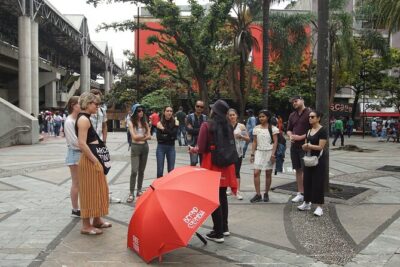
Shared Tour Historic Center of Medellin with Audio System
Read our review →
Medellín Essential: history & local life on E-bike
Read our review →
Medellin Historic Walking Tour with Expert Guide
Read our review →
Bogota Shared Gastronomy Tour in the Historic Center
Read our review →Browse the lists this tour appears in