
REVIEW · HISTORICAL TOURS
Historical Tour of Cartagena
Cartagena rewards walking. This 2-hour-30-minute historical tour links the old city with Getsemaní, taking you from the Clock Tower through grand plazas, colonial streets, churches, murals, and neighborhood corners. I like the route because it gives you a quick sense of both Cartagena’s formal center and its more local, street-level character.
I also like the accredited guide and the small, manageable price of $45 per person. You get fourteen stops, historical introductions, and practical orientation without paying admission to each site. The main consideration is pace: ten minutes at each stop is enough for an explanation and a few photographs, but not enough for a close visit inside every church or museum.
In This Review
- Key Points Before You Book
- Starting Beneath the Clock Tower
- Plaza de los Coches and the City’s Colonial Center
- Customs Square and the City’s Public Face
- San Pedro Claver and the Commercial Heart
- The Queens’ Portal and Colombia’s Beauty Contest
- Bolívar Park, Gabo, and the Inquisition Museum
- Santo Domingo Square and Botero’s Gertrude
- Santa Catalina Cathedral and the Proclamation Square
- Roma Street and the Colonial Façades
- Centennial Park and Urban Wildlife
- Entering Getsemaní Through Calle de la Sierpe
- Plaza de la Trinidad and Evening Street Life
- Callejón Ancho and the End of the Walk
- What $45 Buys You
- Timing, Fitness, and What to Bring
- Is This Cartagena Tour Worth Booking?
- FAQ
- Where does the tour start?
- Where does the tour end?
- How long does the tour last?
- How much does the tour cost?
- What is included in the price?
- Are drinks included?
- How many people can join the tour?
- Do I need a high level of fitness?
- What happens if the tour is canceled because of weather?
Key Points Before You Book
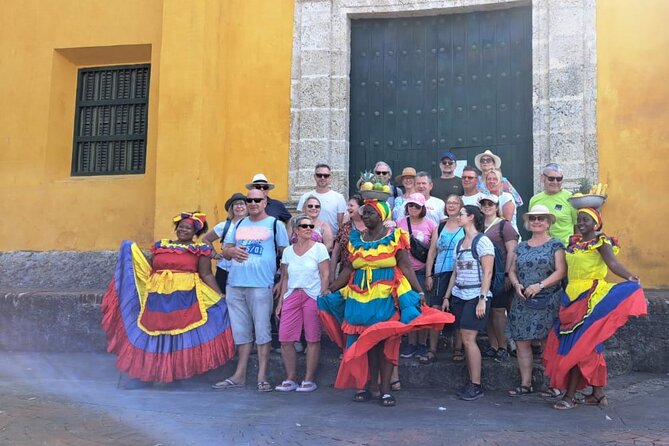
- Fourteen stops in 2.5 hours: The route covers major squares, churches, monuments, streets, and parks at a brisk pace.
- Two sides of Cartagena: You see the grand colonial center and the lively Getsemaní neighborhood in one outing.
- A guide-led introduction: An accredited professional guide explains each location and offers recommendations at the end.
- Free-entry sightseeing: The listed stops do not require admission tickets, though drinks and other personal purchases are extra.
- A praised English-speaking guide: Alvarito is specifically named for clear English and strong knowledge of Cartagena’s history and sights.
- A group limit of 30: This is not a private walk, but the maximum keeps it from becoming an enormous crowd.
Starting Beneath the Clock Tower
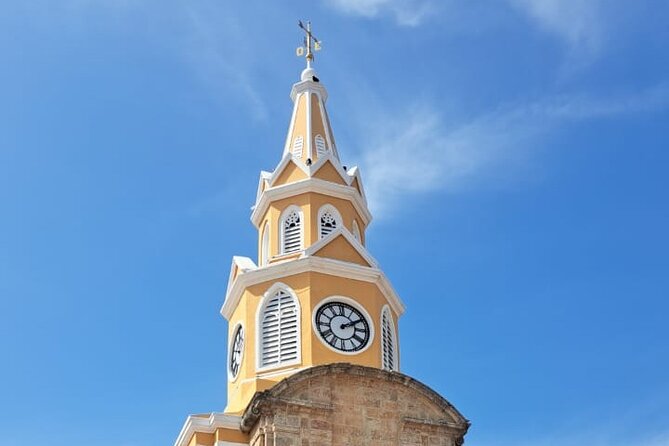
The tour begins at the Monumento Torre del Reloj, also called the Clock Tower, at Boca del Puente in El Centro. This is a useful meeting point because it places you at one of the clearest entrances to Cartagena’s walled historic district.
Allow yourself enough time to locate the guide and group before the scheduled start. The opening presentation covers the places you will visit and gives the walk some order before you set off.
The Clock Tower is more than a photo stop. It introduces the contrast that defines this part of Cartagena: a strong defensive gateway opening onto busy squares, shops, food stalls, and narrow streets. You get about ten minutes here, so expect an orientation rather than a long historical lecture.
More History Tours in Cartagena
- Cartagena: Historic Center and Getsemaní Shared Walking Tour
★ 4.9 · 2,716 reviews - Historic Center & Getsemaní Shared Tour in Cartagena
★ 5.0 · 620 reviews - San Basilio de Palenque History Tour
★ 5.0 · 301 reviews
Plaza de los Coches and the City’s Colonial Center
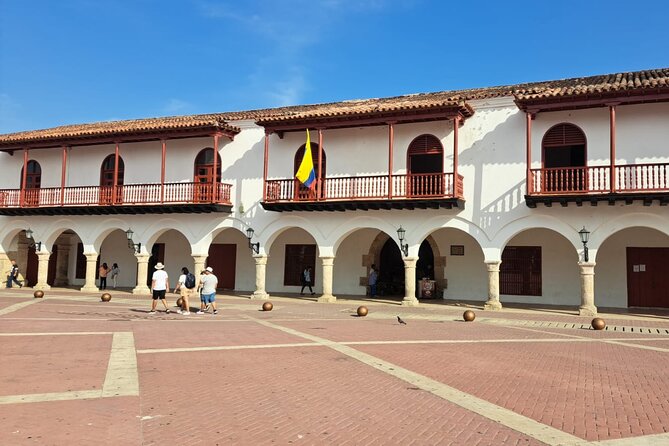
The first square on the route is Plaza de los Coches, known as the Square of the Cars. It is one of Cartagena’s best-known public spaces and a natural place to begin understanding how the historic center developed around commerce, government, and public life.
Your guide points out the Portal de los Dulces, a covered row associated with sweets and local treats. This is one of the more appealing stops for your senses, even if the tour does not include food or tastings. You can look around afterward, but any soda, water, or snack is at your own cost.
The square also contains a monument to Don Pedro de Heredia, the founder of Cartagena. The ten-minute visit gives you a useful name and historical anchor before the walk moves into the larger civic spaces nearby.
Customs Square and the City’s Public Face
Plaza de la Aduana, or Customs Square, is described as the largest square in the city. It brings together several reminders of Cartagena’s political and colonial past.
The mayor’s office is located here, along with the mansion where Pedro de Heredia lived. The square also contains a monument to Christopher Columbus. A guide is especially useful at a place like this because the buildings and monuments can otherwise blur into a general impression of old architecture.
I would listen closely to the explanations here, but keep the historical framing in mind. Cartagena’s past includes conquest, colonial rule, trade, and cultural change. A short tour cannot cover every side of that story, yet these public squares give you the basic framework for understanding the old city.
San Pedro Claver and the Commercial Heart
Plaza de San Pedro Claver shifts the mood from government and civic monuments to daily business. The square is home to the church of the same name and is surrounded by restaurants, jewelry shops, craft sellers, and other commercial businesses.
Your guide also points out contemporary works of art displayed around the square. That mix is part of the appeal: historic stone and religious architecture share space with modern public art and active storefronts.
The stop lasts about ten minutes. You will have time to take in the square and hear the explanation, but not to make a proper church visit. If San Pedro Claver Church matters to you, plan to return independently when you have more time.
A completely different kind of day:
- Cartagena Island Hopping: 5-Stop Rosario Islands Tour with Lunch
★ 4.5 · 4,903 reviews - Cartagena: Rosario Islands Catamaran with Lunch and Snorkel
★ 4.5 · 2,479 reviews - Full-Day Rosario Islands Including Barú, Bocachica & Playa Blanca
★ 4.0 · 1,729 reviews - Tour De Palenque, Road to Emancipation.
★ 5.0 · 1,678 reviews
The Queens’ Portal and Colombia’s Beauty Contest
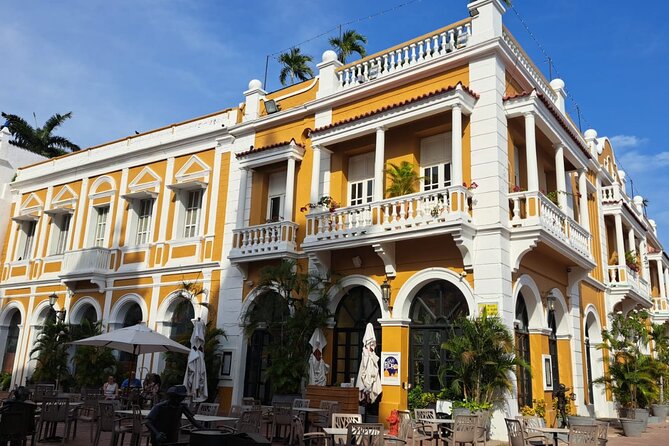
One of the route’s more unusual stops is the Portal de las Reinas, connected with Colombia’s National Beauty Contest. Photographs of Colombia’s beauty queens since 1934 are set into the ground at this location.
This is a change of subject from military walls, churches, and colonial government. It gives the tour a glimpse of a modern Colombian tradition that has had a visible place in the country’s public culture.
The stop may appeal most to you if you enjoy local customs and unexpected details. If you prefer a tour focused only on architecture and early colonial history, this is one of the less essential stops. Still, it breaks up the sequence of similar-looking plazas and gives the route some variety.
Bolívar Park, Gabo, and the Inquisition Museum
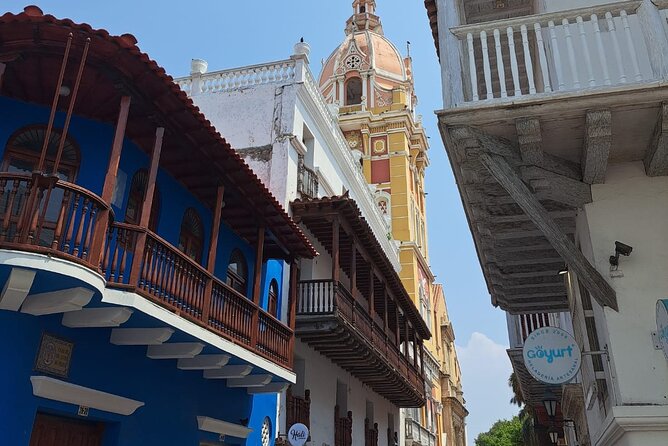
Plaza de Bolívar offers a welcome pause. It is an urban park with trees and vegetation, and the tour describes it as a peaceful resting point in the middle of the historic center.
The square includes a monument to Simón Bolívar and a statue of Gabriel García Márquez, Colombia’s Nobel Prize-winning author. The area also faces the Museum of the Inquisition, an important reminder that Cartagena’s history is not only about colorful façades and pleasant plazas.
This is a good place to pay attention to the setting rather than rush from one object to another. The greenery provides shade and a softer atmosphere, while the nearby monuments connect political history, literature, and colonial institutions.
The tour does not include museum admission. The stop is an exterior orientation, so you should not expect time for a full museum visit during the walk.
Santo Domingo Square and Botero’s Gertrude
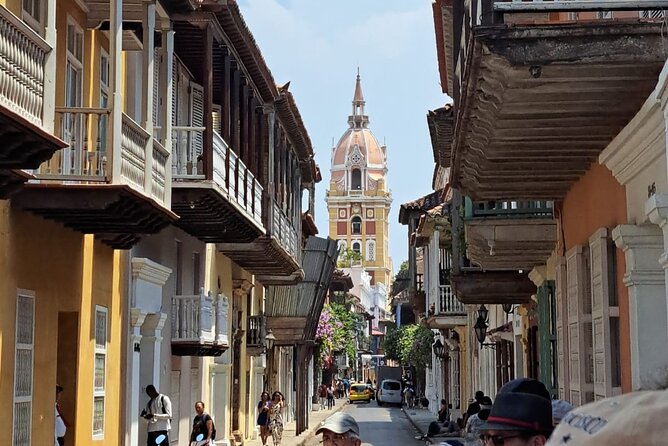
Plaza de Santo Domingo is presented as one of the liveliest and most popular squares in the historic center. Restaurants, bars, jewelry shops, and other businesses surround the space, giving it a more social feel than the formal civic squares earlier in the route.
The main art attraction is Fernando Botero’s sculpture Gertrude. Its rounded form is easy to recognize, and the guide can place the work within the square’s wider mix of old buildings and modern public life.
This is a good photo stop, but it is also a place where commercial activity can compete for your attention. Keep your belongings close in any crowded public area, and stay with the group if you want to hear the guide clearly.
Santa Catalina Cathedral and the Proclamation Square
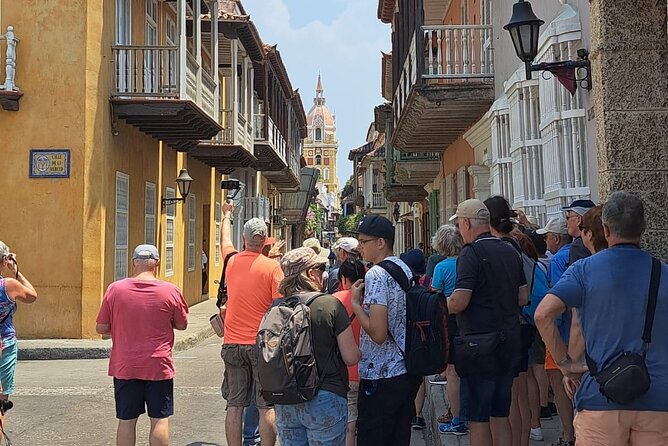
The route next includes Catedral de Santa Catalina de Alejandría. The supplied description repeats the wording used for Santo Domingo Square, so it does not provide many extra details about the cathedral itself. What is clear is that the church is one of the major religious landmarks in Cartagena’s historic center.
Ten minutes here is enough for an outside explanation and photographs. It is not enough to treat the cathedral as a full architectural visit, especially if you want to study the interior.
Plaza de la Proclamación follows. This square is described as another architectural highlight, with the Governor’s Office and a statue of Pope John Paul II. It adds another layer to the route’s picture of Cartagena, linking religious, civic, and political symbols within a compact area.
Roma Street and the Colonial Façades
The walk then follows Roma Street, described as one of the busiest streets in the historic center. Its colorful colonial houses are known for high balconies and decorated façades.
This is one of the stops where simply walking slowly and looking upward pays off. The balconies and façades often tell you as much about the city’s character as the major monuments do. Your guide can help identify features that you might pass without noticing.
The tradeoff is noise and movement. A busy street is not the easiest place to hear every word, and ten minutes goes quickly. Stay near the guide, especially if the group spreads out while taking photographs.
Centennial Park and Urban Wildlife
Parque Centenario offers another change in scenery. The park has a French-style design and an obelisk, but its most unexpected feature is the wildlife associated with the area.
The description mentions titi monkeys, sloths, and many birds typical of Colombia’s Caribbean coast. You might not see every animal on every visit, since wildlife sightings are never guaranteed, but the possibility makes this more than a standard monument stop.
The park is also a useful reminder that Cartagena is not only stone walls and colonial houses. The walk gives you a short look at plant life and animals within the city, though you should avoid treating the ten-minute stop as a dedicated wildlife outing.
Entering Getsemaní Through Calle de la Sierpe
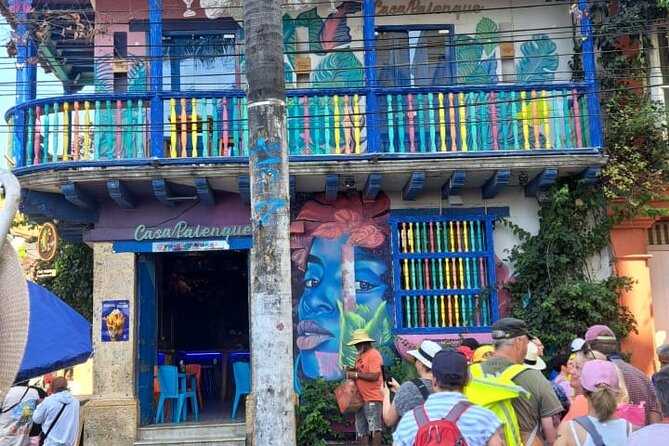
Calle de la Sierpe takes the tour into Getsemaní, a neighborhood known here for hanging flags from countries around the world, graffiti, and urban art.
This is where the route becomes especially visual. Murals and decorated façades provide plenty of photo opportunities, and the street feels different from the formal plazas of El Centro. You get a glimpse of neighborhood identity expressed through color, painted walls, and public decoration.
The guide’s role matters here because street art can change, and a quick walk does not always explain why a particular street has become important. The route promises an introduction rather than a detailed art tour, but it is one of the more memorable sections for anyone who enjoys photography.
Plaza de la Trinidad and Evening Street Life
Plaza de la Trinidad is described as the heart of Getsemaní. It is a social square where local residents and visitors gather, particularly in the evening, with casual food vendors adding smell and flavor to the scene.
This stop gives you a better sense of how public life works in the neighborhood. Instead of viewing Cartagena only through churches, monuments, and official buildings, you see a place used for meeting, eating, and spending time outdoors.
The tour does not include food or drinks, so you can decide later if you want to return for a meal or snack. That flexibility is useful, since the short stop may leave you wanting more time in the square.
Callejón Ancho and the End of the Walk
The final named stop is Callejón Ancho, described as a broad alley and narrow alley within Getsemaní. Here, the emphasis is on neighborhood life, local residents, old buildings, and the area’s architectural character.
This is a fitting finish because it moves away from famous monuments and toward the ordinary streets that give the district its personality. You see how history survives in homes, alleyways, and public spaces, not only in museums.
At the end, the guide provides instructions and recommendations before the tour finishes at the Well Square area near Cl. 32. The end point is useful because you are already in the historic center and can continue exploring on foot, though the tour does not specify a full list of follow-up recommendations.
What $45 Buys You
At $45 per person, the value depends on what you want from a city walk. You are paying for an accredited professional guide, a route through fourteen locations, and a structured introduction to both El Centro and Getsemaní.
The stops themselves have no admission charge, so the main product is the guide’s explanation and the efficient route. If you tried to locate all these places alone, you could walk through them, but you might miss the historical links between Pedro de Heredia, Bolívar, García Márquez, the cathedral, the Inquisition Museum, and Getsemaní’s street art.
The price is easier to justify if this is your first time in Cartagena or if you have only one free afternoon. It is less compelling if you prefer slow photography, long museum visits, or private guiding.
The maximum group size is 30. That is not an intimate private experience, and you may need to position yourself close to the guide in noisy streets. Still, the limit is more practical than an unlimited group, especially on narrow lanes.
Timing, Fitness, and What to Bring
The walk lasts about two and a half hours and includes repeated movement between plazas and streets. You need a moderate level of physical fitness, and comfortable walking shoes are sensible.
Bring water because soda and water are not included. Cartagena’s heat can make even a city walk feel demanding, so a hat and sun protection are also practical choices, although the tour information does not list them as required equipment.
The tour is near public transportation, making the Clock Tower meeting point relatively easy to reach. Check the exact meeting instructions before setting out, since the start is listed at the Clock Tower and the end is near the Well Square area.
The experience depends on good weather. If poor weather forces cancellation, you are offered another date or a full refund. A minimum number of participants is also required, and if that minimum is not reached, you are offered another date, another experience, or a full refund.
You can cancel for a full refund if you do so at least 24 hours before the start time. Changes or cancellations inside that 24-hour window are not accepted for a refund.
Is This Cartagena Tour Worth Booking?
I would choose this tour if you want a broad first look at Cartagena in a short block of time. The route covers the essential plazas, then adds less formal touches such as the beauty queens, Botero’s Gertrude, Centennial Park’s possible wildlife, Getsemaní murals, and Plaza de la Trinidad.
The strongest feature is the guide-led context. Alvarito is specifically praised for clear English and for explaining the city’s history and sights well. If he is leading your departure, that is a useful point in the tour’s favor, though guide assignment should be confirmed before booking.
I would skip it if you want to enter several buildings, spend long periods at one monument, or explore at a slow photographic pace. The ten-minute stops keep the route moving, but they also limit depth.
For a first visit, $45 is a fair price for an organized overview. Use it to learn the city’s layout, mark places you want to revisit, and decide where your own longer explorations should begin.
FAQ
Where does the tour start?
The tour starts at the Monumento Torre del Reloj, or Clock Tower, at Boca del Puente in El Centro, Cartagena de Indias.
Where does the tour end?
The tour ends near the Well Square area at Cl. 32 in El Centro, Cartagena de Indias.
How long does the tour last?
The walking experience lasts approximately 2 hours and 30 minutes.
How much does the tour cost?
The listed price is $45 per person.
What is included in the price?
An accredited professional guide is included.
Are drinks included?
No. Soda, pop, and water are not included.
How many people can join the tour?
The tour has a maximum group size of 30 participants.
Do I need a high level of fitness?
No high level is specified, but you should have a moderate level of physical fitness for the walking route.
What happens if the tour is canceled because of weather?
If poor weather causes cancellation, you are offered a different date or a full refund.
Just added in Cartagena
- Private History Photography Tour★ 5.0 · 17 reviews
- Self-Guided Audio Tour: Pirate Tales in Cartagena★ 3.0 · 2 reviews
- Paue Island Tour in the Rosary Islands★ 5.0 · 1 review
- Totumo Volcano★ 3.5 · 15 reviews
- Palmarito Beach★ 3.5 · 4 reviews
- Party without limits! Cartagena; VIP Party.★ 4.5 · 32 reviews
- Paragliding Experience in Cartagena★ 5.0 · 8 reviews
- Tour cultural to san Basilio de Palenque from cartagena★ 5.0 · 45 reviews
Historical Tours, compared.
Historic Center and Getsemaní Shared Walking Tour
Read our review →
Shared Tour of the Historic Candelaria in Bogotá
Read our review →
Historic Center & Getsemaní Shared Tour in Cartagena
Read our review →
Shared Tour Historic Center of Medellin with Audio System
Read our review →
Medellín Essential: history & local life on E-bike
Read our review →
Medellin Historic Walking Tour with Expert Guide
Read our review →
Bogota Shared Gastronomy Tour in the Historic Center
Read our review →Browse the lists this tour appears in