
REVIEW · HISTORICAL TOURS
African History in Cartagena
Cartagena’s past is impossible to miss. This private 2-hour-35-minute tour connects the walled city, African history, Haitian influence, fortifications, and Getsemaní in one compact outing. I like the clear route through seven meaningful sites, and I like that guides such as Dani make the experience personal, warm, and easy to follow.
The price is $45 per person, including private transportation and bottled water. That is fair value if you want context rather than a quick photo walk, especially since the tour works for solo visitors, families, and mixed-age groups. The main drawback is that it ends in Getsemaní rather than returning you to your hotel, and the pace may feel brisk if you want long visits at each stop.
In This Review
- Key points at a glance
- Why this short tour covers a big subject
- Torre del Reloj: entering the walled city
- Plaza de la Aduana and the painful trade at its center
- Plaza de San Pedro Claver and Haiti’s part in independence
- Baluarte de San Francisco Javier and the city’s defenses
- Catedral Santa Catalina de Alejandria in 15 minutes
- Parque Centenario: a pause under the trees
- Getsemaní and the final stop at Plaza de La Trinidad
- What $45 really buys you
- Timing, pickup, and the practical details
- Who will get the most from this experience
- Should you book African History in Cartagena?
- FAQ
- How long does African History in Cartagena last?
- How much does the tour cost?
- Is the tour private?
- Where does the tour start?
- Where does the tour end?
- Is hotel pickup available?
- Is transportation included?
- Is the tour offered in English?
- Can I cancel for a full refund?
Key points at a glance
- Seven central stops in 2 hours 35 minutes: The route covers the Clock Tower, major plazas, a cathedral, city defenses, Parque Centenario, and Getsemaní.
- African history remains the focus: Plaza de la Aduana is tied to the trade of enslaved people, giving the tour a serious historical center.
- Haiti’s role enters the story: At Plaza de San Pedro Claver, you discuss Haiti’s influence on Colombian independence.
- Private transportation is included: Pickup is offered in the Walled City, Bocagrande, Marbella, and Manga.
- Guide quality matters here: Dani is described as engaging, professional, kind, and able to adjust the outing for different ages and walking speeds.
- The finish is in Getsemaní: You end at Cl. 29 #9119, giving you a useful place to continue exploring on your own.
Why this short tour covers a big subject

Cartagena often gets reduced to colorful streets, balconies, plazas, and seaside views. Those sights are worthwhile, but they can hide the harder story beneath them. This tour puts African history at the center and uses the old city as its classroom.
That matters because the subject is not confined to one museum or monument. It appears in the port, the plazas, the church, the military walls, and the neighborhoods that grew around the colonial center. You move through several places where trade, religion, independence, defense, and daily life overlap.
The tour is private, so only your group takes part. That gives you a better chance to ask questions or request a little more time at a particular stop. It also makes the outing more adaptable than a large group walk. Dani, the guide named in the provided information, has been praised for making the tour feel like time with a well-informed friend while remaining professional.
The subject can be serious, and rightly so. You should expect an educational experience rather than a light sightseeing circuit with a few historical comments added on. At the same time, the tone appears friendly and approachable, which helps when the topic includes slavery, colonial power, and the struggle for independence.
More History Tours in Cartagena
- Cartagena: Historic Center and Getsemaní Shared Walking Tour
★ 4.9 · 2,716 reviews - Historic Center & Getsemaní Shared Tour in Cartagena
★ 5.0 · 620 reviews - San Basilio de Palenque History Tour
★ 5.0 · 301 reviews
Torre del Reloj: entering the walled city
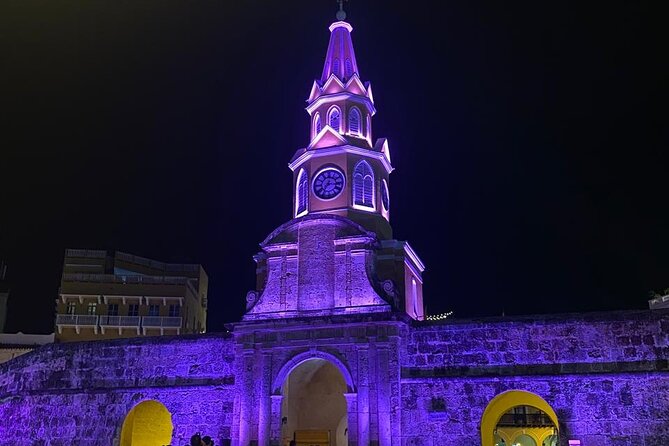
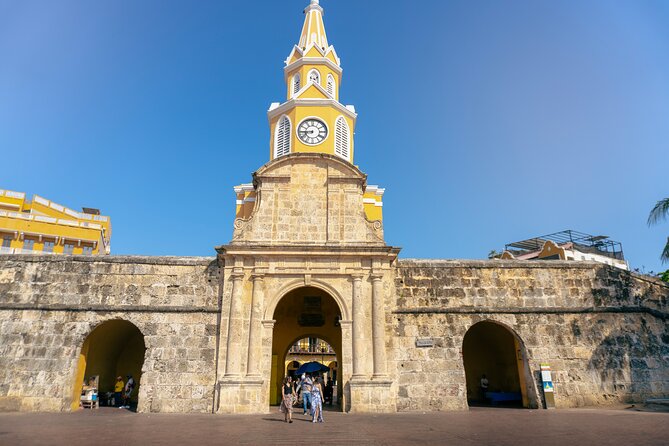
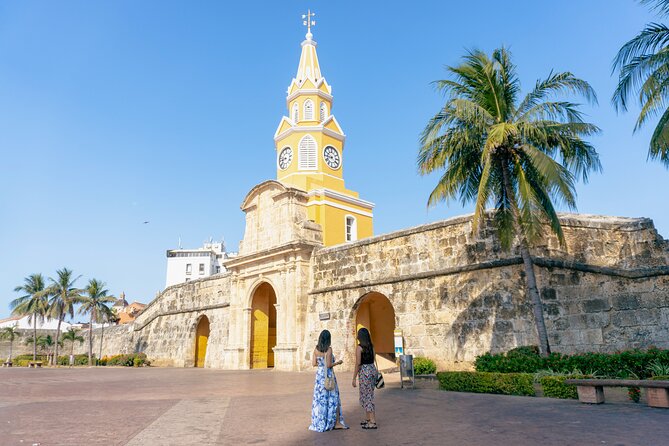
Your first stop is Torre del Reloj, the clock tower that forms the main entrance to Cartagena’s walled city. You have about 15 minutes here, enough to get your bearings and understand why this gateway matters.
The stop works well as an opening because it places you at the threshold between the modern city and the historic center. The tower is not just a photogenic entrance. It introduces the fortified urban world that shaped Cartagena’s trade and political life.
Admission is free, as it is at every listed stop. That keeps the tour focused on interpretation and movement rather than ticket lines. You will not be spending time inside a paid attraction here, so the value comes from the guide’s explanation and the connection to the rest of the route.
I would treat this as an orientation stop, not a long visit. If you want detailed architecture photography, you may need to return later on your own.
Plaza de la Aduana and the painful trade at its center
At Plaza de la Aduana, the tour turns directly to the trade of enslaved people. You have roughly 20 minutes, making this one of the more important stops in the entire experience.
A public square can look harmless when filled with pedestrians and bright buildings. The guide’s role is to help you understand what took place there and how commerce shaped the city. This is where the tour earns its title. African history is not treated as a side note, but connected to Cartagena’s economic foundations.
You should give this stop your full attention. The information may change how you see the surrounding streets for the rest of your visit. Instead of viewing the old city only as a preserved colonial setting, you begin to notice the systems of labor and trade that supported it.
The supplied details do not specify a museum visit or an interior site here. Expect a discussion in the square, with the guide supplying the context. For some people, that is a strength because it keeps the history tied to the actual urban setting. Others may prefer a longer indoor presentation with displays and documents.
Plaza de San Pedro Claver and Haiti’s part in independence

The next stop is Plaza de San Pedro Claver, with about 20 minutes devoted to the influence of Haiti on Colombia’s independence. This is a useful change of focus. The tour does not stop with the history of enslavement. It also looks at political change and the wider Caribbean connections that shaped Colombia.
The setting gives the guide room to connect Cartagena to a larger regional story. Haiti’s influence is not an isolated local detail, and this stop helps you see independence as part of a Caribbean and American exchange of ideas and support.
The name of San Pedro Claver also places the square within Cartagena’s religious and social history, though the stated subject here is Haiti’s influence. You can expect the guide to explain the connection rather than simply point out the plaza.
This is another place where a private tour helps. If the subject raises questions, you can ask them without holding up a large group. If you are traveling with a teenager, the story of independence and international influence may provide a stronger connection than a basic list of dates.
A completely different kind of day:
- Cartagena Island Hopping: 5-Stop Rosario Islands Tour with Lunch
★ 4.5 · 4,903 reviews - Cartagena: Rosario Islands Catamaran with Lunch and Snorkel
★ 4.5 · 2,479 reviews - Full-Day Rosario Islands Including Barú, Bocachica & Playa Blanca
★ 4.0 · 1,729 reviews - Tour De Palenque, Road to Emancipation.
★ 5.0 · 1,678 reviews
Baluarte de San Francisco Javier and the city’s defenses
At Baluarte de San Francisco Javier, you spend about 15 minutes learning about Cartagena’s fortifications. The bastion offers a military angle to the route and shows how the city protected its valuable port and walled center.
The stop is brief, but it adds useful structure. Trade created wealth, wealth created targets, and defenses helped protect the city. The fortifications are not simply old stone walls for photographs. They are part of the same historical system introduced at Plaza de la Aduana.
You may find this stop especially useful if you like history that you can see in physical form. The wall and bastion give the guide something concrete to explain. You can connect the shape of the defenses to the city’s need for protection.
Do not expect a long fortification visit based on the stated timing. Fifteen minutes is enough for an explanation and a look around, but not a detailed military tour.
Catedral Santa Catalina de Alejandria in 15 minutes
The route then reaches Catedral Santa Catalina de Alejandria, identified as the city’s most important Catholic church. The visit lasts about 15 minutes and gives the tour a religious dimension.
This stop helps show how faith and colonial authority were woven into Cartagena’s public life. It also breaks up the outdoor walking with a major architectural landmark. The cathedral is not presented as a separate paid attraction, so the emphasis remains on its place in the city’s story.
Because the stop is short, you should think of it as a guided introduction rather than a full church visit. The exact interior access is not specified, so do not book this expecting an extended look inside or a formal religious tour.
Still, the cathedral belongs on this route. A tour about African history in Cartagena benefits from showing more than commerce and warfare. Religion was another major force in the city, and this stop helps complete the picture.
Parque Centenario: a pause under the trees

Parque Centenario is scheduled for about 15 minutes. Surrounded by trees, it is described as the lung of the historic center, offering a greener break in the middle of the urban route.
This may be the least directly tied to the headline subject, but it serves a practical purpose. The tour has several plazas, walls, and streets in a row. A pause in a tree-filled park gives you a chance to slow down, drink some of the bottled water included with the tour, and reset before the final neighborhood section.
The park also helps mark a change in the route. From here, the experience moves toward Getsemaní and its colorful streets. You begin to shift from the formal colonial center to a neighborhood with a different street character and social energy.
Again, 15 minutes is a short stop. It is enough for a break and explanation, not for a full park visit.
Getsemaní and the final stop at Plaza de La Trinidad
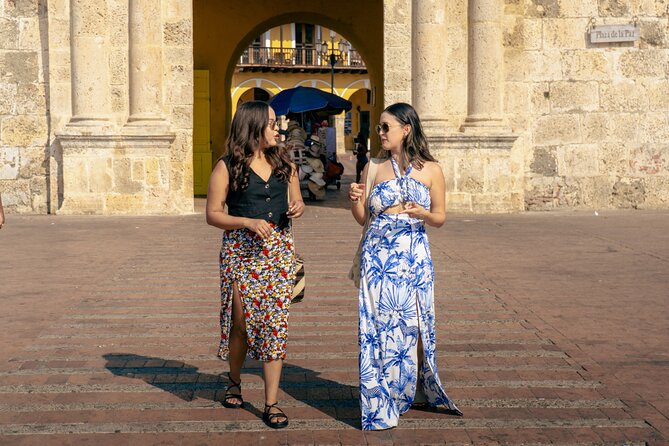
The final listed stop is Plaza de La Trinidad, where you tour the colorful streets of Getsemaní for about 20 minutes. This gives the experience a lively finish after the weightier discussions in the walled city.
Getsemaní is a useful ending because it shows Cartagena beyond its grandest colonial spaces. The neighborhood streets provide a more informal setting and a chance to see how the historic center continues into everyday urban life. The route ends at Cl. 29 #9119 in Getsemaní, rather than taking you back to your hotel.
That final point is both a benefit and a limitation. If you want to continue exploring, you are already in a neighborhood suited to further wandering, eating, or shopping. If you have luggage, mobility concerns, or a tight schedule, you need to plan your next move before booking.
The 20-minute neighborhood visit will give you an introduction, but not an exhaustive tour of Getsemaní. You may want to return later if this part catches your interest.
What $45 really buys you
At $45 per person, this is not the cheapest way to see Cartagena’s old center. You could walk between many of these sites without paying admission. The price is paying for structure, private transport, a guide, bottled water, and the historical links between places that can otherwise feel disconnected.
That value is strongest for first-time visitors who want a clear introduction in a short window. It is also useful during a cruise stop. One organized outing can cover the historic center and Getsemaní without requiring you to build your own route or guess which sites belong together.
The price becomes less attractive if you only want photographs or prefer to explore at your own pace. All listed stops are free, and the timing leaves limited room for lingering. You are paying for interpretation, not entry tickets.
The private format can also improve the value for families or mixed-age groups. One supplied account describes a group ranging from age 35 to 80, with the guide adjusting the itinerary to suit everyone. Another describes an older person who walked slowly and received a flexible pace. That does not guarantee a specific arrangement, but it suggests that you should tell the operator about your group’s needs in advance.
Timing, pickup, and the practical details
The tour runs Monday through Saturday, with departures offered between 7:00 AM and 3:30 PM for the stated operating period from March 14, 2025 through February 22, 2027. The experience lasts approximately 2 hours and 35 minutes.
Pickup is available in the Walled City, Bocagrande, Marbella, and Manga. The meeting point is Cartagena Pegasus PierCentro, and the route ends in Getsemaní. Private transportation is included, but return transportation to your hotel is not.
Those details matter most if you are visiting on a cruise or have another booking later in the day. The duration is fairly compact, but you should still allow extra time around the scheduled start and finish. The listed stop times total about two hours, leaving the remainder for moving between locations and transitions.
Mobile tickets are accepted, and confirmation is provided at booking. Service animals are allowed, and the experience is near public transportation. Most people can participate, but the route includes several historic outdoor areas and walking between stops, so a private booking is helpful if your group needs a slower pace.
Free cancellation is available until 24 hours before the start time. Cancellations made less than 24 hours ahead, along with late changes, are not refunded or accepted under the stated policy.
Who will get the most from this experience
I would recommend this tour to you if you want Cartagena’s beauty explained alongside its difficult past. It suits solo visitors, couples, families, and private groups who prefer conversation over a large crowd.
It is particularly useful for a short visit. Cruise passengers can see several central locations in one half-day outing, while visitors staying in Cartagena can use it as an introduction before exploring more on their own. The tour also appears well suited to groups with different ages and walking speeds, provided you communicate your needs.
You may want another option if you need extensive time inside monuments, a museum-based presentation, or a slow photography walk. The seven-stop route covers a lot in less than three hours. That is efficient, but it means each place receives a focused explanation rather than a long visit.
Should you book African History in Cartagena?
Book it if you want context, personal guiding, and a thoughtful route through the old city. The strongest parts are the direct treatment of the trade of enslaved people, the discussion of Haiti’s influence on independence, and the way the guide links plazas, defenses, religion, and neighborhood life.
The private format and Dani’s warm, adaptable style add real value, especially for solo visitors and mixed-age groups. Just remember that the stops are brief, the sites are free, and the tour ends in Getsemaní without a hotel return.
For a first visit, a cruise day, or anyone who wants more than postcard views, $45 is a reasonable price for the historical framework. Book it when you want Cartagena to make more sense, not simply look pretty.
FAQ
How long does African History in Cartagena last?
The experience lasts approximately 2 hours and 35 minutes.
How much does the tour cost?
The price is $45 per person.
Is the tour private?
Yes. Only your group will participate in the private tour or activity.
Where does the tour start?
The meeting point is Cartagena Pegasus PierCentro in Cartagena, Bolívar, Colombia.
Where does the tour end?
The tour ends at Cl. 29 #9119 in Getsemaní, Cartagena de Indias.
Is hotel pickup available?
Pickup is offered only in the Walled City, Bocagrande, Marbella, and Manga neighborhoods.
Is transportation included?
Private transportation and bottled water are included. Return transportation to your hotel is not included.
Is the tour offered in English?
Yes. The experience is offered in English.
Can I cancel for a full refund?
Yes, if you cancel at least 24 hours before the experience start time. Cancellations made less than 24 hours ahead are not refunded.
Just added in Cartagena
- Private History Photography Tour★ 5.0 · 17 reviews
- Self-Guided Audio Tour: Pirate Tales in Cartagena★ 3.0 · 2 reviews
- Paue Island Tour in the Rosary Islands★ 5.0 · 1 review
- Totumo Volcano★ 3.5 · 15 reviews
- Paragliding Experience in Cartagena★ 5.0 · 8 reviews
- Palmarito Beach★ 3.5 · 4 reviews
- Party without limits! Cartagena; VIP Party.★ 4.5 · 32 reviews
- Tour cultural to san Basilio de Palenque from cartagena★ 5.0 · 45 reviews
Historical Tours, compared.
Historic Center and Getsemaní Shared Walking Tour
Read our review →
Shared Tour of the Historic Candelaria in Bogotá
Read our review →
Historic Center & Getsemaní Shared Tour in Cartagena
Read our review →
Shared Tour Historic Center of Medellin with Audio System
Read our review →
Medellín Essential: history & local life on E-bike
Read our review →
Medellin Historic Walking Tour with Expert Guide
Read our review →
Bogota Shared Gastronomy Tour in the Historic Center
Read our review →Browse the lists this tour appears in