
REVIEW · WALLED CITY AND SAN FELIPE TOURS
Private Tour Walled City Walking Tour
Cartagena’s old town rewards a slow walk. I like the private format, which keeps the route focused on your group, and I like the strong mix of plazas, churches, fortifications, and local sweets. The main consideration is the pace: twelve stops in three hours leaves little time for long visits or unplanned wandering.
The tour costs $30 per person and includes an English-speaking guide and bottled water. Hotel pickup can make the start easy, though private transportation is not included for hotels outside the walled city, and the published starting point is the Clock Tower.
In This Review
- Five things to know before you go
- Starting beneath Cartagena’s Clock Tower
- Plaza de los Coches and the city’s complicated entrance
- Portal de los Dulces: a quick taste of Colombia
- Plaza de la Aduana and Cartagena’s trade routes
- San Ignacio Bastion and the military edge of the city
- San Pedro Claver and the human side of the city
- Plaza de Bolívar and the institutions of colonial power
- The Palace of the Inquisition and a difficult chapter
- Santa Catalina Cathedral and Cartagena’s religious center
- Santo Domingo Square and Botero’s famous sculpture
- Santo Domingo Bastion and the first fortifications
- Teatro Adolfo Mejía, once Teatro Heredia
- What $30 buys you
- Timing, pickup, and the practical side
- The most important sign of service quality
- Who should book this private walk
- Should you book it?
- FAQ
- How long does the tour last?
- Where does the tour begin?
- Where does the tour end?
- Is hotel pickup available?
- Is the tour private?
- Is the tour offered in English?
- What is included in the price?
- Can I cancel for a full refund?
Five things to know before you go
- The route covers 12 major sights in about three hours, with stops ranging from 10 to 20 minutes.
- The private setup gives your group the guide’s attention, rather than placing you in a large shared party.
- The tour balances famous landmarks with difficult history, including Cartagena’s role in the slave trade and the work of the Inquisition.
- No admission fees are included because the listed stops are free, but this is primarily a walking and orientation tour, not an inside visit to every building.
- The guide has shown real flexibility, including waiting roughly 90 minutes after a flight delay and helping the group reach a dinner reservation.
- The route begins and ends at the Clock Tower, making it easy to connect with the rest of your day in the old city.
Starting beneath Cartagena’s Clock Tower
The tour begins at the Monumento Torre del Reloj, also called the Clock Tower, at Boca del Puente. This is one of Cartagena’s clearest meeting points, located between Plaza de los Coches and Plaza de la Paz.
The tower rises about 30 meters and serves as a useful landmark even if you have never visited Cartagena before. It is not simply a clock on a wall. It marks the grand entrance into the fortified old city, so the tour begins with a clear sense of place.
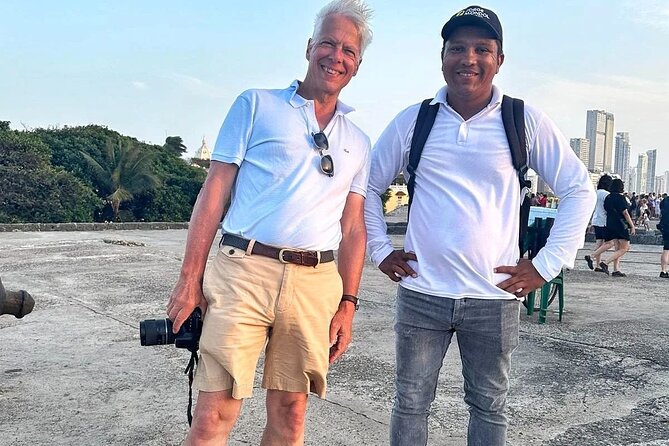
If you arrange pickup, go to your hotel lobby and wait for the guide wearing a cap with the company logo. The official meeting point remains the Clock Tower, so confirm the pickup details when booking, especially if your hotel sits outside the walled city.
The tour ends back at this same meeting point. That matters because you can plan lunch, shopping, or another activity afterward without having to cross town for a final drop-off.
More Walking Tours in Cartagena
- Cartagena: Historic Center and Getsemaní Shared Walking Tour
★ 4.9 · 2,716 reviews - Private Walking Tour in Cartagena Walled City & Getsemaní
★ 5.0 · 1,357 reviews - Cartagena: Walled City and Getsemani Shared Walking Tour
★ 4.5 · 352 reviews
Plaza de los Coches and the city’s complicated entrance
From the Clock Tower, you move into Plaza de los Coches. This was the principal entry area for the walled city and once functioned as a transport hub.
The square also carries a painful history. It was connected to Cartagena’s slave trade, and a good guide should not let the attractive colonial setting hide that fact. The statue of Pedro de Heredia, the city’s founder, adds another layer to the stop. You get a quick introduction to the person associated with Cartagena’s foundation while also confronting the systems that shaped the city.
The scheduled visit lasts 15 minutes. That is enough for an explanation and photographs, but not for a long discussion. If this subject matters to you, ask questions while you are here. The private format gives you a better chance to do that.
Portal de los Dulces: a quick taste of Colombia
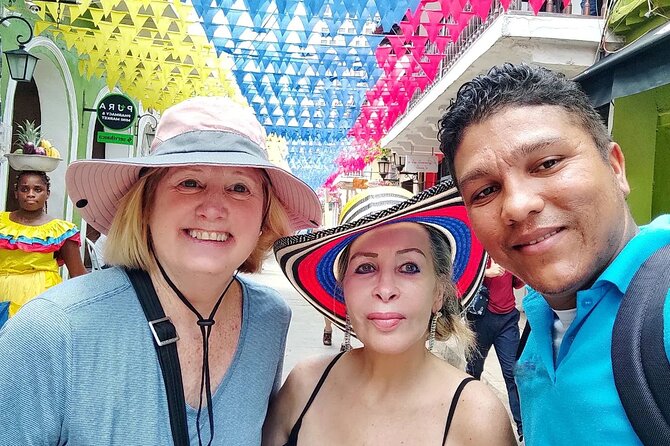
The Portal de los Dulces is a short stop, only 10 minutes, but it changes the mood of the walk. Here you find a wide range of Colombian sweets in one place.
This is a useful pause between larger historical sites. You can look at the colorful displays, identify unfamiliar treats, and pick up something small if you wish. The stop is free, but any sweets you buy are your own expense.
Do not expect a food tour. The schedule allows for a brief introduction rather than a tasting session or a long conversation about ingredients. Still, this stop gives the route a local touch that a strictly architectural walk would miss.
Plaza de la Aduana and Cartagena’s trade routes
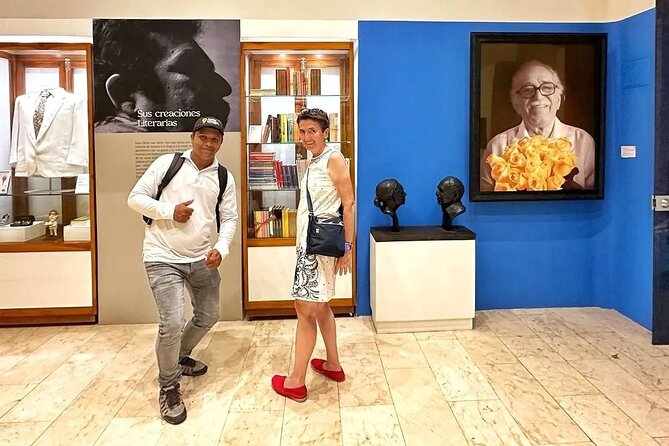
Plaza de la Aduana was a center of colonial commerce. Gold, silver, tobacco, potatoes, sugar, fruit, and other products moved through this area on ships bound for Spain. Imported goods from Spain also passed through here before reaching other parts of South America.
The square helps explain why Cartagena became so important. Its fortifications were not built around an insignificant port. Trade, military power, religion, and government all met here.
The former Royal Accounting Office is located in the square and now serves as Cartagena’s mayor’s office. That change of use is a helpful reminder that the old city is not a museum frozen in time. Its buildings still serve civic purposes.
The scheduled stop is 15 minutes. You will get a concise orientation, not a full study of colonial economics. I find that useful early in a visit because it gives you a framework for understanding the streets ahead.
More Walled City and San Felipe tours:
- Cartagena: Guided Tour, with La Popa Convent, and San Felipe
★ 4.4 · 599 reviews - Walled City, San Felipe Castle & Popa Convent Cartagena City Tour
★ 5.0 · 391 reviews - Cartagena: BILINGUAL CITYTOUR + SAN FELIPE CASTLE & Old city
★ 4.2 · 387 reviews - Cartagena Private Tour of the Walled City & Getsemani
★ 5.0 · 227 reviews
San Ignacio Bastion and the military edge of the city
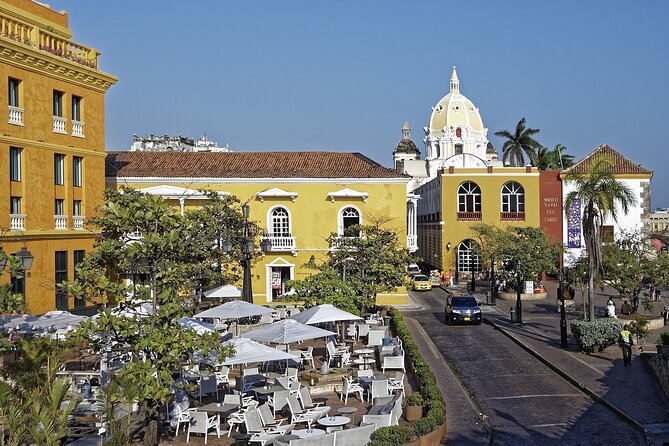
At Baluarte de San Ignacio, the focus shifts from trade to defense. The bastion was designed to protect the isthmus of Bocagrande and Bahía de las Ánimas.
It was first known as the Moros and later changed its name and layout because of the nearby Jesuit school. Details like this make the fortifications easier to read. Cartagena’s walls were not one single project built all at once. They changed as threats, geography, and nearby institutions changed.
The stop lasts 15 minutes. That gives you time to understand the bastion’s purpose, but it is not a dedicated wall walk. If you want a more extended look at fortifications, this tour may work best as an introduction rather than your only military-history activity.
San Pedro Claver and the human side of the city
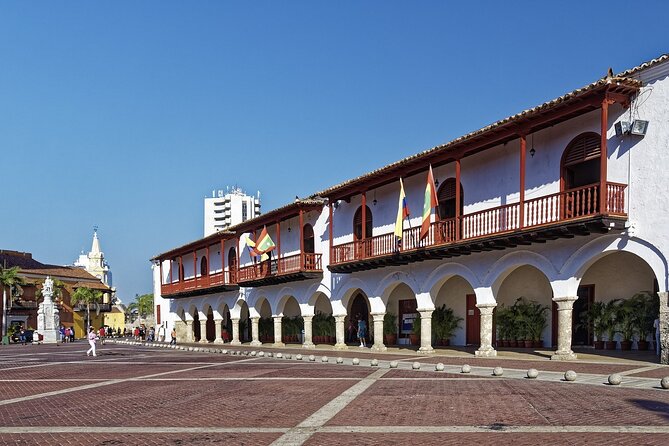
Plaza de San Pedro Claver introduces one of Cartagena’s most important religious and social figures. The square is tied to a life devoted to serving enslaved people and teaching Christian doctrine.
This is one of the more serious moments on the route. The story connects faith with direct social work, but it also brings you back to the brutal world in which enslaved people were held and sold. A responsible explanation should present both sides instead of turning the saint into a decorative figure in a picturesque square.
The scheduled visit is 10 minutes. That is short, yet the stop can carry considerable weight. I would listen closely here and use the private setting to ask for clarification if the story moves too quickly.
Plaza de Bolívar and the institutions of colonial power
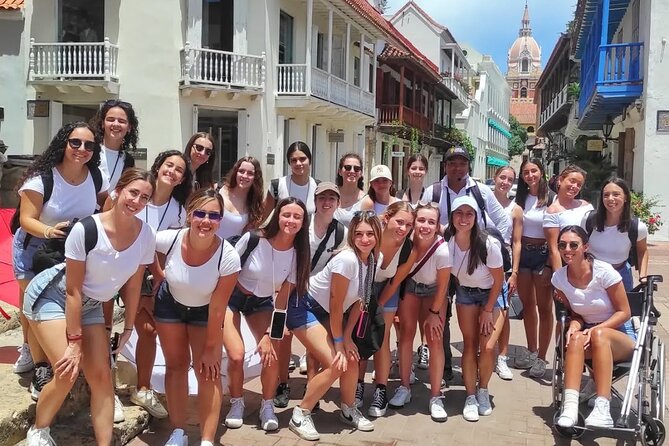
Plaza de Bolívar is framed by several of Cartagena’s most important buildings. The Palace of the Inquisition, the cathedral, and the former town hall, now the Government of Bolívar, face the square.
The Bank of the Republic and Cartagena’s Gold Museum also share this setting. Even if you do not enter them during the tour, their presence gives the square a useful civic and cultural focus.
The 15-minute stop lets you see how colonial authority was organized around a public plaza. Church, government, courts, and commerce were not separated by long distances. They worked together in the center of the city.
Because the itinerary continues to the Palace of the Inquisition and the cathedral, this stop acts as a preview. You will see some of the same buildings from a closer angle, so expect repeated orientation rather than twelve entirely separate scenes.
The Palace of the Inquisition and a difficult chapter
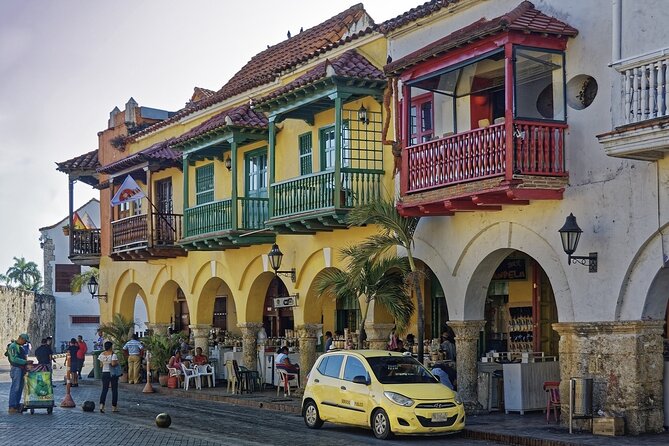
The Palace of the Inquisition sits directly on Plaza de Bolívar. The Tribunal of the Holy Office operated here and issued autos de fe against people accused of heresy.
The building is often admired for its mansion-like appearance, but its function was far darker. That contrast is part of what makes the stop important. Cartagena’s elegant facades can conceal stories of punishment, forced belief, and institutional power.
The visit lasts 15 minutes. The tour does not list an admission ticket for an interior visit, so do not assume that entrance to the museum or all rooms is included. Treat this as a guided stop at the palace unless your guide confirms otherwise.
If you want to spend a long time examining exhibits, arrange that separately. The tour’s value here is the explanation and location within the larger story of the old city.
Santa Catalina Cathedral and Cartagena’s religious center
The Catedral Santa Catalina de Alejandría is officially the Metropolitan Basilica Cathedral of Santa Catalina de Alejandría. It is the seat of the Archbishop of Cartagena and one of the city’s oldest episcopal centers.
It is also the largest church in Cartagena. The route allows 10 minutes, which is enough to see the exterior and receive a short introduction. Depending on conditions at the site, your guide may explain the church’s role in the city’s religious life, but the schedule does not promise an extended interior visit.
This is a good example of the tour’s overall style. You see many essential places, learn why they matter, and then keep moving. I like that approach for a first look at Cartagena, but it will feel too quick if you prefer to study one church or monument in detail.
Santo Domingo Square and Botero’s famous sculpture
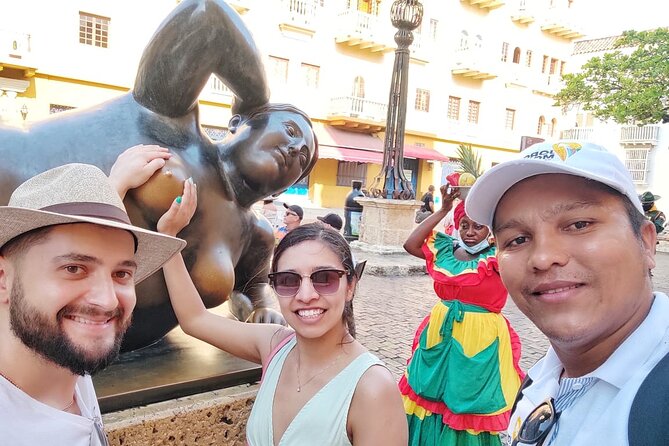
Plaza Santo Domingo brings the tour into one of Cartagena’s most recognizable public spaces. Here you meet Gertrudis, the rounded bronze sculpture often called La Gorda de Botero.
The sculpture is an easy landmark and a lighthearted moment after the heavier subjects at the Palace of the Inquisition. The Church of Santo Domingo is also here. It is described as Cartagena’s first monumental construction, giving the square both artistic and architectural interest.
The stop lasts 20 minutes, one of the longer pauses on the route. That extra time should help you appreciate the square rather than simply walk through it. You can take photographs, hear the story behind Gertrudis, and look more carefully at the church.
The route does not include food, drinks, or alcoholic beverages. If you want a longer break at the square, plan that after the tour or ask whether your private guide can adjust the timing.
Santo Domingo Bastion and the first fortifications
The Baluarte de Santo Domingo was the first part built in Cartagena’s fortified area. Its first stone was laid on September 8, 1614, at a site connected to Sir Francis Drake’s attack on the city in 1586.
This stop gives the walls a clear timeline. You are not just looking at old stone. You are seeing part of a defensive response to a specific attack and a broader effort to protect Cartagena’s wealth and position.
The scheduled visit lasts 20 minutes. Along with Plaza Santo Domingo, this is one of the route’s longer stops, and it gives military history more space than some of the earlier bastions.
The tour does not promise a full walk along the wall. If walking on the fortifications is especially important to you, ask the guide what portion of the bastion or nearby defenses you will see.
Teatro Adolfo Mejía, once Teatro Heredia
The final stop is Teatro Adolfo Mejía, also known as Teatro Heredia. It was built on the site of the former La Merced church and opened in 1911 during the floral games.
Inside are stairs and Italian marble sculptures. That detail makes the theater a welcome change from plazas, churches, and defensive walls. You finish with a look at Cartagena’s performing-arts heritage rather than ending only with colonial buildings.
The stop is planned for 15 minutes. The available details do not promise a performance or a full interior tour, so consider the visit an introduction to the theater. If access is limited at the time of your visit, the guide can still explain its place in the city’s story, but the tour description does not guarantee entry.
What $30 buys you
At $30 per person, the price is reasonable for a three-hour private walking tour if you want structure and personal attention. You are paying for a guide, an English-language explanation, bottled water, and a route that connects twelve major places without requiring you to plan the order yourself.
The value is strongest for a first visit. Cartagena’s old city is compact but full of overlapping stories. A guide can connect trade, slavery, religion, military defense, government, and art in a way that signs alone often cannot.
The price does not include alcoholic drinks or private transportation. The listed stops have free admission, but you should not assume that museums, palace interiors, theater access, or church entry are included. Ask before booking if interior access is essential to you.
The private arrangement also changes the value calculation. A shared tour may cost less, but you would have less control over questions and pace. Here, the guide can focus on your interests, within the limits of a fixed three-hour route.
Timing, pickup, and the practical side
The route is scheduled almost exactly to three hours. Since every stop has a set time, you should arrive ready to walk and avoid planning a tight appointment immediately afterward.
The company says pickup is offered from hotel lobbies, with the guide wearing a cap bearing the company logo. Private transportation is not included for hotels outside the walled city, so the starting arrangement may require you to reach the Clock Tower yourself.
The experience is offered in English and comes with a mobile ticket. Confirmation is received when you book. Service animals are allowed, and the meeting point is near public transportation.
Most people can take part, according to the tour information, but this remains a walking experience through an old city. The supplied details do not state the distance, surface conditions, shade, or seating arrangements. If you need specific mobility information, ask before booking rather than guessing.
The tour usually receives bookings about 12 days ahead. That does not guarantee that every date fills, but it is a useful planning signal. Reserve before your visit if you want a particular start time or need hotel pickup.
The operator also allows free cancellation up to 24 hours before the local start time. Changes or cancellations inside that window are not refunded.
The most important sign of service quality
The strongest service detail is the guide’s response to a serious flight delay. After the group arrived roughly an hour and a half late, the guide waited, stayed later than planned, walked the group to its dinner reservation, and offered help with transportation and parking ideas.
That kind of flexibility matters more than polished sales language. Cartagena’s airport arrivals and dinner bookings do not always fit neatly into a schedule, and a guide who handles a delay with patience can save a day from turning stressful.
Of course, one unusually accommodating situation does not guarantee that every future delay will be handled in the same way. Still, it points to a company culture built around kindness, honesty, and practical help. The operator is Cartagena Top Experiences.
Who should book this private walk
I would choose this tour if you are visiting Cartagena for the first time, have three hours available, and want a clear introduction to the Walled City. It suits couples, families, and small groups who prefer asking questions without competing with a large party.
It also works well if you want to understand the city before exploring on your own. After this route, you will know where the key squares, churches, bastions, palace, cathedral, and theater are located.
I would hesitate if your main goal is a slow museum visit, a long food experience, or a detailed fortification walk. The schedule is full, and the stops are brief. You may need separate visits to spend meaningful time inside the Palace of the Inquisition, Cartagena’s Gold Museum, or the theater.
The route also includes serious subjects. The slave trade and the Inquisition are not side notes, and the religious story of San Pedro Claver is tied to that difficult setting. If you want only light sightseeing, this may feel heavier than expected. That weight is also part of an honest look at Cartagena.
Should you book it?
Book it if you want efficient orientation, a private guide, and strong coverage of Cartagena’s central landmarks for $30 per person. The route gives you a useful first map of the Walled City and includes enough military, religious, civic, and social context to make later exploring more rewarding.
Skip it if you already know the old city well or want to linger inside museums and monuments. In that case, a shorter custom walk with fewer stops may suit you better. For a first visit, though, this is a practical and fairly priced introduction, especially when personal attention and a helpful response to travel delays matter to you.
FAQ
How long does the tour last?
The tour lasts approximately three hours.
Where does the tour begin?
It begins at the Monumento Torre del Reloj, Boca del Puente, in El Centro, Cartagena de Indias.
Where does the tour end?
The activity ends back at the Clock Tower meeting point.
Is hotel pickup available?
Yes. You are asked to wait in your hotel lobby for a guide wearing a cap with the company logo. Private transportation is not included for hotels outside the walled city.
Is the tour private?
Yes. Only your group participates in the activity.
Is the tour offered in English?
Yes. English is the listed tour language.
What is included in the price?
The price includes a guide and bottled water.
Can I cancel for a full refund?
Yes, if you cancel at least 24 hours before the experience start time. Cancellations or changes made less than 24 hours before the local start time are not refunded.
Just added in Cartagena
- Exotic Yacht – Tour through the bay of Cartagena★ 3.7 · 4 reviews
- White Night Boat Party: Dinner Buffet, Dancing and Open Bar★ 4.6 · 3 reviews
- Volcan del Totumo + Playa + Piscina★ 4.7 · 4 reviews
- Enjoy the totumo volcano from cartagena + snack★ 4.0 · 11 reviews
- Private Tour to Tayrona National Park★ 4.0 · 2 reviews
- 18.Transfer (Rafael N-Hotel Decameron Baru Airport) or vice versa★ 5.0 · 1 review
- One-day tour to Playa Blanca by land Popular sector★ 3.0 · 2 reviews
- Full Day Private Activity Mangata Island Kayak and Lunch★ 5.0 · 15 reviews
Walled City and San Felipe Tours, compared.
Private Walking Tour in Cartagena Walled City & Getsemaní
Read our review →
Guided Tour, with La Popa Convent, and San Felipe
Read our review →
Walled City, San Felipe Castle & Popa Convent Cartagena City Tour
Read our review →
BILINGUAL CITYTOUR + SAN FELIPE CASTLE & Old city
Read our review →
Cartagena Private Tour of the Walled City & Getsemani
Read our review →
City Tour Castillo San Felipe & Convento de La Popa
Read our review →
Street Food Tour in Cartagena Walled City and Getsemani
Read our review →Browse the lists this tour appears in