
REVIEW · GRAFFITI AND STREET ART TOURS
Walls of Wonder: Immersive Journey through Distrito Graffiti
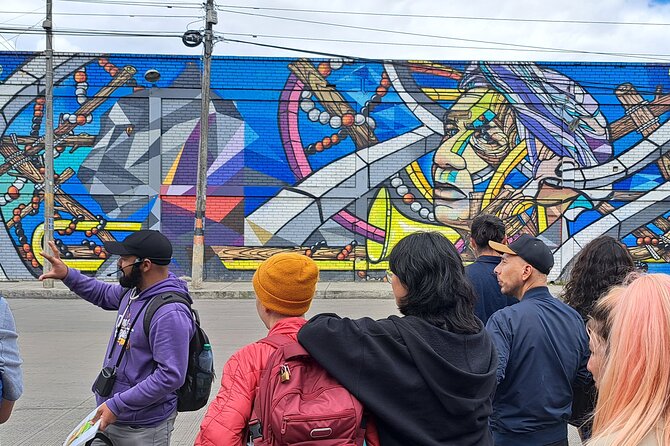
See Bogotá through painted walls. This 90-minute walking tour brings you into Distrito Graffiti, the Puente Aranda art district where giant murals turn factory walls, garages, and industrial buildings into public galleries. You move through works about politics, faith, identity, nature, pollution, music, and imagination.
I like the tour’s wide range of styles, from wild-style lettering and tiny worker stencils to four-story portraits and surreal creatures holding planets. I also like that the guides connect the art to Colombian culture and local politics. The main drawback is its short length: with 14 stops, some visits last only five minutes, so you get a strong introduction rather than a full exploration of the district.
Guides have included Jay, Jahir, Camilo, Jeff, and Tet, with Jay receiving special praise for his clear explanations and local perspective. The small group limit of 15 helps, but you should expect a fair amount of standing and walking. The tour is not recommended for people with limited mobility.
In This Review
- Key points to know before you go
- Why Distrito Graffiti is worth your time
- Starting at Avenida de las Américas
- From spray cans to wild-style lettering
- Small figures and a water-made uterus
- Tucans, Indigenous culture, and the human connection to nature
- Fire, belief, salsa, and memory
- Sentipensar, pollution, and an old telephone
- A four-story face and competing mural styles
- Alien planets and the pursuit of learning
- Ending with a group photo and a useful final thought
- Pace, group size, and who will enjoy it
- Is $25 a fair price?
- Should you book Walls of Wonder?
- FAQ
- How long does the Distrito Graffiti tour last?
- How much does the experience cost?
- Where does the tour start and finish?
- How many people can join the tour?
- Is the tour suitable for people with limited mobility?
- What is included, and can I cancel for free?
Key points to know before you go
- Fourteen mural stops in 90 minutes: You see a broad sample of Distrito Graffiti, but several stops are quick photo and explanation breaks.
- Art with ideas behind it: Themes include Afro-Colombian identity, Indigenous culture, faith, environmental damage, workers’ lives, and political history.
- A good introduction for beginners: The guides explain graffiti history and artistic terms in clear English, making the tour accessible even if you know little about street art.
- A remarkably strong price: At $25 per person, the guided context adds real value to art that you could otherwise pass without understanding.
- Industrial Bogotá is part of the experience: The murals are painted on working commercial buildings, gas stations, textile factories, and warehouses, not inside a polished museum.
- Come ready to walk and stand: Public transportation is nearby, service animals are allowed, and most people can participate, but limited mobility can make the route difficult.
Why Distrito Graffiti is worth your time
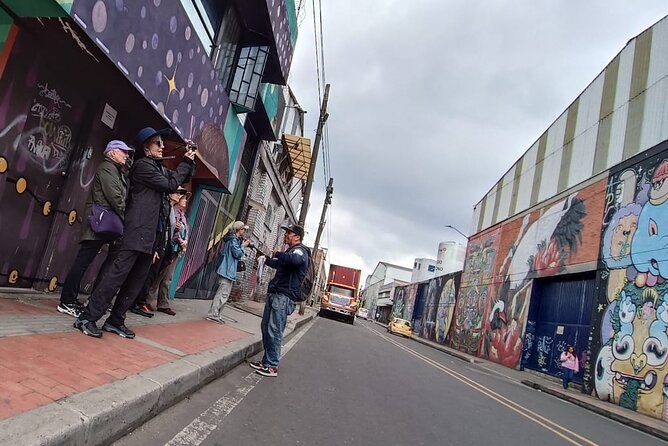
Bogotá’s street art is not simply decoration. It can be witty, political, spiritual, tender, or strange, sometimes all at once. Distrito Graffiti gathers that energy in an industrial part of the city, where large blank walls give artists room to work at a scale that ordinary galleries cannot match.
I especially like the way this tour treats graffiti as both an art form and a public conversation. You are introduced to the district’s goal of presenting international voices alongside Colombian artists. That matters because the murals do not all speak in the same visual language. Some use polished realism. Others use lettering, folk symbols, cartoon figures, or dreamlike images.
The guide adds the missing layer. Without context, a skull with a coca plant or a uterus made of water might look like an arresting image and nothing more. With an explanation, you begin to see the social questions inside the paint.
The tour costs $25 and lasts about an hour and a half. That is a fair price if you want someone to explain what you are seeing and point out political and cultural references that are easy to miss. If you prefer to wander slowly, study every wall, and take dozens of photographs, the fixed pace may feel too fast.
More Graffiti and Street Art Tours in Bogota
- Graffiti Tour: a fascinating walk through a street art City
★ 5.0 · 1,074 reviews - Graffiti Tour in La Candelaria Bogotá
★ 5.0 · 315 reviews - Bogotá: La Candelaria Graffiti & Urban Art Guided Tour
★ 4.7 · 250 reviews
Starting at Avenida de las Américas
The meeting point is at Avenida de las Américas #50-85 in Puente Aranda. The activity ends back at the same meeting point, which makes planning simpler than a one-way city tour. Public transportation is nearby, though the supplied information does not specify the best route or station, so check your own map before setting out.
The tour begins with an introduction to Distrito Graffiti and its purpose. This opening is brief, but useful. You learn that the district is designed to showcase different international and local approaches to large-scale wall art. It also gives you a way to read what follows: look for technique, subject, scale, and the social idea behind each image.
Do not expect a museum-style entrance or a quiet indoor gallery. The works are spread across an industrial area, and part of the appeal is seeing art placed on the buildings where ordinary city life continues around it.
From spray cans to wild-style lettering
At Soplascol sas, a mural shows a graffiti artist in a hoodie and cap, carrying spray cans and rollers. It is a direct image of the person behind the work, almost a signpost for the district. The five-minute stop helps set up a basic question: who gets to claim public space, and how does an artist make a wall speak?
The next stop, at Eds Terpel San Andres, takes a more serious turn. A coca plant grows from a skull, asking you to think about death and the sacred. The explanation also separates coca from cocaine, an important distinction in Colombian cultural and political discussions. This is one of the tour’s more useful moments because a simple image opens a subject that is often reduced to headlines.
At the Textiles Factory Textrama, you encounter wild-style graffiti writing. To an untrained eye, the layered letters may look like a colorful tangle. The guide explains how this form developed from graffiti’s roots as illegal or vandal art, and how Distrito Graffiti now supports the same creative energy in a public setting.
That contrast is worth noticing. The art began as an act of taking space without permission, yet here it is part of an organized district. The tension does not disappear. It becomes part of the story.
Small figures and a water-made uterus
At the corner of Carrera 54 and Calle 5C, small realistic stencils show workers such as builders and cleaners. Belgian artist Jaune made these figures to draw attention to people who often pass without notice. The scale is the point. After several giant murals, these tiny workers require you to look down and focus.
I find this kind of work especially effective on a guided walk. You might walk past the figures while looking at larger walls, but the guide can direct your eyes to them. It is a reminder that public art does not always need to shout.
At Metalfischer, a mural presents a uterus made of water. Inside it is the frailejón, a plant found in Colombia’s highland wet ecosystems. Created by a local female artist, the image links nature, birth, water, and the growth of equity.
This stop gives the tour a welcome change of scale and subject. The work is not only about protecting a plant. It uses the body as a symbol of creation and change, while connecting that idea to Colombia’s fragile highland water systems.
A completely different kind of day:
- Bogotá Bike Tour
★ 5.0 · 3,329 reviews - Bogota: Bicycle City Tour
★ 4.9 · 2,156 reviews - Zipaquirá: Salt Cathedral Group Tour with Pickup
★ 4.8 · 1,606 reviews - La Candelaria, Monserrate and Museums Bogotá Private City Tour
★ 5.0 · 1,567 reviews
Tucans, Indigenous culture, and the human connection to nature
Centro Creativo Textura is one of the fuller stops, with two very different works. One is a colorful mural of cartoon toucans and Indigenous communities. It celebrates Colombia’s cultural heritage through approachable images and strong color.
The second work is a realistic portrait of a woman with a small jaguar walking along her arm. The image suggests a close relationship between people and the natural world. Together, the murals create a conversation between celebration and reflection. One looks outward toward community and heritage. The other focuses on an individual and her bond with an animal.
This is also a good example of why the explanations matter. You can admire the birds, portrait, and colors on your own. The guide helps you connect them to larger questions about Colombian identity and the relationship between culture and nature.
Fire, belief, salsa, and memory
At La Areperia DC, a giant black-and-white acrylic image shows a character watching their mental house burn. The burning house works as a metaphor for beliefs being changed, and for the resilience needed to rebuild after that change.
The image is less literal than the worker stencils or the Afro-Colombian portrait later in the route. It rewards a few quiet minutes of thought, even though the stop itself is scheduled for only five minutes. If you want to discuss the symbolism at length, you may need to ask your guide a question while walking to the next wall.
At Industrias Proton Ltda., a man plays the trombone while a rosary coils around the instrument. The mural links spirituality and music, with a particular connection to salsa. It is a distinctly lively idea: faith is not shown apart from daily life, but wrapped around a sound and a social tradition.
These two stops show the tour’s range. One mural asks you to think about private change. The next ties religion to public music. Neither is just a pretty background for a photograph.
Sentipensar, pollution, and an old telephone
The longest stop comes at TelefonoPostobón Planta San Rafael Industrial. Here you see three works, so the extra time is welcome.
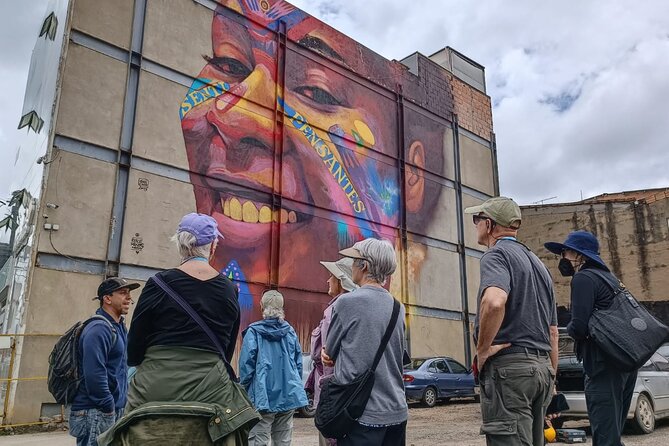
The first is a giant portrait by Colombian artist Guache, showing an Afro-Colombian woman in his recognizable style. The mural introduces the idea of sentipensar, a way of bringing feeling and thought together, with roots in contemporary and ancestral Indigenous philosophy. It is a powerful concept for a city wall because it asks you not only to analyze the image, but also to consider what it makes you feel.
A second mural shows a plastic bag floating in the ocean. The message is plain: waste and pollution do not vanish when they leave your hand. The image provides a sharp environmental pause amid the portraits and fantasy scenes.
The third artwork features an old telephone. It creates a note of nostalgia while pointing to the speed of modern communication technology. In a district filled with enormous new paintings, an old telephone becomes a reminder that technology can change faster than the buildings around it.
This three-part stop is one of the tour’s strongest sections because it moves from identity to environmental responsibility to memory. You get a useful picture of how public art can address personal, social, and global subjects on the same block.
A four-story face and competing mural styles
At COMTUCAR S.A.S., you look up at a hyper-realistic portrait of an old man covering four stories. Spanish artist Sabotaje al Montaje created the work, and its size changes the way you experience realism. A small portrait can invite close inspection. A four-story portrait confronts you from across the street.
You may find yourself more aware of the building than the face itself. That is part of the work’s force. The wall becomes a frame, and the portrait gives an ordinary industrial structure a human presence.
At FIORENZI CEDI, the subject shifts to graffiti on trains and the way different mural styles coexist on buildings. This stop deals with the relationship between public art scenes, including the push and pull between train graffiti, muralism, and authorized wall projects.
The same stop also features a giant psychedelic totem with a Colombian Indigenous symbol, created by a Brazilian crew. Its strong colors and unusual form celebrate Indigenous cultures while showing how artists from outside Colombia can take part in Bogotá’s public art scene.
The result is not a single official style. It is a meeting of approaches, backgrounds, and traditions. That variety is one of the tour’s pleasures, although the quick schedule means you may not have much time to compare every technique.
Alien planets and the pursuit of learning
At Todo Cajas Jemd S.A.S., one mural presents a science-fiction creature holding planets. It invites you to think about the universe and the mysteries beyond ordinary daily life. After the political and cultural subjects earlier in the walk, this cosmic image offers a welcome change.
Nearby, a poetic mural shows a child carrying a school bag shaped like a book. A clock marks the beginning of class, while the child looks toward a magnificent bird. The image connects education with imagination and the desire to learn.
I like this pairing because the two murals address curiosity from different directions. The alien creature points outward, toward space and the unknown. The child points forward, toward knowledge and possibility. Both remind you that street art can be playful without being empty.
The stop lasts about seven minutes. Take a moment to look for the details in the school scene, especially the book-shaped bag and the clock. The smaller symbols help carry the larger idea.
Ending with a group photo and a useful final thought
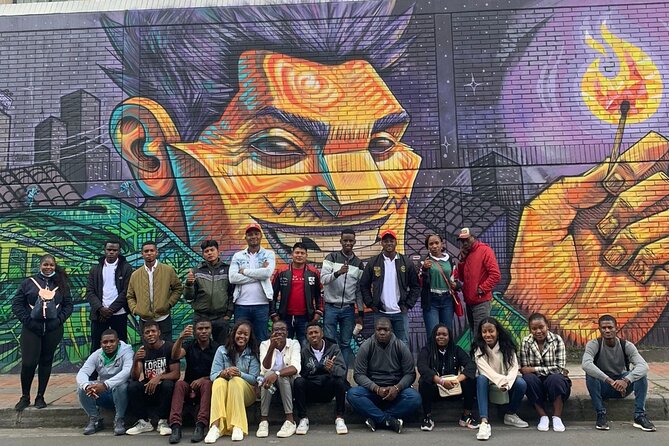
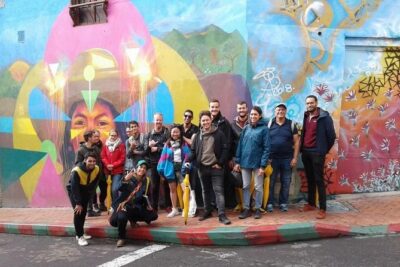
The final stop at Inversiones Merlup Sas is short. It gives the group time for a picture and closes with a discussion of how art can change the way you see Bogotá.
That closing idea is not just a polite send-off. After 14 stops, you have seen industrial walls become places for arguments about social class, Indigenous identity, religion, environmental damage, education, technology, and artistic freedom. You also leave with a practical lesson: look up, look around corners, and do not assume a blank warehouse wall has nothing to say.
Pace, group size, and who will enjoy it
The tour is limited to 15 people, a useful size for hearing explanations and asking questions. The guides have been praised for explaining graffiti history, local politics, and art in clear English. Jay, Jeff, Tet, Jahir, and Camilo have all led tours, so the exact personality and emphasis may vary.
You should plan for a brisk route. The schedule includes many five-minute stops, with longer pauses at the two-mural and three-mural locations. That format keeps the experience moving, but it does not leave much room for sitting, sketching, or photographing every detail.
This tour suits you best if:
- You want an introduction to Bogotá’s street art rather than a long, unstructured art walk.
- You enjoy learning the political and cultural meaning behind public art.
- You are comfortable walking and standing for about 90 minutes.
- You are visiting with family or friends who may not know much about graffiti.
- You prefer a small group and an English-language explanation.
It may not suit you if limited mobility makes walking difficult, or if your main goal is to spend several hours in one place. Food and tips are not included, though the tour itself covers the guided art experience.
Is $25 a fair price?
Yes, for most people. You receive a guided route through 14 stops, explanations of graffiti history and Colombian themes, and a small-group format capped at 15 people. The free admission at each location does not make the guide unnecessary. The value lies in knowing what you are looking at and why the artists chose these subjects.
The price is less attractive if you already know Distrito Graffiti well or want unlimited time with each mural. One tour guide has pointed out that the district contains more art than this route can cover, and that is worth remembering. This experience samples the area. It does not claim to show every wall.
Free cancellation is available if you cancel at least 24 hours before the start time. Cancellations made later, along with late changes, are not refundable.
Should you book Walls of Wonder?
Book it if you want clear explanations, political context, and a compact route through Bogotá’s major murals. The strongest feature is the mix of art and meaning. You see giant portraits, wild lettering, Indigenous symbols, environmental warnings, and surreal scenes, while the guide helps you connect them to Colombia’s society and culture.
I would especially recommend it early in your Bogotá stay. The tour can change the way you look at walls across the city, and it pairs well with a visit to the Candelaria street art area if you want a second, different setting.
Skip it if you dislike walking, need a slow pace, or would rather explore independently with a camera. For everyone else, $25 buys a smart introduction to one of Bogotá’s most thought-provoking public art districts.
FAQ
How long does the Distrito Graffiti tour last?
The tour lasts approximately 1 hour and 30 minutes.
How much does the experience cost?
The listed price is $25 per person.
Where does the tour start and finish?
It starts at Avenida de las Américas #50-85 in Puente Aranda, Bogotá. The activity ends back at the meeting point.
How many people can join the tour?
The tour has a maximum group size of 15 people.
Is the tour suitable for people with limited mobility?
It is not recommended for travelers with limited mobility. Most other participants can take part, and service animals are allowed.
What is included, and can I cancel for free?
The guided tour is included. Food and tips are not included. You can cancel for a full refund up to 24 hours before the experience begins. Changes or cancellations made less than 24 hours before the start time are not accepted for a refund.
Just added in Bogota
- Tour of Zipaquirá: Visit the Salt Cathedral and the main squares★ 4.5 · 55 reviews
- Catedral de Sal desde Bogotá en Tren★ 5.0 · 5 reviews
- Zipaquirá and Salt Cathedral Muisca Heritage with Guide – Private★ 4.5 · 23 reviews
- Botanical Garden Bogotá Private Tour (4 Hrs.)★ 5.0 · 13 reviews
- Zipaquira Salt Cathedral★ 4.5 · 12 reviews
- LOCAL GUIDE Zipaquirá PRIVATE TOUR – Salt Cathedral and Salt Oven★ 5.0 · 24 reviews
- Zipaquirá Salt Cathedral: An architectural wonder.★ 4.5 · 24 reviews
- Private Zipaquira Salt Cathedral and Guatavita Lagoon Tour from Bogota★ 4.5 · 44 reviews
Graffiti and Street Art Tours, compared.
Comuna 13 Graffiti Tour, Cable Car & Street Food
Read our review →
Graffiti Tour: a fascinating walk through a street art City
Read our review →
Comuna 13 Tour with Snacks And Your Own Graffiti
Read our review →
Comuna 13 and Graffiti Guided Tour with a Local
Read our review →Browse the lists this tour appears in