REVIEW · BOGOTÁ TOURS
Shared Tour Colombian Conflict: war, drug trafficking and peace
History hits differently when you walk through it. This three-hour Bogotá walking tour connects the Colombian conflict with real streets, government buildings, monuments, and public squares in La Candelaria and the city center. Rather than treating the past as a list of dates, the guide explains how political violence, drug trafficking, protest movements, and peace talks shaped modern Colombia.
I like the route’s clear focus and its use of important sites, especially the Gaitán Monument and the Palace of Justice. I also like the chance to ask questions, since guides such as Santiago, Leo, Sergio, Angie, and French-speaking Gina have been praised for clear, balanced explanations. The main thing to watch is the payment setup: the $13 booking price is a suggested tip for the guide, not a standard admission fee, and one person reported confusion about language options and the expected tip.
The walk begins at the Gold Museum at 10 a.m. and ends at Teatro Colón. Every scheduled stop is listed for about 18 minutes, which gives you a steady rhythm but also means some subjects receive only a short explanation. The group can reach 25 people, so ask questions early if you want a more personal exchange.
In This Review
- Five things to know before you book
- Why this conflict tour matters in Bogotá
- Starting at Santander Park and Avenida Jiménez
- The Gaitán Monument and the turning point of 1948
- Government buildings and the search for peace
- The Palace of Justice and the cost of violence
- Liévano Palace and the city’s changing politics
- Colegio Mayor San Bartolomé and Plazoleta del Rosario
- Finishing at Teatro Colón
- What the guides do best
- The real cost of the $13 booking
- Group size, pace, and practical planning
- Who should book this walking tour?
- Should you book it?
- FAQ
- How long does the Colombian Conflict walking tour last?
- Where does the tour start?
- What time does the tour begin?
- Where does the tour finish?
- How much does the tour cost?
- Is the $13 an admission fee?
- What is included?
- Is lunch included?
- How many people can join the group?
- Can I cancel for a full refund?
Five things to know before you book
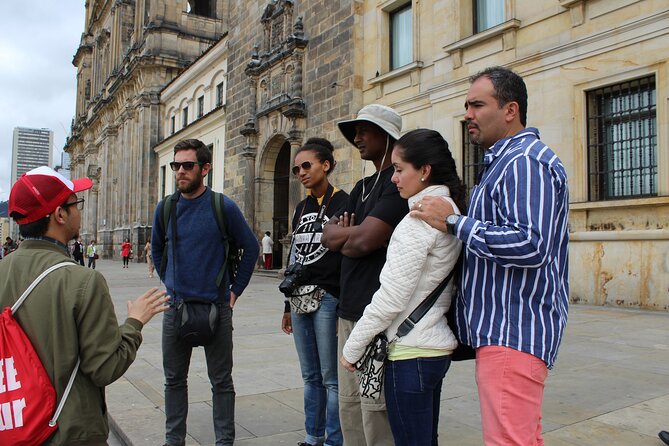
- The $13 price is a prepaid suggested tip: The amount goes to the guide, minus the booking platform’s commission. You are not paying for museum or attraction admission.
- The route links ten politically important places: Santander Park, Avenida Jiménez, the Gaitán Monument, the Palace of Justice, government buildings, schools, squares, and Teatro Colón all fit into one central walking route.
- Santiago receives especially strong praise: His teaching style is described as thoughtful, objective, thorough, and easy to follow, even when covering Colombia’s long political story in a short time.
- The subject is serious but interactive: You learn about war, drug trafficking, assassinations, protests, and peace negotiations while having time to ask questions.
- The walk is best for first-time Bogotá visitors: It gives you historical context that can make later visits to Colombian museums and political sites easier to understand.
- The group may include different language arrangements: English is clearly represented in the supplied experience details, while Gina is praised for leading a French-language group. Confirm your language needs before booking.
Why this conflict tour matters in Bogotá
Many Bogotá sightseeing walks stay with colonial façades, churches, street art, and food. Those subjects matter, but they do not explain why Colombia’s public spaces carry such strong political meaning. This tour adds that missing layer.
You move through places where demonstrations took place, leaders were remembered, institutions operated, and violent confrontations changed national life. That makes the route useful even if you are not normally drawn to political history. You see how a park, avenue, or government office can become part of a national story.
The tour also promises a broad time frame. The guide connects the roots of the armed conflict with the assassination of Jorge Eliécer Gaitán in 1948, later political struggles, violence linked to drug trafficking, and attempts to build peace. A three-hour walk cannot cover every faction or event in full detail, but it can give you a working framework.
That framework is valuable. Once you understand the basic sequence, names and events you encounter elsewhere in Colombia become less confusing. You can place the conflict in relation to political institutions, social movements, and the search for peace instead of seeing it as one long, blurry period of violence.
More things to do in Bogota:
- Bogotá Bike Tour
★ 5.0 · 3,329 reviews - Bogota: Bicycle City Tour
★ 4.9 · 2,156 reviews - Zipaquirá: Salt Cathedral Group Tour with Pickup
★ 4.8 · 1,606 reviews
Starting at Santander Park and Avenida Jiménez
The meeting point is beside the Gold Museum at Carrera 6 number 15-88, near public transportation. The first stop is Santander Park, one of Bogotá’s emblematic public places and a fitting launch point for a tour about public action and political change.
Here, the guide explains events linked to the beginning of Colombia’s armed conflict. The park also provides the setting for discussion of demonstrations and protests. You should expect an introduction to the subject rather than a long lecture at the first stop, since the schedule allows about 18 minutes.
From there, the group continues to Avenida Jiménez. This major avenue has played an important role in Bogotá’s civic life and has been the scene of clashes and demonstrations. Its value on this walk comes from seeing a normal city thoroughfare as a place where political tension became visible.
I like this early part of the route because it puts conflict into a public setting. You are not simply hearing about distant battles. You are learning how protests, crowds, and government responses affected the city where people lived and worked.
The Gaitán Monument and the turning point of 1948
The Jorge Eliécer Gaitán Monument is one of the key stops. Gaitán’s assassination in 1948 changed Colombia’s political course and triggered events that influenced the armed conflict.
The guide uses the monument to explain why this death mattered beyond the loss of one political leader. The stop links a single assassination with wider unrest and the violence that followed. It is one of the most important moments on the route because it gives you a clear historical turning point.
The subject can be difficult, and the quality of the explanation matters. Santiago has been praised for presenting Colombia’s political history in a clear and objective way, while Leo is credited with explaining modern history with nuance. Those comments point to what you should want from this stop: context, not drama for its own sake.
You may also find that this is a good place to ask about the relationship between political exclusion, public anger, and later armed movements. The tour does not promise a university course, but its question-and-answer format lets you pursue the parts that matter most to you.
Government buildings and the search for peace
The route then turns toward institutions that represent the state. At the Ministry of Agriculture and Rural Development, the guide explains the building’s connection with important peace negotiations and efforts to find solutions to the armed conflict.
This stop broadens the story. Conflict is not only about armed groups and violence. It also involves land, rural communities, government policy, and negotiations. The ministry’s place in the route helps connect those subjects to the work of public institutions.
Next comes the Murillo Toro Building, which has housed different government institutions over time. The guide discusses its place in Colombian political life and how it has been affected by the conflict.
You might find these stops less immediately striking than a monument or a site of violence. Their value is more indirect. They show how political decisions are made, how institutions change, and how national conflict reaches government offices. If you prefer dramatic landmarks, these parts may feel slower. If you want a fuller picture of how a country functions during crisis, they are useful.
The schedule allows about 18 minutes at each place. That keeps the walk moving, but do not expect a detailed architectural tour or an extended account of every negotiation. The emphasis is political meaning.
A completely different kind of day:
- La Candelaria, Monserrate and Museums Bogotá Private City Tour
★ 5.0 · 1,567 reviews - Shared Tour of the Historic Candelaria in Bogotá
★ 5.0 · 1,551 reviews - Bogotá: Guided La Candelaria Walking Tour
★ 4.8 · 1,229 reviews - Graffiti Tour: a fascinating walk through a street art City
★ 5.0 · 1,074 reviews
The Palace of Justice and the cost of violence
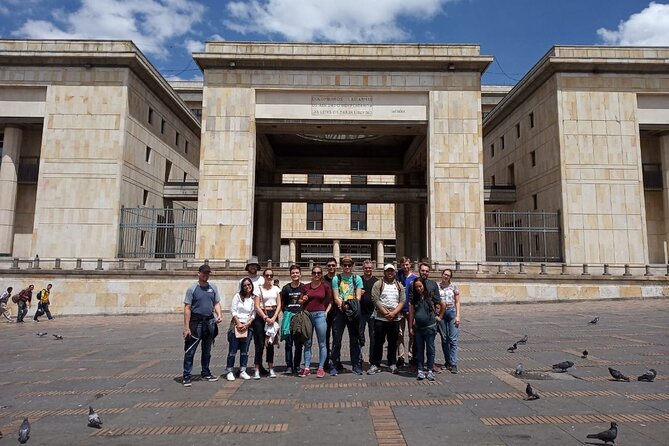
The Palace of Justice is likely to be the most emotionally heavy stop. It was the site of one of the most violent seizures associated with Colombia’s armed conflict. The guide explains what happened there and the consequences that followed.
This is the point where the tour’s history becomes especially concrete. You are looking at a functioning place associated with a national tragedy, not merely hearing the name in a textbook. A good guide needs to explain the event with care, and the strongest comments about Santiago, Leo, and Sergio suggest that the tour team can handle difficult material without turning it into spectacle.
Give yourself room to listen here. The subject involves violence, political power, and lasting consequences, so it may not be the lightest part of your morning. That is also why the tour is not a casual sightseeing walk. You should book it because you want to understand Colombia, not simply collect attractive photographs.
Liévano Palace and the city’s changing politics
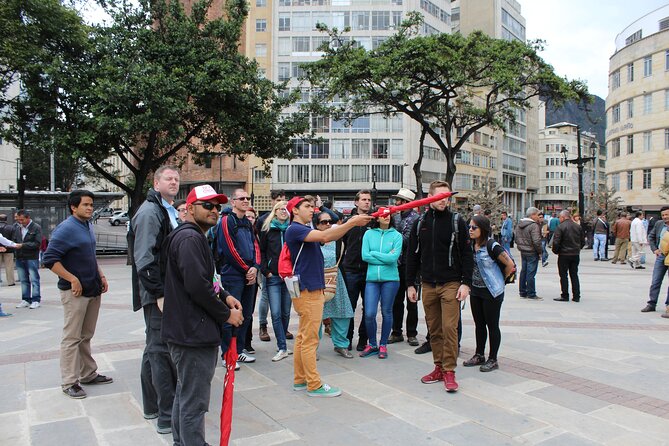
Liévano Palace, home to the Mayor of Bogotá for many years, brings the story back to city government. The guide explains how the building witnessed changes in Bogotá and broader political shifts in Colombia.
This stop helps you connect national conflict with local life. Mayors, city services, public demonstrations, and political change all affect the streets you are walking through. The building is also a reminder that Bogotá’s history is not separate from the country’s larger struggles.
The tour does not present every stop as a grand monument. Some are working government sites with meaning that comes from explanation. That is an advantage if you want substance, though it requires attention. Keep listening even when a building looks ordinary. The guide is doing much of the work by showing why the place matters.
Colegio Mayor San Bartolomé and Plazoleta del Rosario
Colegio Mayor San Bartolomé is one of Colombia’s oldest educational institutions. The guide explains its role in educating political and social leaders.
This is a welcome change of angle. The conflict story is not only about presidents, armed groups, police, or negotiations. Schools also shape national life by educating the people who later influence public policy and social movements. The stop gives you a chance to think about how ideas and leadership develop over time.
The walk then reaches Plazoleta del Rosario, also identified as Rufino Cuervo Square. It offers a quieter pause in the middle of the city, with a monument to the Colombian philologist Rufino Cuervo.
The square is described as a place to rest and admire the monument, but it also works as a breathing space after the heavier political subjects. Do not expect a major conflict site here. Its role is different. It gives the group a calmer setting before the final cultural stop and reminds you that Bogotá’s public spaces contain many layers of history.
Finishing at Teatro Colón
The tour ends at Teatro Colón Bogotá, at Calle 10 number 5-32 in La Candelaria. The theater is presented as an important cultural symbol, with neoclassical architecture and a long role in Bogotá’s cultural life.
Ending here is a smart choice. After three hours of political history, the theater points toward another part of national identity: culture, performance, and public life. The guide discusses the theater’s history and importance rather than treating it as a simple photo stop.
Admission is not included, so you should not assume that the tour price covers entry. The supplied details identify the theater as the endpoint, not as an included interior visit. If you want to go inside, check separately for admission arrangements.
The end point also places you in La Candelaria, a useful area for continuing your day. You can plan your next activity from there, though the tour itself does not include lunch or additional sightseeing.
What the guides do best
The strongest part of this experience is the guide-led storytelling. Santiago receives the most enthusiastic praise for covering Colombia’s history from independence through modern politics while keeping the group interested. His approach is described as thoughtful, unbiased, and thorough.
Leo is also praised for explaining modern Colombian history with clarity and balance. Sergio receives high marks for giving a powerful overview of wartime history and the continuing movement toward peace. Angie is described as friendly and well informed, while Gina is praised for leading a French-language group and using a microphone for a group of 14.
These details matter because the subject is complicated. You need a guide who can explain competing political forces without reducing the country’s history to heroes and villains. The chance to ask questions is a real benefit, especially when a short explanation raises a subject you want to understand better.
Still, your exact guide and language should not be assumed. The experience details identify a certified professional guide, but they do not guarantee a particular person. If you have a strong preference for English, French, or another arrangement, confirm it before the tour.
The real cost of the $13 booking
The price requires careful reading. The $13 per person is described as the suggested tip for a free walking tour. You pay it in advance through the booking platform, and the guide receives the amount minus commission.
That can be good value if you want a serious three-hour introduction to Bogotá’s political history. You are paying about the cost of a modest meal for a guided route through ten central locations, with a certified guide and a free tour map included. There are no attraction admission fees listed for the first nine stops.
But the payment model can feel unclear. One person was surprised to learn that the online charge functioned as a tip and questioned an expected payment of 50,000 Colombian pesos per person. If you are booking for a large group, the total can become significant, so calculate the full amount before confirming.
The description also says lunch and tips are not included, even though the $13 is treated as the suggested guide tip. Read that wording carefully and ask the operator if you are unsure about any additional tipping expectation. You should not feel embarrassed about clarifying the cost before joining.
Group size, pace, and practical planning
The maximum group size is 25 people. That is not enormous, but it is large enough for the guide to use a clear speaking voice and for you to stay close to the group. Gina’s use of a microphone with 14 people suggests that audio support may be used when needed, though it is not promised for every departure.
The itinerary gives each stop 18 minutes. In practice, that means a brisk but organized morning. You will not spend an hour at one location, and you should not expect long breaks between stops. Wear comfortable shoes and keep your attention on the guide while walking between sites.
The tour begins at 10 a.m. at the Gold Museum and finishes at Teatro Colón after about three hours. Public transportation is nearby, and most people can participate. Service animals are allowed.
Free cancellation is available if you cancel at least 24 hours before the local start time. Changes or cancellations made within 24 hours are not accepted for a refund. The experience is often booked around 11 days ahead, so planning early is sensible if your Bogotá schedule is tight.
Who should book this walking tour?
I would choose this tour for a first visit to Bogotá, especially if you want more than colonial architecture and food. It is also a strong choice if you plan to visit other parts of Colombia and want basic political context before you go.
It suits adults, students, families with older children, and anyone who enjoys asking questions. The subject matter is serious, so I would not choose it for a group looking for a light morning of entertainment.
You should also consider your preferred learning style. The route is strongest when you listen, think, and engage with the guide. It is less useful if you want long interior visits, extensive museum time, or a tour centered on architecture.
Should you book it?
Book it if you want a focused, low-cost introduction to Colombia’s conflict, political institutions, and peace efforts. The Gaitán Monument and Palace of Justice give the walk emotional weight, while the government buildings and school add useful context.
Before booking, confirm the tour language and understand that the $13 is a prepaid suggested tip. If you do that, the experience offers strong value. A skilled guide such as Santiago, Leo, Sergio, Angie, or Gina can turn a difficult subject into a clear starting point for understanding Bogotá and the country beyond it.
FAQ
How long does the Colombian Conflict walking tour last?
The tour lasts approximately three hours.
Where does the tour start?
It starts at the Gold Museum, at Carrera 6 number 15-88 in Santa Fe, Bogotá.
What time does the tour begin?
The stated start time is 10 a.m.
Where does the tour finish?
The tour ends at Teatro Colón Bogotá, at Calle 10 number 5-32 in La Candelaria.
How much does the tour cost?
The listed price is $13 per person. This amount is the suggested tip for the guide and is paid in advance.
Is the $13 an admission fee?
No. The amount is described as a suggested guide tip. Admission is free at the first nine listed stops, while Teatro Colón admission is not included.
What is included?
A certified professional guide and a free tour map are included.
Is lunch included?
No. Lunch is not included.
How many people can join the group?
The maximum group size is 25 people.
Can I cancel for a full refund?
Yes, if you cancel at least 24 hours before the experience start time. Cancellations or changes made less than 24 hours in advance are not accepted for a refund.
Just added in Bogota
- Tour of Zipaquirá: Visit the Salt Cathedral and the main squares★ 4.5 · 55 reviews
- Catedral de Sal desde Bogotá en Tren★ 5.0 · 5 reviews
- Zipaquirá and Salt Cathedral Muisca Heritage with Guide – Private★ 4.5 · 23 reviews
- Botanical Garden Bogotá Private Tour (4 Hrs.)★ 5.0 · 13 reviews
- Zipaquira Salt Cathedral★ 4.5 · 12 reviews
- LOCAL GUIDE Zipaquirá PRIVATE TOUR – Salt Cathedral and Salt Oven★ 5.0 · 24 reviews
- Zipaquirá Salt Cathedral: An architectural wonder.★ 4.5 · 24 reviews
- Private Zipaquira Salt Cathedral and Guatavita Lagoon Tour from Bogota★ 4.5 · 44 reviews
Bogotá Tours, compared.
Zipaquirá: Salt Cathedral Group Tour with Pickup
Read our review →
La Candelaria, Monserrate and Museums Bogotá Private City Tour
Read our review →
Shared Tour of the Historic Candelaria in Bogotá
Read our review →
Graffiti Tour: a fascinating walk through a street art City
Read our review →