REVIEW · BOGOTÁ TOURS
Pedaling in Full Color: Urban Art, and Cultural Diversity
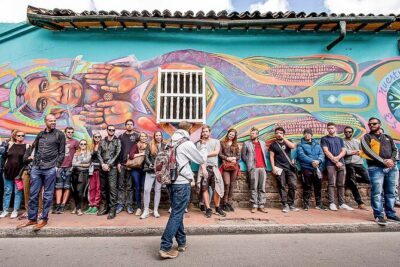
Bogotá tells its story on walls. This three-hour bike tour links murals, political art, Indigenous symbols, and neighborhood projects across the city, with a local street artist guiding the way. I especially like the way the route connects artwork to Colombia’s social struggles, and I like that you cover far more ground by bicycle than you could on foot.
The strongest guides include Diego, Natalia, and Anna, all praised for clear explanations and an easygoing manner. The main drawback is pace: with about 20 stops in three hours, some visits last only five or ten minutes, and the political subject matter may feel heavy if you want a light sightseeing ride.
In This Review
- Key points to know before you book
- Why a bicycle is the right way to see Bogotá’s murals
- The opening murals, from double vision to Indigenous identity
- Water, music, and a statue removed from its pedestal
- Wayuu patterns, birds, and a mural against banking power
- Female artists, social leaders, and Colombia’s road toward peace
- Santa Fe, compassion, and Colombia’s tallest mural
- How much does the $56.18 price really buy?
- Who should book this bike tour?
- Should you book Pedaling in Full Color?
- FAQ
- How long does the bike tour last?
- Where does the tour begin and end?
- What is included in the price?
- Are coffee and tastings included?
- How many people can join the tour?
- Can most people participate?
- Is the tour close to public transportation?
- Can I cancel for a full refund?
Key points to know before you book
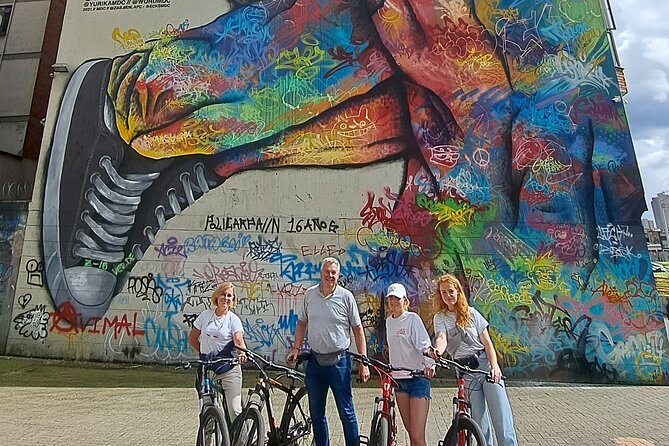
- A local artist leads the ride: Guides such as Diego explain technique, symbolism, politics, and the city’s street art culture from an insider’s point of view.
- Twenty stops create a broad city portrait: You see murals about Indigenous identity, biodiversity, peace, gender, music, inequality, and Colombia’s conflict.
- The bicycle saves time: The route reaches four areas of Bogotá and covers more ground than a walking tour, with rest stops built into the schedule.
- Sunday can be the best day: If your date lines up with Bogotá’s ciclovía, streets open to bicycles can make the ride feel calmer and more local.
- Coffee and tastings cost extra: A 15-minute stop at Café de la Fonda includes an explanation of street art law, but drinks and tastings are not included.
- The group is limited to 15 people: That is small enough for questions, though the experience may feel more personal when fewer people book.
Why a bicycle is the right way to see Bogotá’s murals
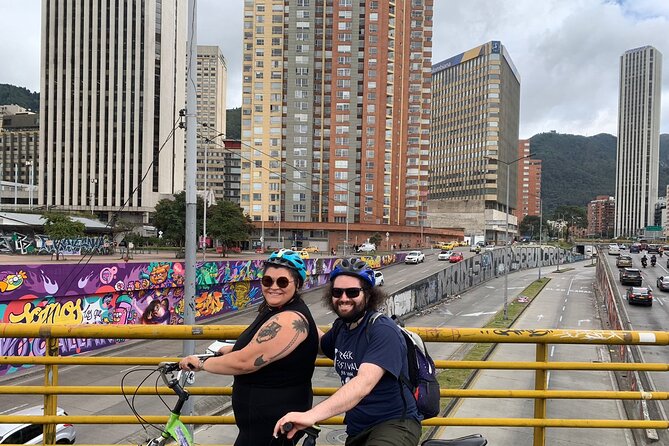
Bogotá’s street art is scattered across several districts. Walking between all these walls would take much longer, while a car would leave you disconnected from the pavement, storefronts, and changing neighborhoods. A bicycle gives you a useful middle ground.
You begin at Cl 26b #4-13, where the guide welcomes the group, explains the route’s central idea, and covers basic bike security. The story is clear from the start: street art is not only decoration. It can preserve memory, challenge prejudice, honor communities, and imagine a better future.
The bicycles, helmets, and rain ponchos are included. That last item matters in Bogotá, where weather can change quickly. You should still wear comfortable clothes and shoes, since the ride includes repeated stops, short walks, and time standing beside busy streets.
This is not a race. The route includes pauses for people who need a rest, and the guide stops often to explain individual works. Still, the schedule is active. You will cycle between neighborhoods, listen while standing near murals, and get back on the bike many times.
More things to do in Bogota:
- Bogotá Bike Tour
★ 5.0 · 3,329 reviews - Bogota: Bicycle City Tour
★ 4.9 · 2,156 reviews - Zipaquirá: Salt Cathedral Group Tour with Pickup
★ 4.8 · 1,606 reviews
The opening murals, from double vision to Indigenous identity
The first artwork at Casa Genoveva sets a thoughtful tone. It shows a child with a duplicated face, painted in a hyper-realistic spray style that creates the feeling of double vision. The image plays with innocence and the urban world around it.
That opening is useful because it asks you to question your first reaction to graffiti. The guide connects the image to prejudice, minority communities, and the way people make quick judgments about public art. You are not simply told that a mural is beautiful. You are asked what it is saying and who gets to shape a city’s public image.
At Chorro de Quevedo, the murals turn toward Indigenous and Afro-Colombian cultures. The walls celebrate identities often pushed aside in official versions of national history. The company behind the tour has also commissioned local artists to paint some of these walls, giving the stop a direct link to Bogotá’s working art scene.
The next stop, at Plaza de Mercado La Concordia, brings Colombian farming culture into view. A market facade has been transformed with colorful images of farmers. It is a small stop, but it helps connect city life with the people who grow and supply the food sold in urban markets.
At Skal Bogotá, you see a large work by Bastardilla, an internationally known artist. The unusual technique uses brooms and mops rather than standard brushes to portray a child launching a shooting star with a slingshot. The guide leaves you with a good question: what wishes might the child be sending into the sky?
Water, music, and a statue removed from its pedestal
The mural at Edificio Venado de Oro focuses on the frailejón and the páramo. These high-altitude wetlands are important to Colombia’s water supply and biodiversity. Even if you know little about Colombian ecology, the painting gives the subject a human scale and makes the connection between art, water, and daily life easier to grasp.
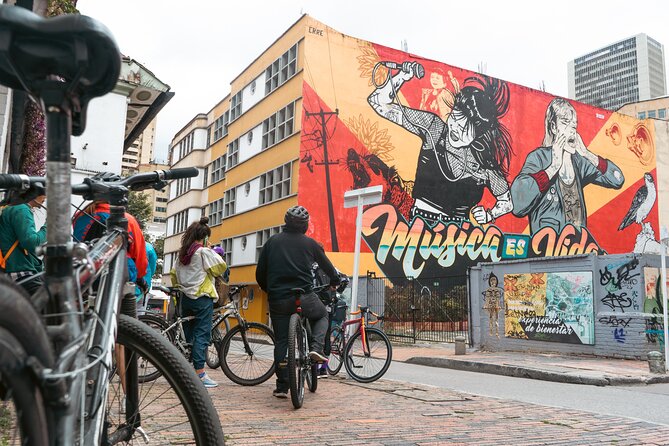
At a nearby parking area, La Música es Vida pays tribute to Colombian female singers. The giant stencil was commissioned by a major music festival, and it shifts the mood from environmental concerns to popular culture and women’s place in the country’s musical story.
Plazoleta del Rosario offers one of the tour’s most direct conversations about colonialism. An empty pedestal marks the place where the Misak Indigenous nation removed a conquistador statue. The absence is the artwork here. It opens a discussion about political tension, public memory, and who deserves honor in a modern city.
From this square, you can also see the city’s highest vandal graffiti on a nearby skyscraper. That sight helps explain the scale and risk involved in Bogotá’s street art scene. Some works are carefully commissioned, while others appear in places where permission is uncertain or absent.
On Seventh Pedestrian Avenue, paste-ups carry political and social messages. These are smaller, temporary works rather than giant painted walls. Look closely for hidden pictures and quiet references. This section rewards attention, and your guide’s interpretation helps you notice details that are easy to miss while riding past.
Wayuu patterns, birds, and a mural against banking power
At Panamericana Centro, a stencil portrays a Wayuu Indigenous woman against a background based on Wayuu weaving. The design links a human portrait with a traditional craft. It is a good example of how Bogotá’s urban art can bring regional cultures into the center of the capital.
Plaza de Las Nieves features a giant mural of colorful birds in flight. The birds represent the biodiversity of Colombia and Bogotá. After the more confrontational political works, this painting offers a lighter pause without losing the tour’s wider point: cultural and natural variety are major parts of the country’s identity.
The mural at Bancolombia Mercantil takes a sharper turn. It challenges the influence of the banking industry and shows how public art can question powerful institutions. You may not agree with every political position presented on the route, but that is part of its value. The tour gives you a way to understand what local artists choose to criticize.
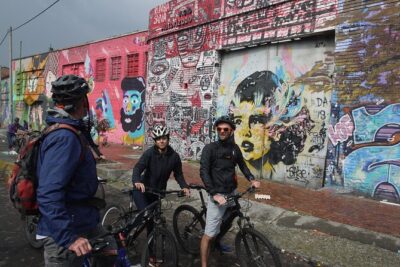
Near Plaza de Toros Santamaria, a street close to the bullring carries around 20 murals by Colombian and international artists. Some oppose bullfighting directly. Because the works are gathered in one area, this is one of the best places to compare different styles and messages without traveling far between walls.
The subject is not neutral, and the guide’s job is to explain the arguments rather than turn the stop into a lecture. You get art, local debate, and a clear sense that Bogotá’s walls are active public spaces.
A completely different kind of day:
- La Candelaria, Monserrate and Museums Bogotá Private City Tour
★ 5.0 · 1,567 reviews - Shared Tour of the Historic Candelaria in Bogotá
★ 5.0 · 1,551 reviews - Bogotá: Guided La Candelaria Walking Tour
★ 4.8 · 1,229 reviews - Graffiti Tour: a fascinating walk through a street art City
★ 5.0 · 1,074 reviews
Female artists, social leaders, and Colombia’s road toward peace
In Barrio Armenia, illustrations by female artists share walls with community garden projects. This stop broadens the tour’s focus beyond large downtown murals. You see how art can work at a neighborhood level, where gardens, local participation, and painted walls help shape a shared environment.
Casa Kilele brings the history of Colombia’s conflict into sharper focus. A mural honors social leaders who have been killed, and the guide provides storytelling about their lives and the pressures faced by people working for their communities.
This is one of the points where the tour becomes emotionally serious. If you prefer sightseeing without difficult subjects, take note. If you want to understand why street art matters so much in Bogotá, this section is central.
At the Centro de Memoria, Paz y Reconciliación, a mosaic uses corn seeds to represent the journey toward peace. The image connects agriculture, memory, and renewal. It is a quieter work than some of the political paste-ups, but its message carries more weight because it sits within a city dedicated to remembering violence and pursuing reconciliation.
The tour then pauses for about 15 minutes at Café de la Fonda. You learn about the decriminalization of street art and the decree that supports it, while visiting a local coffee and beer factory. Coffee, other tastings, and tips are not included, so bring some extra money if you want to sample what is offered.
This break is well placed. You have time to rest, ask questions, and let the earlier stories settle before returning to the bicycle.
Santa Fe, compassion, and Colombia’s tallest mural
In Santa Fe, a mural uses a monkey and a cumbia instrument to symbolize peace and the post-conflict period. The image shows how artists can treat serious subjects through playful, imaginative characters rather than solemn scenes alone.
At Cl. 26 #13-69, the route reaches one of Bogotá’s most recognizable murals. It is based on a photograph of two homeless people showing tenderness toward each other during difficult circumstances. Painted across a ten-floor wall, the work makes compassion the main subject.
This is a useful reminder that the tour is not only about artistic technique. It also asks you to look at people who are often ignored in city centers. The scale of the wall forces you to stop and consider the dignity of the individuals shown.
The final stop at Spotty Bogotá features Colombia’s tallest mural. Children from different parts of the country and different cultural backgrounds appear in a work that presents cultural and natural diversity as Colombia’s greatest strength and a tool for a better future.
Ending with children gives the route a hopeful note. After murals about colonialism, inequality, conflict, industry, and loss, the last image looks forward. It does not erase the hard subjects covered earlier, but it suggests why artists keep working in public spaces.
How much does the $56.18 price really buy?
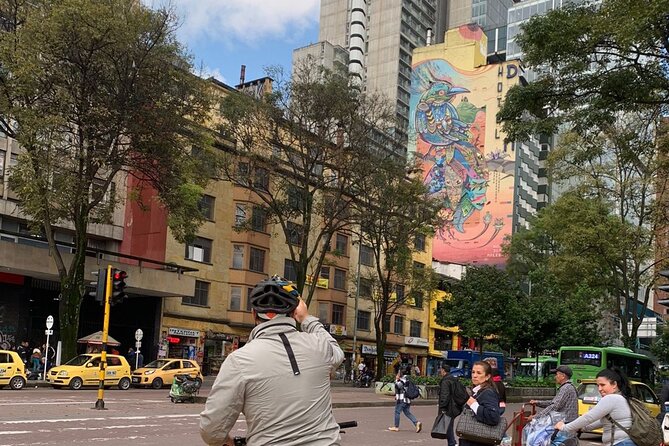
At $56.18 per person, this is not the cheapest way to see Bogotá. But the price includes the bicycle, helmet, rain poncho, a local artist guide, and a route that reaches many areas in roughly three hours.
You are also paying for interpretation. A self-guided ride might show you the same walls, but it would not necessarily explain Bastardilla’s unusual tools, the Misak statue removal, the legal status of street art, or the links between murals and Colombia’s conflict.
The value is strongest if you are curious about politics, culture, and public art. It is less compelling if you want a relaxed ride with only attractive images and minimal commentary. The route covers a lot, but the short stop times mean you should not expect long periods for photography at every wall.
The maximum group size is 15. That keeps the tour manageable, and the guides have been praised for answering questions and creating a friendly atmosphere. Private rides are also possible based on the experience offered by Capital Graffiti Tours, though the listed price is for the standard booking.
Who should book this bike tour?
I would recommend it to first-time visitors who want a quick orientation to Bogotá beyond the standard historic sights. It is also a strong choice for anyone interested in mural technique, Indigenous representation, social justice, music, or Colombia’s peace process.
The tour suits people with moderate cycling comfort. You do not need to be a serious cyclist, but you should be ready for a three-hour outing with frequent starts and stops. The guides include rest breaks, and most people can participate, but the experience is still more physical than a walking lecture or bus tour.
Sunday deserves special consideration. Bogotá’s ciclovía opens streets to bicycles, and riding during that time can make the city feel more connected to local life. You will need to select a Sunday departure for that possibility, and the information provided does not guarantee that every Sunday tour takes place during the full ciclovía period.
The tour is near public transportation, begins and ends at Cl 26b #4-13, and includes free cancellation up to 24 hours before the start time. Confirmation is sent within 48 hours, subject to availability. The minimum number of bookings must be met, or you will be offered another date or experience, or a full refund.
Should you book Pedaling in Full Color?
Book this tour if you want Bogotá explained through the people who paint it. The strongest feature is the mix of art and context: one wall celebrates biodiversity, another questions financial power, another remembers social leaders, and another imagines peace through children.
Skip it if your main goal is a slow, photo-focused mural walk or if political and historical subjects are not your interest. For everyone else, the bicycle, the broad route, the included equipment, and guides such as Diego, Natalia, and Anna make this a useful and unusually human introduction to Bogotá.
FAQ
How long does the bike tour last?
The experience lasts approximately three hours. It includes cycling between many stops, short explanations, and a 15-minute break at Café de la Fonda.
Where does the tour begin and end?
It begins at Cl 26b #4-13 in Bogotá and ends back at the same meeting point.
What is included in the price?
The price includes use of a bicycle, a helmet, and a rain poncho.
Are coffee and tastings included?
No. Coffee, other tastings, and tips are not included. The tour does include a 15-minute stop at Café de la Fonda.
How many people can join the tour?
The activity has a maximum of 15 participants.
Can most people participate?
The provided information says most people can participate. The experience is still a bicycle tour lasting about three hours, with repeated stops and movement between neighborhoods.
Is the tour close to public transportation?
Yes. The meeting point is near public transportation.
Can I cancel for a full refund?
Yes, if you cancel at least 24 hours before the experience’s start time. Cancellations or changes made less than 24 hours before the start time are not accepted for a refund.
Just added in Bogota
- Tour of Zipaquirá: Visit the Salt Cathedral and the main squares★ 4.5 · 55 reviews
- Catedral de Sal desde Bogotá en Tren★ 5.0 · 5 reviews
- Zipaquirá and Salt Cathedral Muisca Heritage with Guide – Private★ 4.5 · 23 reviews
- Botanical Garden Bogotá Private Tour (4 Hrs.)★ 5.0 · 13 reviews
- Zipaquira Salt Cathedral★ 4.5 · 12 reviews
- LOCAL GUIDE Zipaquirá PRIVATE TOUR – Salt Cathedral and Salt Oven★ 5.0 · 24 reviews
- Zipaquirá Salt Cathedral: An architectural wonder.★ 4.5 · 24 reviews
- Private Zipaquira Salt Cathedral and Guatavita Lagoon Tour from Bogota★ 4.5 · 44 reviews
Bogotá Tours, compared.
Zipaquirá: Salt Cathedral Group Tour with Pickup
Read our review →
La Candelaria, Monserrate and Museums Bogotá Private City Tour
Read our review →
Shared Tour of the Historic Candelaria in Bogotá
Read our review →
Graffiti Tour: a fascinating walk through a street art City
Read our review →