
REVIEW · MEDELLÍN TOURS
We Don’t Talk About Pablo: Untold Narcos Story and Transformation
Medellín’s past is more complicated than television suggests. This four-hour private tour uses the story of Pablo Escobar as a starting point, then moves toward the people, neighborhoods, victims, and public changes that shaped modern Colombia. I like the victim-centered narrative and the smart use of Medellín’s cable car and tram network to explain how the city fits together. I also like that the route includes the Museo Casa de la Memoria, rather than treating Escobar as a folk hero.
The main drawback is simple: if you expect a greatest-hits tour of Escobar’s houses, grave, prison, and other personal sites, this may feel restrained. Its purpose is education and context, not a parade of cartel landmarks. At $95 per person, the price is fair for private guiding, transport, transit tickets, snacks, and museum admission, but it may feel high if you only want a quick city drive.
In This Review
- Key points to know before booking
- Why this is not a standard Escobar tour
- Starting in Medellín: the city becomes part of the story
- Riding the cable car toward Comuna 8
- Museo Casa de la Memoria: the emotional center
- The tram ride and the city’s changing connections
- Parque Memorial Inflexion and the final two hours
- What the $95 price really covers
- The guides make or break the experience
- What could disappoint you
- Who should book this Medellín tour?
- Final verdict: a thoughtful choice for context
- FAQ
- How long does We Don’t Talk About Pablo last?
- How much does the tour cost?
- Is hotel pickup included?
- What type of transportation does the tour use?
- Are cable car and tram tickets included?
- Is museum admission included?
- Is the tour offered in English?
- Is this a private tour?
- What should I wear?
Key points to know before booking
- The story goes beyond Escobar: You learn how narcotrafficking affected Colombian society, politics, neighborhoods, and the environment.
- Cable cars are part of the lesson: The ride toward Comuna 8 helps you see Medellín’s steep geography and the role of public transport in the city’s social renewal.
- The Memory Museum gives victims a voice: Interactive exhibits add perspectives that a crime-focused tour often leaves out.
- This is a private experience: Your group participates on its own, with a bilingual English and Spanish guide.
- The route involves walking and public transit: Wear comfortable clothes and shoes, and expect a moving four hours rather than a sit-back bus ride.
- Book for context, not celebrity intrigue: The focus is Colombia’s transformation, with Escobar’s life and death placed inside a much larger story.
Why this is not a standard Escobar tour
Medellín has no shortage of tours built around Pablo Escobar. Many focus on his former home, burial place, the building where he died, or La Catedral, the prison he arranged for himself. Those places can satisfy curiosity, but they can also reduce a painful period of Colombian history to a collection of photo stops.
This experience takes a different line. It explains how narcotrafficking emerged, how violence spread through Colombian society, and how the damage still shapes public life. Escobar is important, but he is not presented as a leader or a charming outlaw. The stated goal is to give you a fuller account of Colombia and a view of the country as it is now.
That distinction matters. If you watched Narcos and want to separate drama from fact, the tour can help. If you want a fast tour devoted only to Escobar’s personal story, you may find the museum and social history take up more time than expected.
The strongest guides add depth through personal experience. Carlos, Juan Carlos, Juan, Wilson, Luis Ospina, Hector, Nicolas, and John William are among the guides praised for clear storytelling, patience, and broad knowledge of Medellín and Colombia. One guide had worked as a police officer during the Escobar era, while another connected the period to present-day Colombian politics. Guide assignments can change, so do not book on the assumption that you will receive a particular person.
More things to do in Medellin:
- Medellin: Comuna 13 Graffiti Tour, Cable Car & Street Food
★ 4.8 · 9,046 reviews - Comuna 13 Graffiti Tour with Street Food
★ 5.0 · 7,503 reviews - Museo Pablo Escobar
★ 5.0 · 7,242 reviews
Starting in Medellín: the city becomes part of the story
Your experience begins with hotel pickup in an air-conditioned minivan. The tour takes place mainly in the center and east of Medellín, where the guide uses streets, neighborhoods, and transit routes to explain the city’s geography and its past.
This opening hour is not just filler before the main attractions. Medellín is built in and around a narrow valley, with steep residential areas climbing the hillsides. Seeing the city from different points helps explain why access, housing, policing, and transport have mattered so much. The geography also helps you understand why some communities experienced violence and isolation in very different ways from wealthier districts.
The transport arrangement deserves a little attention. Round-trip transportation is included, and the tour begins with hotel pickup in a minivan. The main route then uses Medellín’s public transportation system, including the cable car and tram. The inclusion of transit tickets saves you the trouble of handling fares during a tightly timed private outing.
Guides often add useful details along the way. Past versions of similar outings included extra stops connected with Escobar, neighborhood viewpoints, local food, and, in some cases, La Catedral for an additional fee. Those additions should not be treated as guaranteed parts of this current route. The advertised experience now centers on Comuna 8, the Memory Museum, and Parque Memorial Inflexion.
Riding the cable car toward Comuna 8
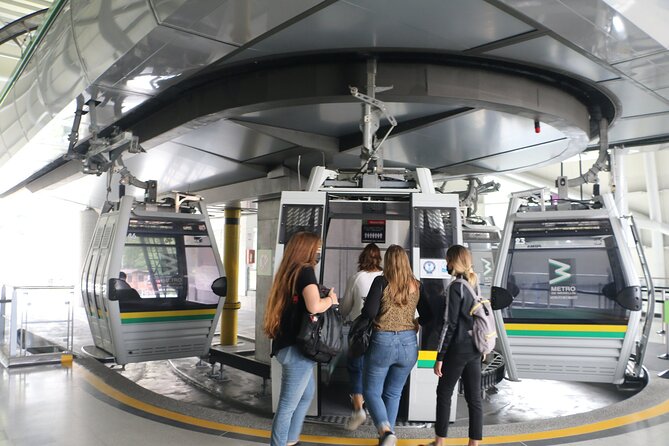
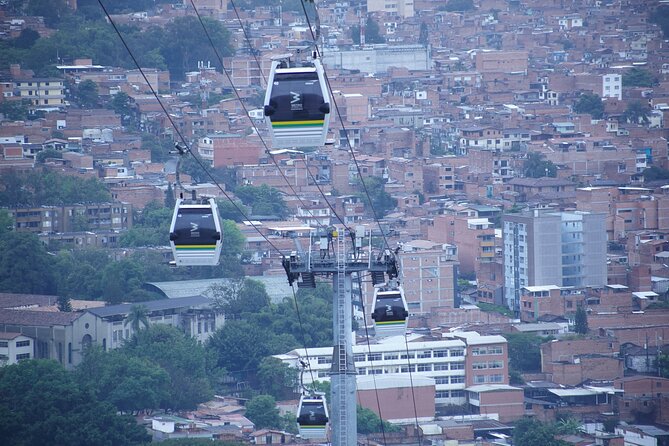
The cable car is one of the most memorable parts of the morning, but it is also one of the most useful. As you rise above Medellín, you get a clear sense of the city’s steep slopes and dense neighborhoods. The ride turns a map lesson into something you can see with your own eyes.
The cable car is not included merely for a pleasant view. Medellín’s public transport system is closely tied to the city’s efforts to connect hillside communities with jobs, schools, and services. Your guide can use the journey to discuss how transport became part of a wider program of social change.
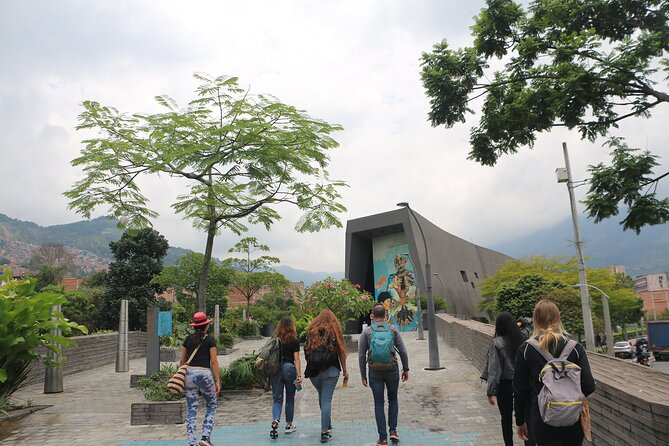
The route reaches Comuna 8, an area linked in the tour’s story to the pressures created by violence, poverty, and narcotrafficking. You will walk through several stops rather than rush through one famous address. That approach gives the area more dignity and avoids turning a working neighborhood into a crime set.
You should be ready for a tour that keeps moving. There is walking between stops, time on the cable car, and later a tram ride. Comfortable shoes are not a minor suggestion here. Comfortable clothing will also help, especially if you prefer to explore without worrying about what you are wearing.
Museo Casa de la Memoria: the emotional center
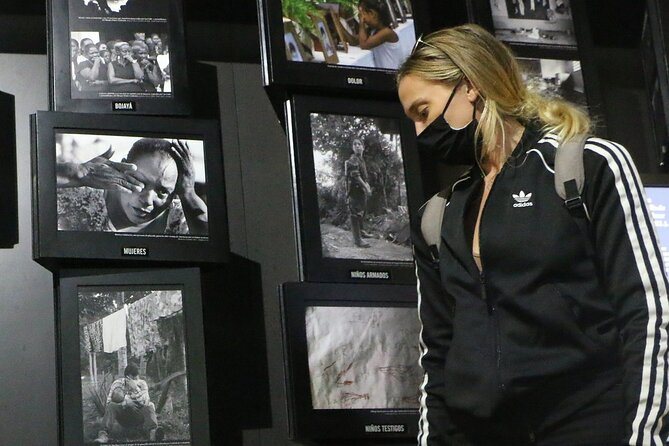
The Museo Casa de la Memoria is the clearest sign that this tour is not built around cartel mythology. The museum examines Colombia’s armed conflict and social violence through interactive exhibits and multiple personal viewpoints. Its work helped shape the tour’s research and presentation.
Allow about an hour here. The value is not in collecting more facts about Escobar. It is in seeing how narcotrafficking affected families, communities, public institutions, and ordinary people who had no control over the forces surrounding them.
A museum visit can also correct the imbalance created by popular television. Screen dramas often give major criminals the most dialogue, glamour, and screen time. A place devoted to memory shifts attention to loss, survival, and the long work of rebuilding trust.
I would give this stop your full attention. It may be the most serious section of the tour, and the material can be difficult. The experience is better suited to someone willing to listen than to someone looking for nonstop entertainment.
The museum also gives structure to what you have seen in the city. After traveling through Medellín and Comuna 8, you can connect physical places with personal stories and social consequences. That combination makes the visit more useful than a museum stop taken in isolation.
A completely different kind of day:
- Guatapé Tour: Piedra del Peñol with Boat Tour, Breakfast, Lunch
★ 5.0 · 7,035 reviews - Medellín: The Real Pablo Escobar Tour
★ 4.8 · 3,205 reviews - Day Trip To Guatapé with ,Breakfast, Lunch and Boat Ride
★ 5.0 · 2,996 reviews - Comuna 13 Graffitour knows the urban art district of Medellín
★ 5.0 · 2,856 reviews
The tram ride and the city’s changing connections
After Comuna 8, the tram takes you toward the museum area and helps show another side of Medellín’s public transport network. The tram is a practical part of the route, but it also supports the larger theme: public infrastructure can change how neighborhoods relate to the rest of a city.
You are not simply being driven from one attraction to the next. The cable car and tram let you experience the systems that residents use. That makes the tour feel more grounded in daily Medellín than a private vehicle route with no public contact.
The tradeoff is time. Public transport can be slower and less predictable than staying in a minivan. On the other hand, it gives the tour a stronger connection to the city and makes the discussion of social renewal easier to understand.
Parque Memorial Inflexion and the final two hours
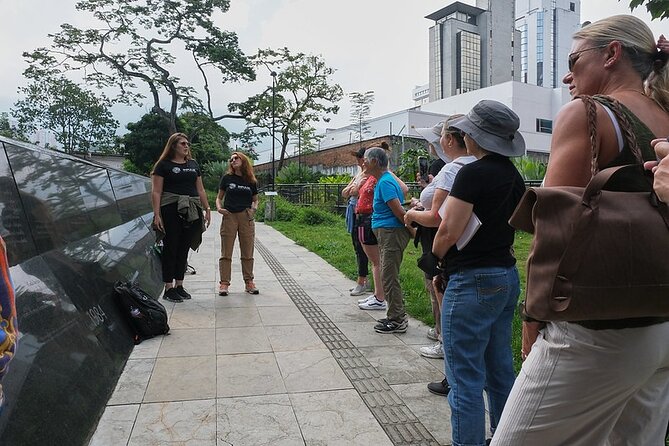
The final section includes Parque Memorial Inflexion and other meaningful stops from El Pinal to Ayacucho. The park is a memorial to victims of the narco wars, and its role is to remember lives lost rather than celebrate the people responsible.
Expect about two hours for this part of the experience. You will walk through neighborhoods and hear different accounts of Medellín’s transformation. The guide’s job is to connect the visible city with the forces that changed it, including violence, public policy, community effort, and improved access.
This is where the tour’s title makes the most sense. The point is not to avoid talking about Escobar. The point is to refuse to let him control the entire story. His crimes form one part of the explanation, while the courage and persistence of Colombian communities receive equal attention.
You may also notice a difference between this route and older Escobar-focused excursions. Some previous outings included the exterior of the house where Escobar was killed, his grave, the homes he built, old aircraft, a favorite bar, or La Catedral. Those stops created vivid memories for some people, but they are not the center of the route described here. If you specifically want those places, confirm the day’s stops before booking.
What the $95 price really covers
At $95 per person, this is not the cheapest way to hear about Escobar. You are paying for a private, bilingual experience lasting about four hours, not a basic transfer with a few facts added.
The price includes:
- English and Spanish guiding
- Hotel pickup and drop-off
- Cable car and tram tickets
- Entry tickets
- Snacks
The transport wording deserves care. The experience begins with an air-conditioned minivan, while the sightseeing route uses public transportation. That mix is useful: you get a comfortable start and finish, then use the city’s own cable car and tram system as part of the tour.
The private format is valuable if you want to ask questions. Guides have been praised for answering detailed questions, adjusting the schedule in some cases, and adding context about current Colombian politics and Medellín’s social changes. A private group can also make a difficult subject feel less rushed.
Still, price matters. One past participant considered the tour expensive for a ride around the city. That criticism is fair if your priority is sightseeing alone. The tour earns its price through interpretation, museum access, private attention, and the way the stops fit together. It is less convincing as a simple collection of famous Escobar locations.
Tips, unspecified food and drinks, and personal expenses are not included. Optional gratuities are also separate.
The guides make or break the experience
A good guide is essential for this subject. Facts about dates and places are not enough. You need someone who can explain the difference between describing Escobar’s influence and excusing his crimes.
The strongest guide accounts point to several qualities. Carlos was praised for combining the Escobar story with Medellín’s wider history and, in one case, for sharing personal experience from his time as a police officer during that era. Juan Carlos was remembered for making the tour feel like a friend showing you around the city while still covering difficult political material.
Other guides, including Juan, Wilson, Luis Ospina, Hector, Nicolas, and John William, were praised for clear explanations, good storytelling, and a neutral presentation. One guide helped add an extra stop at Comuna 13, while others took groups to additional sites or local food places. These examples show the value of a flexible private guide, but they should not be taken as promises of specific extras.
The experience seems best when you ask questions. Ask how a particular neighborhood changed, how public transport affected access, or how Colombians remember the period today. The tour is designed for conversation, not just photographs.
What could disappoint you
The biggest risk is a mismatch between expectations and the title. The name draws attention to Pablo Escobar, but the content is really a study of Colombia’s narco era and Medellín’s response to it.
You may see fewer personal Escobar sites than expected. One past participant was disappointed not to visit the prison Escobar built for himself. Another felt there was not much to see at a house viewed from a distance, a deteriorating building, and a cemetery without prominent headstones or photographs. Those comments point to a useful truth: physical Escobar sites are often modest, changed, private, or emotionally less dramatic than television suggests.
The tour can also feel heavy. The museum and memorial stops ask you to think about victims and long-term damage. That seriousness is the reason to choose this experience, but it may not suit anyone looking for a light afternoon outing.
Finally, the route is active. You will use public transit and walk through several areas. Most people can participate, but the tour is not designed as a fully seated vehicle excursion.
Who should book this Medellín tour?
I would choose it if you want to understand Medellín rather than simply photograph places associated with a notorious criminal. It is especially suitable for first-time visitors who want an early orientation to the city’s geography, transport system, social changes, and recent past.
It also suits anyone who has watched Narcos and wants a more careful account. The guide can help place the show’s familiar names and events within the experience of Colombian communities, police, public institutions, and victims.
Families with older children may find the subject educational, but the material is serious and should be approached with care. The private format lets you control the pace and ask questions without holding up a large group.
I would skip it if your only goal is La Catedral, Escobar’s grave, his former home, or the location where he died. Those places have appeared on earlier versions of similar tours, but the current route emphasizes Comuna 8, the Memory Museum, Parque Memorial Inflexion, and the broader story of transformation.
Book at least a day before your intended date if possible. The experience is often reserved well ahead, with an average booking time of about 124 days. Confirmation is sent within 48 hours, subject to availability. Free cancellation is available up to 24 hours before the start time, while later cancellations and changes are not accepted.
Final verdict: a thoughtful choice for context
I recommend this tour to you if you want a serious, human account of Medellín’s past and present. The cable car, tram, neighborhood walks, memorial, and museum work together well, and the private bilingual guide adds value that a self-guided search for Escobar locations cannot easily match.
I would not recommend it as a pure crime-tour checklist. Its best feature is also its defining limit: it refuses to make Pablo Escobar the hero, main attraction, or sole explanation for Colombia. At $95, you are buying a carefully framed lesson in violence, memory, public transport, and renewal. For that purpose, it is a strong and worthwhile half-day.
FAQ
How long does We Don’t Talk About Pablo last?
The experience lasts approximately four hours.
How much does the tour cost?
The listed price is $95 per person.
Is hotel pickup included?
Yes. Round-trip transportation is included, with pickup and drop-off at your Medellín accommodation.
What type of transportation does the tour use?
The experience begins in an air-conditioned minivan and also uses Medellín’s public transportation system, including the cable car and tram.
Are cable car and tram tickets included?
Yes. Cable car and tram tickets are included in the price.
Is museum admission included?
Yes. Entry tickets, including admission connected with the Museo Casa de la Memoria portion of the tour, are included.
Is the tour offered in English?
Yes. The guide is bilingual in English and Spanish.
Is this a private tour?
Yes. Only your group participates in the activity.
What should I wear?
Comfortable clothes and shoes are recommended because the tour includes walking and public transportation.
Just added in Medellin
- Walking Tour, Cable Car & Fruit Tasting★ 5.0 · 1 review
- Pablo Escobar and Griselda Blanco Tour★ 5.0 · 1 review
- City tour, Commune 13, Metro Cable, Botero Park and more. Private★ 5.0 · 34 reviews
- comuna 13 tour★ 3.5 · 6 reviews
- 3 days private mountain tour, nature and culture near Medellin★ 5.0 · 22 reviews
- commune thirteen transformation story★ 4.5 · 14 reviews
- fruits tour★ 5.0 · 2 reviews
- Paragliding and hammocks zipline over waterfalls private tour★ 5.0 · 6 reviews
Medellín Tours, compared.

Comuna 13 Graffiti Tour, Cable Car & Street Food
Read our review →

Guatapé Tour: Piedra del Peñol with Boat Tour, Breakfast, Lunch
Read our review →
Day Trip To Guatapé with ,Breakfast, Lunch and Boat Ride
Read our review →
Comuna 13 Graffitour knows the urban art district of Medellín
Read our review →
Tour to Guatape, Piedra del Peñol, lunch, snacks boat trip
Read our review →
Half Day Bike Tour in Medellin – Local snack, Coffee or Beer
Read our review →