
REVIEW · CYCLING TOURS
Tour Medellin by bike
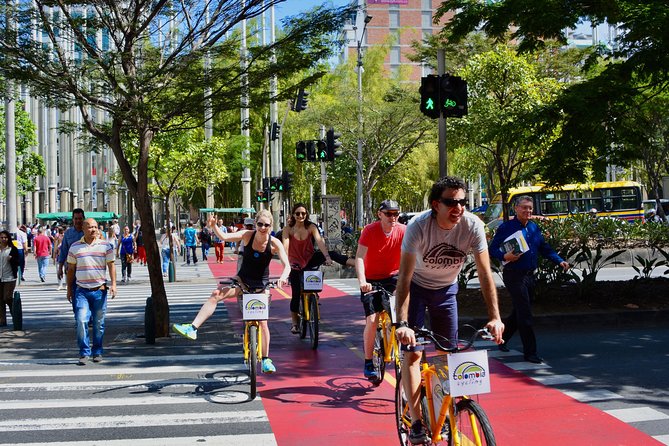
See Medellín at street level. This 2 to 3 hour bike tour links churches, public squares, cycling landmarks, and shopping streets in one lively city route. I like the mix of architecture and local stories, especially the French Gothic Church of Perpetual Help and Botero Plaza. I also like that your bicycle, snacks, and a beer are included.
The main consideration is pace. You will cover several parts of central Medellín in a short time, so this suits riders who want a broad introduction rather than long visits at each stop. The city route also includes traffic and urban streets, so you should feel comfortable riding in a city setting.
In This Review
- Key points at a glance
- Why this bike ride makes sense in Medellín
- Starting at the Museum of Modern Art
- The Church of Perpetual Help and a changing neighborhood
- Botero Plaza and 23 bronze sculptures
- Cisneros Square and the old Guayaquil quarter
- La Alpujarra and the Monument to the Race
- A tribute to Colombia’s cycling champions
- A glimpse of tram-era Medellín and Gardel
- Young designers among old houses
- Snacks, beer, bicycles, and the overall value
- Who should book this ride
- Booking and cancellation details
- Should you book Tour Medellín by Bike?
- FAQ
- Where does the Medellín bike tour start?
- What time does the tour begin?
- How long does the experience last?
- Is the tour offered in English?
- What is included in the price?
- Where does the tour finish?
Key points at a glance
- French Gothic church and creative district: Begin with the Church of Perpetual Help, known locally as the church of mirrors, then learn how its neighborhood is changing.
- Botero’s open-air sculptures: See the 23 sculptures donated by Fernando Botero in the plaza that carries his name.
- Medellín’s public squares explained: Visit Cisneros Square and the José María Córdova Administrative Center, where the city and department governments work.
- A route with cycling connections: The Martín Emilio Cochise Rodríguez stop honors one of Colombia’s great cyclists and other national champions.
- Old Medellín and modern shopping: The ride shifts from tango-era memories and Gardel stories to a stylish commercial district lined with traditional houses and new design.
- Small-group format: The maximum group size is 15, with an English-speaking tour and a 9:00 a.m. start from the Medellín Museum of Modern Art.
Why this bike ride makes sense in Medellín
Medellín is a city best understood through movement. Its districts change quickly from old civic buildings to renovated public spaces, from churches to art installations, and from historic streets to modern design shops. A bicycle lets you connect these areas without spending the morning waiting for cars or walking long distances between unrelated sights.
I like the way this route uses the city itself as the subject. You are not simply stopping for photographs. The guide explains how downtown Medellín changed, how public space was recovered, how Botero shaped the city’s art identity, and how cycling fits into Colombian culture.
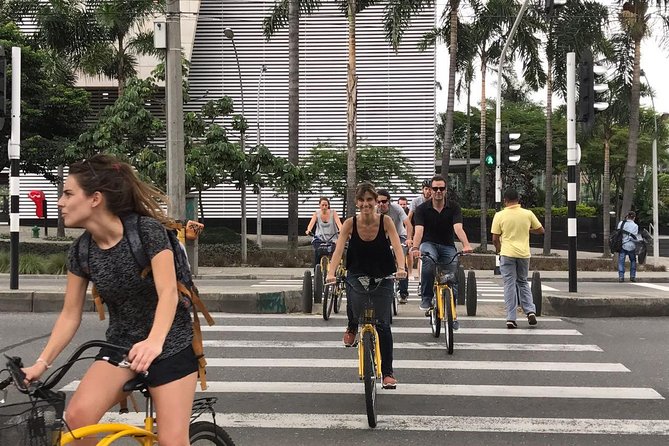
The tour costs $50 per person. That is not the cheapest way to sightsee in Medellín, but the price includes the bicycle, snacks, and an alcoholic beverage, specifically beer. For a short guided ride with a maximum of 15 people, the value is reasonable if you want orientation and local context without arranging transport between each stop.
This is not a road-cycling excursion into the mountains. The longer Colombia Cycling trips connected with the same company have included serious road rides, support vehicles, quality bicycles, snacks, drinks, and guides such as Tomas, Marcela, Juan, and Victor. This Medellín activity is much shorter and city-based, so do not book it expecting a demanding training ride or a countryside route.
More Bike Tours in Medellin
- Half Day Bike Tour in Medellin – Local snack, Coffee or Beer
★ 5.0 · 2,509 reviews - Electric Bike City Tour Medellin With Colombian Coffee and Snack
★ 5.0 · 1,275 reviews - Medellín Essential: history & local life on E-bike
★ 5.0 · 459 reviews
Starting at the Museum of Modern Art
The meeting point is the Medellín Museum of Modern Art, at Cra 44 #19a-100 in El Poblado. The ride begins at 9:00 a.m. and returns to this same point.
That start is useful for anyone staying in El Poblado because you do not need to cross the city before breakfast. It also gives the tour a clear beginning in one of Medellín’s best-known cultural areas before the route moves toward central civic and historic districts.
Your ticket is mobile, and the tour is offered in English. The group can include up to 15 people. That is large enough for a social ride but still small enough for a guide to keep the group together and explain what you are seeing.
The tour lasts approximately two to three hours. Since the itinerary includes several stops, expect brief visits rather than long museum-style talks. Wear clothes suitable for riding, bring water even though refreshments are included, and arrive ready to start on time.
The Church of Perpetual Help and a changing neighborhood
The first major stop is the Church of Perpetual Help, an architectural reference in Medellín. Its design draws from French Gothic style, with a facade shaped by the arched framing around the main entrance, a central rose window, and two tall towers.
The upper portion includes glass and copper work. This has given the building its local nickname, the church of mirrors. It is the kind of detail that can pass unnoticed if you rush by in a taxi, but a guide can point out the features that give the church its unusual character.
The stop is also about urban change. The surrounding neighborhood is being reshaped as the Perpetual Socorro Creative District. That project brings together companies, entrepreneurs, groups, and people working on new ideas for the area.
I like this part of the tour because it avoids presenting Medellín as only old or only new. You see a historic religious building while hearing about a current effort to reuse and rethink the neighborhood around it. The drawback is that a developing district may feel less polished than the finished public spaces later in the ride. That is part of the point, but it may not match expectations if you want a fully completed attraction.
Botero Plaza and 23 bronze sculptures
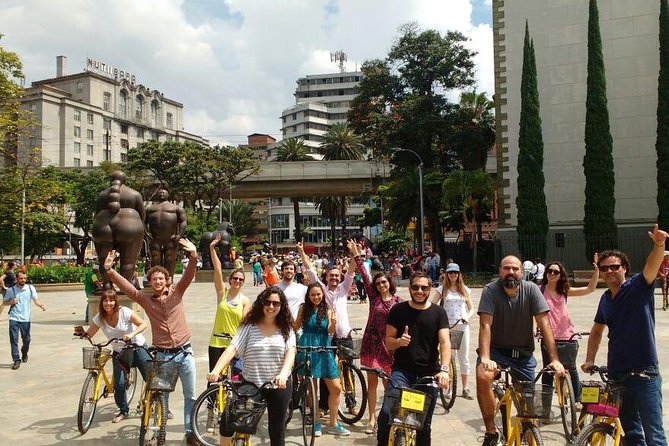
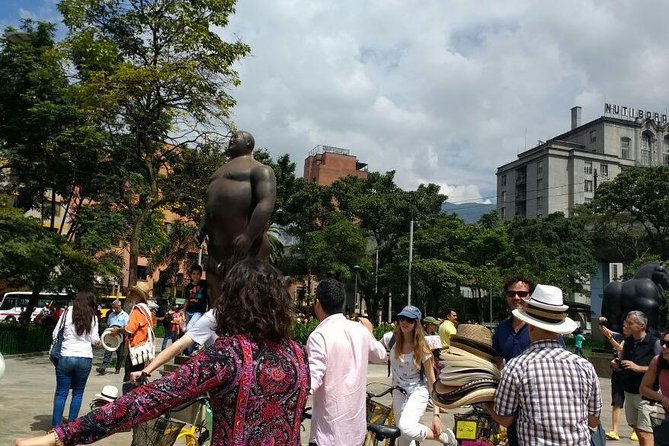
The ride then reaches Botero Plaza, one of the clearest cultural stops on the route. The plaza grew from the downtown changes around the Museo de Antioquia at the start of the 21st century. Creating it required removing an entire city block of buildings so that public space could be returned to Medellín’s residents.
Fernando Botero donated 23 sculptures for the plaza. Together they form his largest open-air museum. The rounded figures are instantly recognizable, and the open setting lets you view the works from several angles rather than behind museum glass.
This is an excellent stop for a first visit because it combines art, city planning, and public life. You can look at the sculptures, then consider the much larger decision to clear a block and create a civic gathering place.
Allow yourself a moment to notice how the art works in the square. These are not isolated objects placed in a quiet gallery. They share space with pedestrians, nearby buildings, and the daily activity of central Medellín.
The short format limits how much time you can spend with each sculpture. If Botero’s work is a main reason for your visit, plan a separate visit to the Museo de Antioquia. On the bike tour, the plaza works best as a lively introduction and a lesson in how Medellín uses art in public space.
A completely different kind of day:
- Medellin: Comuna 13 Graffiti Tour, Cable Car & Street Food
★ 4.8 · 9,046 reviews - Comuna 13 Graffiti Tour with Street Food
★ 5.0 · 7,503 reviews - Museo Pablo Escobar
★ 5.0 · 7,242 reviews - Guatapé Tour: Piedra del Peñol with Boat Tour, Breakfast, Lunch
★ 5.0 · 7,035 reviews
Cisneros Square and the old Guayaquil quarter
Next comes Cisneros Square, named for Francisco Javier Cisneros, the Cuban engineer who helped pioneer the Antioquia Railroad. The square sits between the EPM Library, the Vásquez and Carré Buildings, and the old Railway Station.
The space was remodeled in 2002, giving it its present form. Its earlier identity was Guayaquil Square, once one of the busiest places in the city. People came here to buy, sell, and trade the things they needed, so the square drew people from every social class.
That background helps explain why public squares matter so much in Medellín. This was not simply an attractive place to pass through. It was a practical center of exchange, where different parts of city life met.
Look for the contrast between the older buildings and the more recent public design. The EPM Library and the preserved commercial buildings frame a space that has changed function while keeping its connection to the city’s past.
A bike makes the transition between Botero Plaza and Cisneros Square easy to follow. You are moving through the center rather than jumping from one isolated photo stop to another. Still, the tour gives you an overview, not a detailed architectural inspection. If you want to study every facade, you will need to return on foot.
La Alpujarra and the Monument to the Race
The route continues to the official José María Córdova Administrative Center, commonly associated with La Alpujarra. This urban complex houses the administrative offices of Antioquia and Medellín.
A broad square brings together the governor’s office, the departmental assembly, the mayor’s office, and Medellín’s council. At its center is Rodrigo Arenas Betancur’s Monument to the Race.
This stop gives the tour a civic focus. After the church, art plaza, and former market square, you see where regional and city government operate. The arrangement makes it easier to understand Medellín not only as a collection of neighborhoods, but also as the administrative center of Antioquia.
The monument is an important visual marker, and the guide can help you read the space as a piece of public design rather than just another plaza. You will likely spend only a short time here, but it provides useful context for the city’s institutions.
The practical limitation is that administrative areas can feel more formal and less intimate than the older commercial streets. I would treat La Alpujarra as a strong orientation stop, not the emotional highlight of the ride.
A tribute to Colombia’s cycling champions
One of the more unusual stops honors Martín Emilio Cochise Rodríguez, the historic Colombian cyclist. The location also recognizes major riders such as Fernando Gaviria, Juan Esteban Arango, Juliana Gaviria, and Fabián Puerta.
This stop matters because cycling in Colombia is more than a way to get around. It is a source of national pride, and Colombian riders have become important figures at home and abroad. A bicycle tour that includes this tribute connects your own ride with a wider sporting tradition.
For anyone interested in cycling, this may be one of the most personal parts of the route. You can place the city ride within Colombia’s broader cycling culture instead of treating the bicycle as a simple rental tool.
The information provided does not specify how long you stop here or what facilities are present, so expect an interpretive visit rather than a full cycling museum. The value comes from the guide’s explanation and from seeing the names and figures recognized in a city route.
A glimpse of tram-era Medellín and Gardel
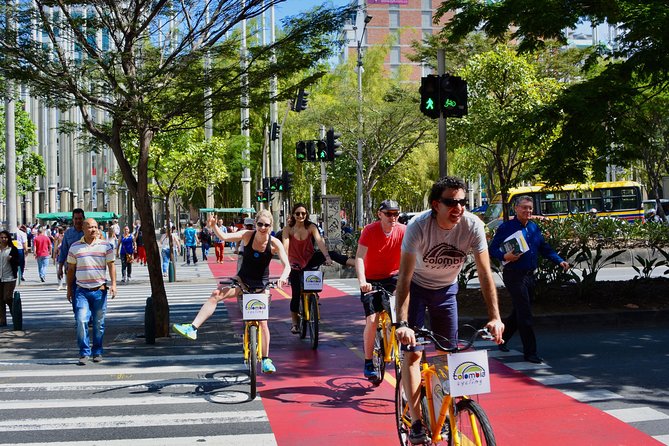
The itinerary also reaches a place where you can picture an earlier Medellín of trams, mules, and pianolas. The streets and walls recall years shaped by music, dancing, laughter, and social life.
Gardel stories are part of the stop. Carlos Gardel, the famous tango singer, has a strong connection to Medellín’s cultural memory, and the tour uses those stories to evoke an older city.
This is a welcome change of pace. The churches and civic plazas explain buildings and institutions. This stop leans more toward atmosphere, music, and memory. You get a sense of how people imagined and enjoyed the city before modern transport and present-day development reshaped it.
Because the description is more historical and cultural than site-specific, the guide’s storytelling will matter here. If you enjoy local anecdotes, this could be a highlight. If you prefer only major monuments, it may feel less concrete than Botero Plaza or La Alpujarra.
Young designers among old houses
The final major stop presents a newer commercial idea in Medellín. Young paisa designers and local businesses share space among large trees and traditional houses, creating a shopping route that mixes old residential architecture with modern commerce.
The comparison is made with famous shopping streets such as Oxford Street in London, Fifth Avenue in New York, and Avenue Montaigne in Paris. You should not expect Medellín to copy those places. The point is that the city has its own route where shopping, design, trees, old houses, and newer architecture meet.
I like ending here because it shows Medellín as a working, changing city rather than a museum display. You see how local designers use an established neighborhood and how commercial life can grow around older buildings.
The stop may appeal most to anyone interested in design, fashion, and city renewal. It is less useful if you want a long shopping session, since the full ride lasts only two to three hours and returns to the museum.
Snacks, beer, bicycles, and the overall value
The tour includes the use of a bicycle, snacks, and beer. That makes the $50 price easier to justify, particularly if you value having equipment and refreshments handled in advance.
The food is not described in detail, so you should not book this expecting a full meal. Think of the snacks as a useful break during a morning ride. The included beer adds a relaxed finish, but remember that you are cycling, so drink responsibly and follow the guide’s timing.
The strongest praise connected with Colombia Cycling concerns organization, support, food, drinks, and good bicycles. Tomas has guided demanding rides and provided cycling facts along the route. Marcela has handled support logistics with local snacks and drinks, while Juan and Victor have guided and supported longer trips. Those details suggest a company that understands cyclists and pays attention to practical needs.
Still, this particular tour is a short urban outing. The longer ride experiences included support vehicles, road bikes, electrolytes, protein bars, transport, hotels, and restaurant planning. None of those extras are listed for the Medellín city ride, so judge this activity on its own terms.
Who should book this ride
I would choose this tour if you want a quick introduction to Medellín that combines:
- Architecture and churches
- Public art and city planning
- Government landmarks
- Cycling culture
- Older music and social history
- Local design and shopping districts
It suits riders who can manage a two to three hour city outing and who like moving between districts instead of spending the entire morning in one museum.
It may not suit you if you want a hard workout, a countryside route, a long visit inside historic buildings, or a detailed art tour. The itinerary is broad, and each stop receives only part of the morning.
Most people can participate, according to the activity information, but you should still be comfortable riding a bicycle in an urban setting. The group maximum is 15, and the English option makes the tour practical for English-speaking visitors.
Booking and cancellation details
Confirmation is sent within 48 hours of booking, subject to availability. The experience has a minimum number of participants, so it can be moved or refunded if that minimum is not reached.
You can cancel for a full refund up to 24 hours before the local start time. Cancellations or changes made less than 24 hours before departure are not refunded or accepted. Poor weather can also cause a cancellation, in which case you are offered another date or a full refund.
Should you book Tour Medellín by Bike?
Book it if you want to connect several sides of Medellín in one morning and prefer a guide-led ride to independent wandering. The best parts are the contrast between the Church of Perpetual Help and its new creative district, Botero’s 23 sculptures, the story of old Guayaquil Square, and the tribute to Colombian cycling.
At $50, the tour is most worthwhile for a first visit, especially when the bicycle, snacks, beer, English guide, and small-group limit are useful to you. If you already know central Medellín or want a serious cycling challenge, spend your money on a longer road ride instead. For a compact city introduction with art, architecture, civic spaces, music, and local design, this is a sensible choice.
FAQ
Where does the Medellín bike tour start?
The tour starts at the Medellín Museum of Modern Art, Cra 44 #19a-100, El Poblado, Medellín.
What time does the tour begin?
The start time is 9:00 a.m.
How long does the experience last?
The tour lasts approximately two to three hours.
Is the tour offered in English?
Yes. The experience is offered in English.
What is included in the price?
The price includes use of a bicycle, snacks, and an alcoholic beverage, specifically beer.
Where does the tour finish?
The activity ends back at the Medellín Museum of Modern Art, the starting point.
Just added in Medellin
- Walking Tour, Cable Car & Fruit Tasting★ 5.0 · 1 review
- Pablo Escobar and Griselda Blanco Tour★ 5.0 · 1 review
- City tour, Commune 13, Metro Cable, Botero Park and more. Private★ 5.0 · 34 reviews
- comuna 13 tour★ 3.5 · 6 reviews
- 3 days private mountain tour, nature and culture near Medellin★ 5.0 · 22 reviews
- commune thirteen transformation story★ 4.5 · 14 reviews
- fruits tour★ 5.0 · 2 reviews
- Paragliding and hammocks zipline over waterfalls private tour★ 5.0 · 6 reviews
Cycling Tours, compared.
Half Day Bike Tour in Medellin – Local snack, Coffee or Beer
Read our review →
Electric Bike City Tour Medellin With Colombian Coffee and Snack
Read our review →
Medellín Essential: history & local life on E-bike
Read our review →
Local neighborhoods and included food on e-bike
Read our review →
Night Bike Tour In Medellin, Typical Snacks, Beer and Spectacular Viewpoints
Read our review →
Browse the lists this tour appears in