
REVIEW · MEDELLÍN TOURS
Post-conflict Shared Tour (Paul) and Violence Medellin
Medellín’s story is bigger than its skyline. This three-hour walking tour connects parks, public art, schools, and memorial spaces to the city’s long struggle with violence and its ongoing work toward peace. I like the clear historical focus and the way the route uses ordinary downtown places rather than treating history as something locked in a museum. I also like the small-group format, capped at 10 people, which should leave room for questions.
The price is $14 per person, but it functions as a suggested guide tip paid in advance, with Viator keeping its commission. That is good value for a guided introduction to Medellín’s political and social past, though you should know the tour is mainly about conversation and context, not grand monuments. Some stops may look plain until the guide explains why they matter.
Guides named in past bookings include Paul, Alejandro, Sebastian, Miguel, Manuel, and Daniel. The strongest praise centers on clear explanations, honest discussion, and the guides’ ability to answer questions about Colombia’s conflict, politics, and path toward peace. There is one serious caution: two bookings report that the guide did not arrive and gave no notice, so keep your confirmation and cancellation rights handy.
In This Review
- Key points to know before you book
- Why this tour adds something beyond a standard city walk
- Parque San Antonio begins the story
- Plazuela San Ignacio connects education with peace
- Comfama San Ignacio shows culture at work
- Torres de Bomboná brings architecture into the discussion
- Pasaje Cervantes turns murals into public history
- Boston Park offers time to think
- Simona Duque Park remembers a human rights advocate
- Bicentenario Park finishes with the city’s future
- What $14 really gets you
- Timing, group size, and practical comfort
- The important weakness: guide reliability
- Who will get the most from this walk
- Should you book the Violence and Post-Conflict Tour?
- FAQ
- Where does the tour start?
- Where does the tour finish?
- What time does the tour begin?
- How long does the experience last?
- How much does the tour cost?
- What is included?
- Are food and snacks included?
- What happens if I need to cancel?
Key points to know before you book
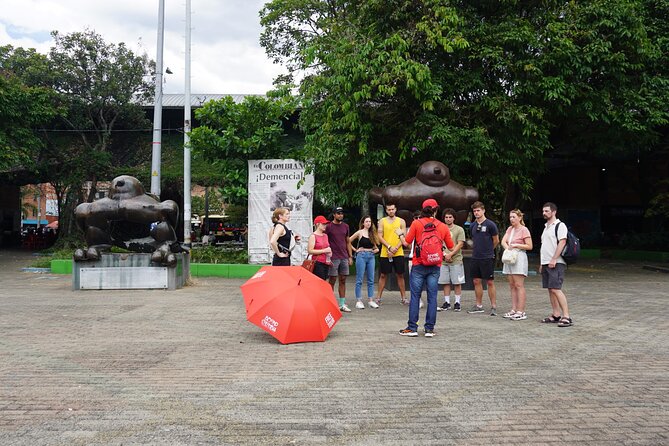
- A three-hour walk through central Medellín: The route begins at Parque San Antonio and finishes near the Memory House Museum at Parque Bicentenario.
- History is tied to ordinary places: Parks, a cultural center, apartment towers, and a painted passage become starting points for discussing conflict and recovery.
- Education gets a full stop: Plazuela San Ignacio and Comfama San Ignacio show how learning, culture, and social programs support peacebuilding.
- Small group, serious subject: The maximum group size is 10, a useful limit for a topic that works best when you can ask questions.
- The $14 is a prepaid suggested tip: The money goes to the guide after Viator’s commission, rather than covering meals, snacks, or a standard admission package.
- Expect a physically active afternoon: The tour starts at 2 p.m., lasts about three hours, and requires a strong level of physical fitness.
Why this tour adds something beyond a standard city walk
Medellín is often introduced through its public transport, views, architecture, and urban renewal. Those subjects matter, but they can leave out the painful events that shaped the city and the people who live here.
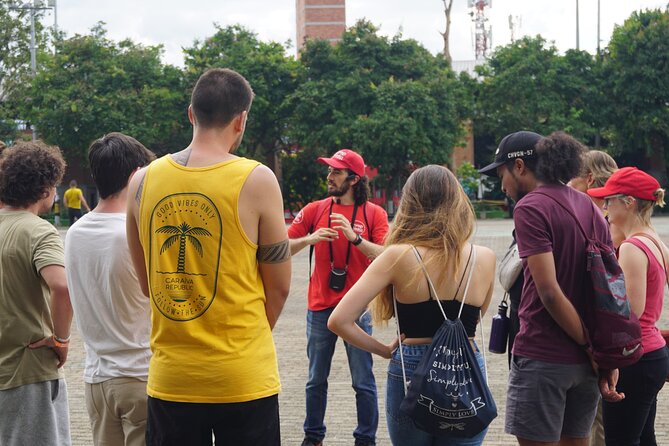
This route takes a different path. It asks you to look at public spaces as evidence of change. A park can carry memories of violence. A school or cultural center can show how a city tries to repair trust. A mural can turn a passageway into a place for shared identity.
I find that approach useful because it avoids reducing Medellín to either a crime story or a feel-good comeback tale. The walk links both realities. You hear about the conflict, then consider the social and civic work that followed. The subject is serious, but the format remains accessible and grounded in places you can see.
The guides are central to the experience. Daniel has been praised for an honest, authentic, and insightful presentation. Miguel is noted for explaining national and local struggles in clear English. Manuel is described as passionate and able to make politics, Colombian history, and the current peace process interesting. Paul is praised for explaining the complex history of Medellín and Colombia in detail.
Those descriptions point to the tour’s main strength: the guide’s interpretation matters more than the scenery. Several locations are not visually dramatic on their own. You go for the stories, questions, and connections.
More things to do in Medellin:
- Medellin: Comuna 13 Graffiti Tour, Cable Car & Street Food
★ 4.8 · 9,046 reviews - Comuna 13 Graffiti Tour with Street Food
★ 5.0 · 7,503 reviews - Museo Pablo Escobar
★ 5.0 · 7,242 reviews
Parque San Antonio begins the story
The walk starts at Parque San Antonio, at Calle 44 #50 in La Candelaria, with a 2 p.m. departure. This is a useful opening because the park is described as an emblematic Medellín site, not just a place to gather before the tour.
Here, the guide explains the park’s history and its importance to local residents. You also look at how the space has changed over time, using those changes to discuss Medellín’s wider transformation.
Allow about 22 minutes at this stop. There is no admission charge. Since this is the first part of the walk, it sets the tone for the rest of the afternoon: less sightseeing checklist, more guided reading of the city.
You should arrive ready to listen. The value here will come from the explanation, not from a long list of attractions or a formal museum display.
Plazuela San Ignacio connects education with peace
The next stop, Plazuela San Ignacio, shifts the discussion toward education. The guide explains the history of education in Medellín and its role in the city’s peacebuilding efforts.
This is one of the route’s most useful themes. Conflict is often discussed through armed groups, politics, and crime. Education brings the focus back to institutions and daily life. It asks how a city creates better choices and stronger communities over time.
The stop lasts about 22 minutes and is free to enter. You will likely find this section especially useful if you want to understand social change rather than simply memorize dates or names.
The best guides appear to explain the topic in a way that welcomes questions. Miguel’s clear English and ability to discuss both Colombian and local struggles would be particularly helpful here, though the exact guide is not guaranteed.
Comfama San Ignacio shows culture at work
At Comfama San Ignacio, the tour visits a cultural center devoted to art, culture, and education. The discussion turns to programs intended to strengthen social ties and support peaceful coexistence.
This stop gives the tour a practical side. Instead of asking only what went wrong in Medellín, you consider what institutions are doing to help people share public life again.
A cultural center may not sound like a major sightseeing stop, but that is part of the point. Recovery is built through programs, classrooms, arts spaces, and places where people meet. The visit lasts about 22 minutes and has no admission charge.
I would not book this tour expecting a series of famous monuments. Comfama works better as a place for explanation. If you enjoy learning how cities try to solve social problems, it should be one of the more meaningful stops.
A completely different kind of day:
- Guatapé Tour: Piedra del Peñol with Boat Tour, Breakfast, Lunch
★ 5.0 · 7,035 reviews - Medellín: The Real Pablo Escobar Tour
★ 4.8 · 3,205 reviews - Day Trip To Guatapé with ,Breakfast, Lunch and Boat Ride
★ 5.0 · 2,996 reviews - Comuna 13 Graffitour knows the urban art district of Medellín
★ 5.0 · 2,856 reviews
Torres de Bomboná brings architecture into the discussion
The Torres de Bomboná are presented as symbols of modern architecture in Medellín. The guide explains their background and their place in the city, then uses them to discuss how architecture can shape urban change.
This is a welcome change of subject after the focus on education and social programs. Buildings tell you what a city wants to become, but they can also raise questions about who benefits from change and how new development fits into older neighborhoods.
The visit lasts about 22 minutes and is free. Do not expect the towers alone to carry the stop. Their value depends on the guide making the connection between design, public space, and the city’s wider transformation.
A strong guide can make an apartment complex or modern building more interesting than a famous monument. This is also where the tour’s slower pace pays off. You have time to consider the building rather than simply walk past it.
Pasaje Cervantes turns murals into public history
Pasaje Cervantes is the route’s urban art stop. The passage contains colorful murals, and the guide discusses the artists and the messages behind the work.
Public art can change how you read a city. A painted wall may add color, but it can also carry memory, identity, or a demand for recognition. This stop gives you a visual break from the more political discussion while keeping the central theme intact.
The passage is free to visit and receives about 22 minutes. Bring your attention to the details. Look at how the murals use the space and listen for the link between the artists’ work and Medellín’s social story.
This may be one of the easiest places to photograph, but the photos are not the whole point. The guide’s explanation should help you see the murals as public messages, not decoration alone.
Boston Park offers time to think
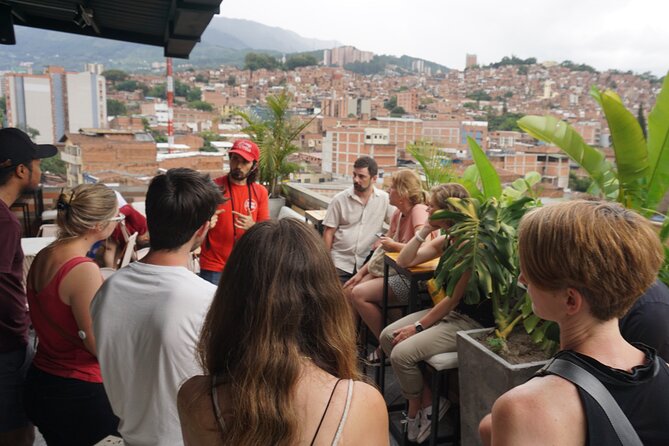
At Boston Park, the tour pauses for rest and reflection. You are invited to share your thoughts about what you have seen and learned so far.
That pause matters. A route covering violence, social repair, education, and political change can become a flood of information. Boston Park gives you space to ask a question, compare ideas with the group, or simply sit for a moment.
The stop lasts about 22 minutes and is free. It is also a reminder that a good walking tour does not need to fill every minute with facts. Reflection is part of understanding.
You should expect an open conversation rather than a formal lecture. If you prefer a tour that keeps moving from attraction to attraction, this pause may feel slow. If you want time to process a difficult subject, it is welcome.
Simona Duque Park remembers a human rights advocate
The route then reaches Simona Duque Park, a tribute to a woman who devoted her life to human rights. The guide tells her story and explains her legacy.
This stop brings the tour’s broad themes down to one person. A city’s history can seem abstract when discussed through institutions and political events. A personal story gives the subject a human shape.
The supplied details do not include an admission price for this stop, so you should not assume that every part of the route has the same entry arrangement. The scheduled visit is about 22 minutes.
This is also a good place to ask questions about how individual action fits into Colombia’s wider history. The tour appears strongest when the guide connects a specific person or place to the larger story of violence and peacebuilding.
Bicentenario Park finishes with the city’s future
The final stop is Bicentenario Park, described as a modern, sustainable space representing Medellín’s future. The group reflects on the challenges and opportunities facing the city as it continues its path toward peace.
The tour ends near the Memory House Museum at Parque Bicentenario, on Calle 51 #36-66. The experience does not state that museum admission is included, so treat the museum as the endpoint rather than an included visit.
Ending here gives the walk a forward-looking shape. You begin with a central park shaped by the city’s past, then finish by asking what comes next. That does not erase the difficult parts of Medellín’s story. It simply places them beside the work still being done.
Allow about 22 minutes at the park. Since the entire tour lasts roughly three hours, you will spend close to the full afternoon walking and listening.
What $14 really gets you
At $14 per person, this is inexpensive for a three-hour guided experience in central Medellín. The price is not a conventional entrance fee. It is the suggested tip for the guide’s work, paid ahead of time through Viator, with the guide receiving the amount after Viator’s commission.
That arrangement has two practical effects. First, your payment supports the guide directly rather than covering a large set of paid attractions. Second, you should not expect snacks, lunch, or extra services to be part of the price.
The included item is a certified guide. Snacks, lunch, and tips are not included, although the prepaid amount itself functions as the suggested guide tip. There are no listed admission fees for the first six stops. The final two stops show admission as not included, so keep that distinction in mind.
I consider the value good if you want context and conversation. It is less compelling if you mainly want photo stops, interior visits, or a relaxed stroll with little discussion.
Timing, group size, and practical comfort
The tour begins at 2 p.m. at Parque San Antonio and ends at Parque Bicentenario. Both locations are in La Candelaria, and the route is near public transportation.
The maximum group size is 10 people. That is small enough to make questions possible and large enough to give the walk a social feel. Because the subject includes conflict, politics, and human rights, a smaller group should also make discussion more manageable.
The tour requires a strong level of physical fitness. The supplied information does not give a total distance, number of stairs, or exact walking conditions, so you should be prepared for a sustained urban walk rather than assume it will be easy.
Service animals are allowed. Confirmation is provided at booking. If plans change, free cancellation is available up to 24 hours before the local start time. Cancellations made later are not refunded, and changes within that window are not accepted.
The important weakness: guide reliability
Most of the positive feedback focuses on the quality of the explanations. Alejandro is praised for answering questions about the conflict. Sebastian receives praise for the tone of his storytelling. Daniel is singled out for an honest and thoughtful presentation, while Miguel and Manuel are praised for clarity, passion, and strong command of the subject.
But two accounts describe the same serious problem: the guide did not show up, and there was no communication despite contact details being available.
That is not a minor inconvenience. Since this is a small operation built around one guide leading one group, a missed departure can ruin the afternoon. I would keep the booking confirmation accessible, arrive at the meeting point early, and use the stated cancellation terms if the operator cancels because the minimum number of participants is not met.
The guide’s name is not guaranteed. The experience title includes Paul, and Paul has received strong praise, but other guide names are also associated with the route. Book this for the subject and format, not only for one particular person.
Who will get the most from this walk
I would choose this tour if you want to understand Medellín beyond its popular image. It suits you if you enjoy asking questions, thinking about public policy, and learning how education, culture, art, and public space can support peace.
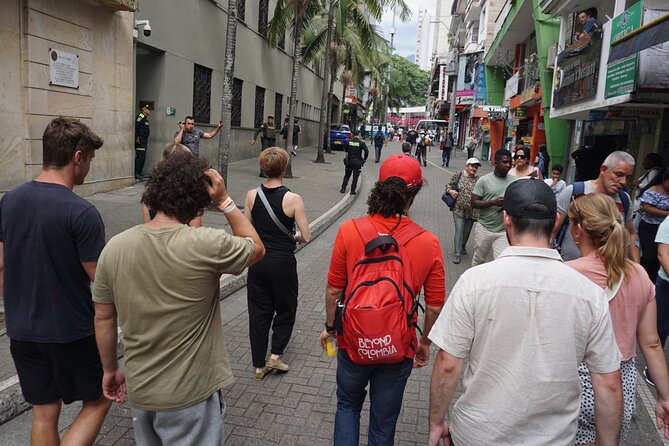
It is also a good fit after a general city tour. One person booked this walk after a downtown tour with Beyond Colombia and found it useful as a more detailed introduction to Medellín and Colombia’s past and present.
You may want something else if your priority is food, shopping, nightlife, or spectacular views. The places are central, but the tour’s reward is explanation. A few stops may look ordinary until the guide gives them meaning.
Should you book the Violence and Post-Conflict Tour?
Book it if you want serious local context at a low price. The route makes difficult subjects understandable by attaching them to real parks, buildings, murals, and civic spaces. The 10-person limit and roughly three-hour schedule give the guide enough time to explain rather than rush.
Before booking, accept three conditions: the tour demands physical effort, food is not included, and the guide’s arrival record is not perfect. If those points do not bother you, this is one of the more useful ways to examine Medellín’s past and its continuing effort to build peace.
FAQ
Where does the tour start?
It starts at Parque San Antonio, Cl. 44 #50, La Candelaria, Medellín.
Where does the tour finish?
It finishes at the Memory House Museum area in Parque Bicentenario, Cl. 51 #36-66, La Candelaria, Medellín.
What time does the tour begin?
The scheduled start time is 2 p.m.
How long does the experience last?
The tour lasts approximately three hours.
How much does the tour cost?
The listed price is $14 per person. This amount is the suggested guide tip paid in advance through Viator, with Viator’s commission deducted before the guide receives it.
What is included?
A certified guide is included.
Are food and snacks included?
No. Snacks and lunch are not included, and the provided details also list tips as not included.
What happens if I need to cancel?
You can cancel up to 24 hours before the local start time for a full refund. Cancellations or changes made less than 24 hours before the start are not accepted for a refund.
Just added in Medellin
- Tour Peñol-Guatape privado: con desayuno, almuerzo y bote★ 5.0 · 1 review
- Silletero Tour – From Medellín★ 5.0 · 1 review
- Tour Medellín: Commune13 and Pablo Escobar + Rooftop★ 5.0 · 2 reviews
- Tour Medellín: Pablo Escobar and Commune 13★ 5.0 · 3 reviews
- Medellin: Tour Pablo Escobar Privado Con Guia Local★ 5.0 · 1 review
- Tour Guatapé: luxury yacht to the stone of Peñol.★ 5.0 · 2 reviews
- Tour Guatapé – Piedra del Peñol with departure from Medellín★ 5.0 · 24 reviews
- Tour Guatapé con visita a Granja de las Llamas y las Alpacas★ 3.5 · 11 reviews
Medellín Tours, compared.
Comuna 13 Graffiti Tour, Cable Car & Street Food
Read our review →

Guatapé Tour: Piedra del Peñol with Boat Tour, Breakfast, Lunch
Read our review →
Day Trip To Guatapé with ,Breakfast, Lunch and Boat Ride
Read our review →
Comuna 13 Graffitour knows the urban art district of Medellín
Read our review →
Tour to Guatape, Piedra del Peñol, lunch, snacks boat trip
Read our review →
Half Day Bike Tour in Medellin – Local snack, Coffee or Beer
Read our review →