
REVIEW · PABLO ESCOBAR HISTORY TOURS
Pablo Escobar Tour in Medellin Private
Dark history, told with care. This private Medellín tour connects the victims of the drug trade with Pablo Escobar’s grave, his namesake neighborhood, and the house where he died. I especially like the private air-conditioned transport, which keeps the three-and-a-half-hour route easy, and the chance to focus on serious local context rather than chase crime-show drama. The main drawback is that lunch is not included, and the subject matter can feel heavy.
I also like the small-group format. Your own party takes part, so you can ask questions and set the pace with your guide. Sofia earned special praise for her patience and careful explanations, while Julian was described as personable and well informed. This is not a tour for anyone seeking a light sightseeing outing, but it can give you a clearer view of Medellín’s painful past and its effort to remember those harmed by it.
In This Review
- Key points to know before you book
- Why this Medellín tour is different
- Parque Memorial Inflexion puts victims at the center
- Jardines Montesacro and the Escobar family graves
- Barrio Pablo Escobar and the complicated question of charity
- Los Olivos and the roof where Escobar died
- What the private format changes
- Is $85 per person good value?
- Who will get the most from this experience?
- Timing, comfort, and practical planning
- Should you book the Pablo Escobar tour?
- FAQ
- How long does the Pablo Escobar tour last?
- What locations does the tour visit?
- Is transportation included?
- Is this a private tour?
- Is lunch included?
- Can I cancel for a full refund?
Key points to know before you book
- Four sharply different stops: You move from a memorial park to a cemetery, a public housing neighborhood, and the site of Escobar’s death.
- The victims come first: Parque Memorial Inflexion gives the tour a serious frame before you visit Escobar’s grave.
- A private vehicle matters: Air conditioning and private transport make the route more comfortable and flexible.
- The tour lasts about three and a half hours: That is enough time for context without taking up your whole day.
- Sofia and Julian set a strong tone: Sofia was praised for patience, while Julian was praised for his personal approach and clear explanations.
- It pairs well with Comuna 13: One participant specifically recommended doing both experiences together.
Why this Medellín tour is different
Many visitors first encounter Pablo Escobar through television, podcasts, or crime documentaries. Those accounts often turn him into a larger-than-life character. This tour works better when you use it to question that image, not simply repeat it.
The route places Escobar beside the people and places affected by his actions. You see a memorial for victims, his family’s burial site, a neighborhood connected to his public generosity, and the house where his life ended. That sequence matters. It shows how power can bring both fear and gratitude, while leaving a long list of victims behind.
I appreciate that the tour does not stop at a grave or a famous photograph. It gives you several ways to think about the man and his legacy. The neighborhood visit adds social context. The memorial park adds public memory. The final stop brings the story back to a specific place in Medellín.
Your guide is important here. Sofia was praised for taking time with explanations and making sure the pace suited the group. Julian was described as personable and well informed. Since this is a private outing, you can ask for clarification when a detail is unclear instead of trying to follow a set speech in a large group.
More Pablo Escobar history tours:
- Museo Pablo Escobar
★ 5.0 · 7,242 reviews - Medellín: The Real Pablo Escobar Tour
★ 4.8 · 3,205 reviews - Pablo Escobar Shared Tour of Medellin
★ 5.0 · 1,560 reviews
Parque Memorial Inflexion puts victims at the center
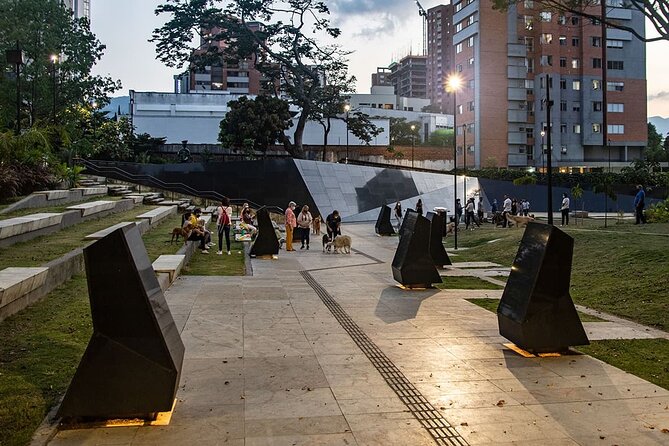
The first stop lasts about 50 minutes at Parque Memorial Inflexion. The park is divided into three sections and was built to remember victims of drug trafficking during the 1980s and 1990s.
This is the right place to begin. Before you visit Escobar’s grave or see the neighborhood connected to his name, you are asked to consider the people who suffered during the period. That order helps prevent the tour from becoming a celebrity visit focused only on the criminal himself.
I would give this stop your full attention. A memorial park can seem quiet or simple at first, but the value comes from the setting and the guide’s explanation. The three-part design gives your guide room to explain different aspects of remembrance and the effect of violence on Medellín.
Admission is included, and the stop takes up a useful portion of the tour without taking over the entire day. You should expect a reflective visit rather than an entertainment stop. If you prefer fast sightseeing and photo opportunities at every turn, this may feel slow. If you want the tour to address the cost of the drug trade, it gives the rest of the route a needed moral center.
Jardines Montesacro and the Escobar family graves
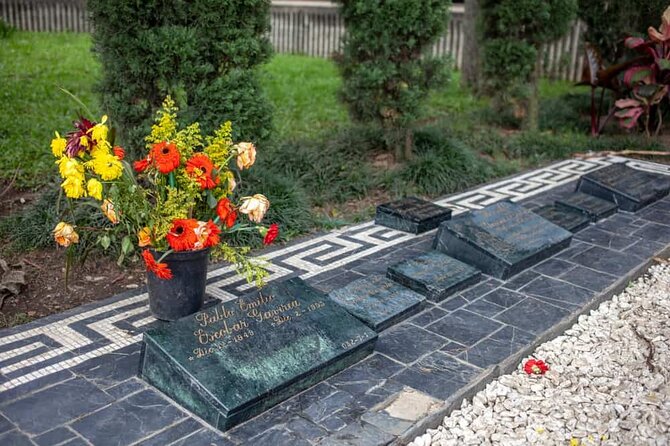
The tour then spends about 40 minutes at Cementerio Jardines Montesacro. Here you visit Pablo Escobar’s tomb and part of his family’s burial area.
This is a more personal stop. At the memorial park, the focus is public remembrance. At the cemetery, the subject becomes a family story as well as a national one. Seeing the grave can be striking, but it also raises questions about how notorious figures are remembered after death.
I would keep your expectations measured. The cemetery visit is not a long museum experience, and the tour does not suggest a large exhibit or a collection of artifacts. Its value comes from being physically present at the burial site and hearing the guide explain its place in the wider story.
The visit lasts 40 minutes, which should give you time to see the tomb and part of the family area without making the cemetery the entire focus. Admission is included. You may find this stop uncomfortable, especially if you are uneasy with tours connected to notorious public figures. That is also why the earlier memorial park matters: it reminds you to look past the legend.
Barrio Pablo Escobar and the complicated question of charity
The third stop lasts about 50 minutes in Barrio Pablo Escobar. The neighborhood is linked to roughly 250 houses that Escobar gave away, and you also see a mural honoring him.
This is the most complicated part of the route. Providing homes can create real gratitude among people who received help. It does not erase the violence and fear tied to the drug trade. Both facts can exist at the same time, and the neighborhood gives you a place to think about that contradiction.
I find this more useful than a simple good-versus-evil story. Public figures who use money to help a community can build loyalty, especially when official services are limited. That generosity may become part of local memory even when the source of the money was destructive.
The mural adds another layer. It shows that Escobar’s image remains contested and emotionally charged. A memorial to victims and a mural honoring Escobar do not deliver the same message, and seeing both during one tour helps you understand why Medellín’s memory of this era is not tidy.
Your guide’s role is especially important here. Ask about the difference between material help and public approval. Ask how the neighborhood is viewed today. The supplied details do not promise a long walk, specific resident encounters, or a particular kind of neighborhood activity, so I would not book this expecting an elaborate community tour. The draw is the setting, the mural, and the discussion around Escobar’s local reputation.
More things to do in Medellin:
- Medellin: Comuna 13 Graffiti Tour, Cable Car & Street Food
★ 4.8 · 9,046 reviews - Comuna 13 Graffiti Tour with Street Food
★ 5.0 · 7,503 reviews - Guatapé Tour: Piedra del Peñol with Boat Tour, Breakfast, Lunch
★ 5.0 · 7,035 reviews - Day Trip To Guatapé with ,Breakfast, Lunch and Boat Ride
★ 5.0 · 2,996 reviews
Los Olivos and the roof where Escobar died
The final stop lasts about one hour in Medellín’s Los Olivos neighborhood. You visit the house where Pablo Escobar died, specifically the roof of a house.
This is likely the most recognizable scene on the route. It connects the broad story of Medellín’s drug violence to one precise location. After seeing a memorial, a cemetery, and a neighborhood shaped by Escobar’s money, you end at the place associated with his final moments.
The stop can feel dramatic, but the tour’s value depends on how it is explained. A roof alone cannot tell you much. Your guide’s account helps place the location within the wider story and keeps the visit from becoming a simple photo stop.
One hour is a generous share of the tour. That suggests time for explanation and questions, rather than a quick look from a vehicle. Still, the information provided does not promise access to the full house, a museum, or original interior furnishings. I would plan on visiting the roof location and hearing the story connected to it.
The final stop also gives the tour a clear ending. You begin with people remembered as victims and finish at the place where Escobar’s own story ended. That structure makes the tour feel more thoughtful than a route built around famous addresses alone.
What the private format changes
The tour is private, meaning only your group takes part. For this subject, that can make a real difference. You can ask direct questions about the memorial, the neighborhood, or the conflicting ways Escobar is remembered without worrying about holding up a large group.
A private tour also gives your guide room to adjust the pace. Sofia was praised for being patient and making sure the group had the best possible experience. Julian was praised for being personable and clear. Those comments suggest that the human side of the guiding matters as much as the route.
The included air-conditioned private vehicle is another practical advantage. Medellín’s route includes several separate locations, and moving between them by private transport is easier than arranging each transfer yourself. It also gives your group a place to regroup between serious stops.
The details do not say that you can redesign the itinerary or choose the exact order. I would not assume unlimited flexibility. Still, a private setting should make questions and conversation easier than on a crowded group excursion.
Is $85 per person good value?
At $85 per person, this is not the cheapest way to see a few Escobar-related locations. The price makes more sense when you consider what is included: private transportation, an air-conditioned vehicle, admission to the memorial park and cemetery, a private guide, and about three and a half hours of organized touring.
If you are traveling with friends or family, the value improves because the vehicle and guide serve only your group. You are not paying for lunch, so plan to eat before or after the experience. Since the tour lasts most of a morning or afternoon, that missing meal is easy to manage, but it is worth remembering when planning your day.
I would compare this price with the cost and effort of arranging several distant stops on your own. You would need to organize transport, identify the correct places, and supply your own context. The tour’s strongest value is not simply getting from one address to another. It is having someone explain how the places connect.
The price is less convincing if you only want a quick photograph at Escobar’s grave or the house where he died. In that case, you are paying for interpretation you may not use. Book it for the context, the private format, and the chance to discuss difficult subjects at your own pace.
Who will get the most from this experience?
I would recommend this tour to you if you want to understand Medellín beyond its popular attractions. It suits visitors interested in the city’s recent past, the social effects of drug trafficking, and the way communities remember controversial figures.
It is also a good fit for people who prefer direct questions and a private setting. Sofia’s patient style, in particular, sounds useful for anyone who wants explanation rather than a rushed narration. Julian’s personable approach may suit a group that likes conversation during a tour.
You should think twice if you want a cheerful sightseeing trip. The memorial park and cemetery deal with death and violence, while the neighborhood stop raises difficult questions about money, loyalty, and public memory. The tone is serious even when the guide is friendly.
The tour may also suit you if you are planning to visit Comuna 13. One participant specifically recommended combining the two experiences. They address different parts of Medellín’s story, so placing them in the same trip can give you a broader sense of the city’s recent transformation and unresolved memories.
Timing, comfort, and practical planning
Set aside about three hours and 30 minutes, plus any time needed to meet the vehicle at the starting point. The tour includes private transportation, but the supplied details do not state the pickup location, so confirm that when you book.
Wear something comfortable for moving between the stops. The information does not specify the amount of walking, stairs, or roof access arrangements, so you should ask the provider if you have mobility concerns. Most people can participate, but no tour should be assumed to suit every physical need.
Bring water and plan your meal separately. Lunch is not included. You may also want a little quiet time afterward, since the subject matter can be emotionally tiring.
The tour is usually booked about 24 days ahead. That is a useful planning signal, especially if you have fixed dates in Medellín. Confirmation arrives at booking, and free cancellation is available until 24 hours before the local start time. After that point, refunds are not available and changes are not accepted. A minimum group size is required, though the activity is private once it operates.
Should you book the Pablo Escobar tour?
Book this tour if you want a serious, well-organized look at Medellín’s Escobar era, with victims, family, public housing, and the final crime scene all included. The private vehicle, air conditioning, and patient guiding make the $85 price easier to justify, especially for a small group.
I would not book it if your interest is only in crime celebrity or quick photo stops. The best parts are the difficult ones: the victim memorial, the neighborhood’s mixed legacy, and the chance to ask how generosity and violence can be remembered together.
For the strongest day, pair it with Comuna 13 and leave room for lunch and a break. With Sofia or Julian guiding the conversation, you get more than a list of addresses. You get a sober look at how one man’s power affected a city, and how Medellín continues to remember what happened.
FAQ
How long does the Pablo Escobar tour last?
The tour lasts approximately three hours and 30 minutes.
What locations does the tour visit?
It visits Parque Memorial Inflexion, Cementerio Jardines Montesacro, Barrio Pablo Escobar, and the house in Medellín’s Los Olivos neighborhood where Pablo Escobar died.
Is transportation included?
Yes. Private transportation in an air-conditioned vehicle is included.
Is this a private tour?
Yes. Only your group participates in the activity.
Is lunch included?
No. Lunch is not included in the tour price.
Can I cancel for a full refund?
Yes, if you cancel at least 24 hours before the experience’s local start time. Cancellations made less than 24 hours in advance are not refunded.
Just added in Medellin
- Walking Tour, Cable Car & Fruit Tasting★ 5.0 · 1 review
- Pablo Escobar and Griselda Blanco Tour★ 5.0 · 1 review
- 3 days private mountain tour, nature and culture near Medellin★ 5.0 · 22 reviews
- City tour, Commune 13, Metro Cable, Botero Park and more. Private★ 5.0 · 34 reviews
- comuna 13 tour★ 3.5 · 6 reviews
- commune thirteen transformation story★ 4.5 · 14 reviews
- fruits tour★ 5.0 · 2 reviews
- Paragliding and hammocks zipline over waterfalls private tour★ 5.0 · 6 reviews