
REVIEW · MEDELLÍN TOURS
Medellin: Mémoire et Transformation – Une Visite Authentique
Medellín makes more sense from above. This 3.5-hour experience links public transport, local food, memorials, and Colombia’s difficult past into one thoughtful introduction to the city. I especially like the MetroCable ride and the stop at Museo Casa de la Memoria, where Medellín’s changes are placed in a wider Colombian context. The main drawback is that the tour requires a minimum number of bookings, so you should confirm it by text after reserving.
I also like the relaxed pace and the way the tour moves beyond the usual postcard stops. Guides such as Braulio and Daniela are praised for clear English, warmth, humor, and an open conversation style rather than a stiff script. Just remember that the museum is closed on Mondays, and on Tuesdays when Monday is a public holiday.
In This Review
- Key points to know before you book
- Why this Medellín tour feels different
- Starting in El Poblado and crossing into a wider Medellín
- Parque Memorial Inflexion and the cost of remembering
- Metro rides and the city’s transformation
- Tango, theatre, and the cultural center of downtown
- Pan de Azúcar and seeing the city from another angle
- Placita de Florez: Medellín through tropical fruit
- Museo Casa de la Memoria and Colombia’s difficult past
- What the $35 price really includes
- Timing, meeting points, and practical concerns
- Who should take this experience?
- Should you book Medellín: Memory and Transformation?
- FAQ
- How long does the Medellín tour last?
- Where does the tour start and end?
- Can I meet the tour at Poblado Metro station?
- Is MetroCable admission included?
- Is food included in the price?
- Is Museo Casa de la Memoria open every day?
Key points to know before you book
- Public transport is part of the story: You ride the Metro and MetroCable, seeing how transport has connected hillside communities with the rest of Medellín.
- The city’s painful past is handled directly: Parque Memorial Inflexion and Museo Casa de la Memoria focus on victims, armed conflict, and remembrance.
- Fruit tasting adds a welcome local pause: At Placita de Florez, tropical fruit and local specialties make the history easier to digest, quite literally.
- The tour is genuinely small: A maximum of 15 people allows room for questions and conversation.
- It begins in El Poblado and ends downtown: The finish at Museo Casa de la Memoria is useful if you want to continue exploring central Medellín.
- The price is strong for the mix: At $35 per person, you get transport, guiding, fruit snacks, and several meaningful stops, though food beyond the included snacks is extra.
Why this Medellín tour feels different
Many city tours in Medellín keep their distance from difficult subjects. This one does not. It presents the city as a place still changing, with modern transport and renewed public spaces set beside memories of violence and loss.
That balance is the main reason I find the experience worthwhile. You are not simply shown a scenic viewpoint, a market, and a museum as unrelated stops. The guide uses them to explain how Medellín works and how it has changed.
The tour also gives you access through the city’s own transport system. Only part of the experience involves walking. The rest uses the Metro and cable car, which keeps the outing moving and gives you a better sense of daily life than a vehicle-based sightseeing loop.
The group can include up to 15 people, but the format is still designed for questions. That matters here. The subjects include politics, economics, social change, and Colombia’s armed conflict. A guide who can explain and discuss those topics is far more useful than a guide who simply recites dates.
Braulio is singled out for his strong English, energy, broad knowledge, and conversational style. Daniela is also praised for making the visit feel relaxed and personal. The guide may vary, but the best part of the format is the chance to ask direct questions.
More things to do in Medellin:
- Medellin: Comuna 13 Graffiti Tour, Cable Car & Street Food
★ 4.8 · 9,046 reviews - Comuna 13 Graffiti Tour with Street Food
★ 5.0 · 7,503 reviews - Museo Pablo Escobar
★ 5.0 · 7,242 reviews
Starting in El Poblado and crossing into a wider Medellín
The stated starting point is Vita Hotel Boutique at Cra 43D #13-26 in El Poblado. If you contact the operator beforehand, you may also be able to meet at Poblado Metro station.
That flexibility is useful if you are already near the station or prefer to begin with a familiar transport point. Confirm the meeting arrangement in advance, since one cancellation problem involved poor communication about where and when the tour would start.
El Poblado is Medellín’s best-known base for international visitors, with plenty of hotels and restaurants. Starting there makes the tour easy to fit into a stay, but the real value comes from moving beyond that comfortable area.
The experience gradually shifts your attention from the polished visitor district to a broader view of the city. You begin to see Medellín not just as a place for nightlife and restaurants, but as a city shaped by transport, inequality, conflict, and civic projects.
Parque Memorial Inflexion and the cost of remembering
The first major stop is Parque Memorial Inflexion, a memorial dedicated to victims of Pablo Escobar. You spend about 20 minutes there, and admission is free.
This is a short stop, but it sets the moral direction for the rest of the visit. Medellín’s past cannot be reduced to the image of one notorious criminal. The memorial shifts attention toward the people who suffered.
That distinction is important. The city’s connection with Escobar often attracts visitors because of television, crime stories, and popular culture. A memorial to victims asks you to look at the human cost instead of treating the subject as entertainment.
You should not expect a large museum visit here. The time is brief, and the experience is primarily about reflection and explanation. The guide’s role matters because the site can otherwise be easy to pass through without understanding its significance.
For me, this stop works best as an introduction rather than a complete lesson. The fuller historical discussion comes later at Museo Casa de la Memoria.
Metro rides and the city’s transformation
The Metro and MetroCable are not just convenient ways to get around. On this tour, they are part of the central idea.
Medellín’s cable cars carry you above the city and into the story of how transport has connected hillside communities with jobs, education, and the wider urban area. The Line H MetroCable ride lasts about 45 minutes and includes admission.
The views are one obvious reward. You see the city from a different angle, with the cable car moving above streets and hills rather than through them. But the more useful part is the explanation of what the system means to local residents.
The experience has been praised for showing how transport links changed access for disadvantaged communities. That gives the ride more purpose than a simple scenic outing. You are encouraged to consider infrastructure as a social tool.
I especially like this section because it lets you experience a working part of Medellín rather than a transport attraction designed only for sightseeing. The cable car is innovative, but the tour keeps attention on the people who use it every day.
The practical drawback is that public transport can be less predictable than a private vehicle. The information does not promise a seat for every segment or describe every transfer in detail, so you should be ready for a normal city transit experience. Comfortable shoes and a rain layer are sensible choices.
A completely different kind of day:
- Guatapé Tour: Piedra del Peñol with Boat Tour, Breakfast, Lunch
★ 5.0 · 7,035 reviews - Medellín: The Real Pablo Escobar Tour
★ 4.8 · 3,205 reviews - Day Trip To Guatapé with ,Breakfast, Lunch and Boat Ride
★ 5.0 · 2,996 reviews - Comuna 13 Graffitour knows the urban art district of Medellín
★ 5.0 · 2,856 reviews
Tango, theatre, and the cultural center of downtown
The route includes one of downtown Medellín’s iconic tango bars and a local theatre with a changing cultural program. The supplied details do not name either venue, so the exact places may vary.
These stops help broaden the tour beyond conflict and transport. Tango points to Medellín’s long connection with music and urban culture, while the theatre shows that the city’s cultural life is not limited to the districts most often promoted to visitors.
The tango bar is described as one of the city’s most iconic. Do not expect a full evening performance based on the stated duration. It is better understood as a brief cultural stop within a larger route.
The theatre’s program is always changing, which means the attraction is its role as a local cultural institution rather than one fixed exhibit. You might find a different offering depending on the day.
This section is also where a good guide can make a major difference. Without context, a quick look at a bar or theatre can feel thin. With explanation, the stops become clues to how downtown Medellín lives and creates.
Pan de Azúcar and seeing the city from another angle
Pan de Azúcar Mount is included in the route, though the available information does not give a separate duration or specify exactly how much time you spend there.
The stop adds another viewpoint to a tour already built around seeing Medellín from different levels. The MetroCable gives you an aerial ride, while Pan de Azúcar offers a more fixed perspective over the city.
Because the schedule is only three to four hours, do not assume this is a long mountain hike or a major hiking excursion. The tour description does not promise a strenuous walk. It is safest to treat the mountain as a scenic and interpretive stop within the larger route.
This is one reason the tour may suit you if you want variety without committing to a full-day excursion. You get transport, urban culture, food, and a viewpoint in one half-day outing.
Placita de Florez: Medellín through tropical fruit

At Placita de Florez, the tour turns into a small food discovery. You taste fruity snacks and encounter tropical flavors, with other food purchases not included in the $35 price.
This is one of the most enjoyable parts of the route because food creates an easy connection with place. A market visit gives you something to see, smell, taste, and ask about. It also breaks up the heavier material from the memorials and museum.
The experience is not presented as a formal meal. You should expect samples and tastings rather than lunch. If you are hungry, budget for anything extra you want to buy at the market.
The local connection matters, too. The guide is said to know vendors at the market, which can make the stop feel more natural than simply walking past stalls with no explanation. You might learn about unfamiliar fruit or local specialties as you taste them.
I would keep an open mind here. The charm comes from trying tropical produce that may not be familiar to you and letting the guide explain what you are seeing. It is a small detail, but it helps turn the tour from a lecture into a lived experience.
Museo Casa de la Memoria and Colombia’s difficult past
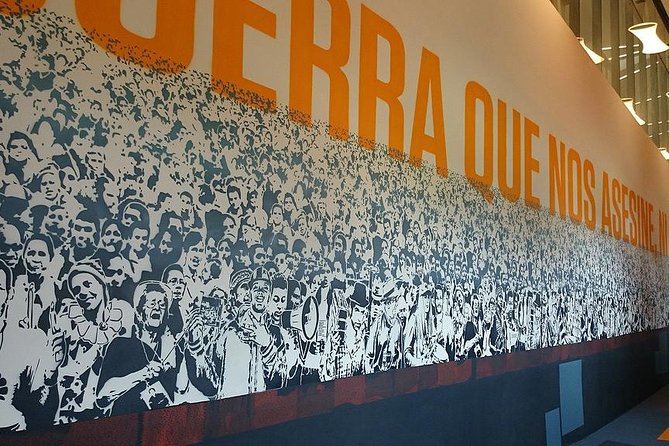
The final stop is Museo Casa de la Memoria at Parque Bicentenario, Cl. 51 #36-66 in La Candelaria. Admission is free, and the visit lasts about 30 minutes.
This museum focuses on the Colombian armed conflict and its historical development. It is the most serious part of the tour, and it gives shape to the themes introduced at Parque Memorial Inflexion.
The museum visit is described as moving, even shocking at times. You should come prepared for difficult material. This is not a light final attraction added to round out a sightseeing route. It asks you to think about victims, violence, memory, and the country’s ongoing effort to understand its past.
The guide’s explanation is especially valuable here. A museum can present powerful material, but context helps you understand how the conflict developed and why remembrance matters in present-day Colombia.
Ending here is a smart choice. The tour builds toward the museum instead of opening with the most difficult material. You first see the city’s transport system, cultural life, food traditions, and public spaces. By the time you reach the museum, you have a wider frame for understanding what you are seeing.
The museum is closed on Mondays. It is also closed on Tuesdays when Monday is a public holiday. Check the operating day before you reserve, since this is the final stop and one of the main reasons to take the tour.
What the $35 price really includes
At $35 per person, the tour offers good value if you want history, transport, and local context in one compact outing.
The price includes the approximately three-and-a-half-hour visit, the MetroCable admission, and fruit snacks. It also includes a rainproof format, which is useful in Medellín’s changeable weather. The tour does not include anything not specifically mentioned, including additional food or purchases at Placita de Florez.
The value is strongest for first-time visitors and for people staying in El Poblado who want to understand more than their immediate neighborhood. You get a guide, public transport experience, a memorial, market tasting, a mountain viewpoint, and a museum without paying separate entrance fees for the main stops.
It is less suited to someone who wants a relaxed food tour or a simple sightseeing ride. The historical and political material is central. You should choose it because you want context, not merely because you want cable-car views.
The small group limit of 15 also helps justify the price. A guide can respond to questions and adjust the conversation. That personal exchange is a major part of what you are paying for.
Timing, meeting points, and practical concerns
The tour lasts approximately three to four hours, with the advertised visit lasting about 3.5 hours. It starts at Vita Hotel Boutique in El Poblado and ends at Museo Casa de la Memoria in downtown Medellín.
Ending downtown can be useful. You do not need to return to El Poblado before continuing your day, and the final museum places you near other central areas. The tour does not provide a return transfer.
Most people can participate, and service animals are allowed. The tour is near public transportation by design, since the Metro and MetroCable are essential parts of the route.
Rain is a real planning concern, so bring a light waterproof layer even if the morning looks clear. The experience is described as three-quarters rainproof, but that does not mean every outdoor portion will be comfortable in heavy rain.
You receive confirmation at booking. Because the experience requires a minimum number of participants, send a text after booking to double-check availability. This is the single most important practical tip. A past cancellation was made worse by poor communication, and the operator later acknowledged that the meeting host had not explained the actual reason.
Free cancellation is available if you cancel at least 24 hours before the start time. Cancellations or changes made later are not refunded or accepted. If the minimum number is not reached and the operator cancels, you are offered another date or experience, or a full refund.
Who should take this experience?
I would recommend this tour to you if you want a first look at Medellín that combines daily life with serious history.
It is particularly good for:
- First-time visitors who want to understand how the city fits together
- People staying in El Poblado who want to move beyond the tourist district
- Anyone interested in public transport and urban change
- Visitors who want a thoughtful introduction to Colombia’s armed conflict
- Solo visitors or small groups who enjoy asking questions
- People who like food stops but do not need a full restaurant tour
You may want another type of tour if you prefer a purely scenic outing, a nightlife experience, or a long museum visit. The schedule is compact, and the material can be emotionally demanding.
The guide also makes a difference. Braulio is praised for speaking excellent English and handling questions across history, politics, society, and economics. Daniela is described as warm and easy to talk with. You should expect an informal, discussion-based style rather than a rehearsed script.
Should you book Medellín: Memory and Transformation?
Yes, if you want Medellín explained rather than simply photographed.
The combination of MetroCable views, the victims’ memorial, Placita de Florez, local cultural stops, and Museo Casa de la Memoria gives you a useful framework for the city. The tour shows both progress and pain, without turning either into a simple story.
Book it early in your stay if possible. The information can help you understand later visits, and the final downtown location makes it easy to continue exploring. Confirm the meeting point and minimum booking by text, avoid Mondays for the museum, and bring rain protection.
For $35, this is a strong half-day choice for curious visitors who want authentic local context, not just a checklist of attractions.
FAQ
How long does the Medellín tour last?
The experience lasts approximately three to four hours, with the stated visit duration around 3.5 hours.
Where does the tour start and end?
It starts at Vita Hotel Boutique, Cra 43D #13-26 in El Poblado. It ends at Museo Casa de la Memoria in Parque Bicentenario, La Candelaria.
Can I meet the tour at Poblado Metro station?
You may be able to meet at Poblado Metro station if you contact the operator beforehand and arrange it.
Is MetroCable admission included?
Yes. Admission for the Line H MetroCable ride is included.
Is food included in the price?
Fruity snacks are included. Additional food, purchases, and anything not specifically listed are not included.
Is Museo Casa de la Memoria open every day?
No. The museum is closed on Mondays and also on Tuesdays when Monday is a public holiday.
Just added in Medellin
- Walking Tour, Cable Car & Fruit Tasting★ 5.0 · 1 review
- Pablo Escobar and Griselda Blanco Tour★ 5.0 · 1 review
- City tour, Commune 13, Metro Cable, Botero Park and more. Private★ 5.0 · 34 reviews
- comuna 13 tour★ 3.5 · 6 reviews
- 3 days private mountain tour, nature and culture near Medellin★ 5.0 · 22 reviews
- commune thirteen transformation story★ 4.5 · 14 reviews
- fruits tour★ 5.0 · 2 reviews
- Paragliding and hammocks zipline over waterfalls private tour★ 5.0 · 6 reviews
Medellín Tours, compared.

Comuna 13 Graffiti Tour, Cable Car & Street Food
Read our review →

Guatapé Tour: Piedra del Peñol with Boat Tour, Breakfast, Lunch
Read our review →
Day Trip To Guatapé with ,Breakfast, Lunch and Boat Ride
Read our review →
Comuna 13 Graffitour knows the urban art district of Medellín
Read our review →
Tour to Guatape, Piedra del Peñol, lunch, snacks boat trip
Read our review →
Half Day Bike Tour in Medellin – Local snack, Coffee or Beer
Read our review →