
REVIEW · PABLO ESCOBAR HISTORY TOURS
Knowing the history of Pablo Escobar Tour
The story is darker than the legend. This Medellín tour is interesting because it moves beyond Pablo Escobar’s fame and looks at the people harmed by drug trafficking, while still visiting major places tied to his life. I especially like the victim-focused account at Parque Memorial Inflexion and the chance to see Escobar’s grave, final hideout, and namesake neighborhood in one outing.
I also like that this is a private tour for your group, with an English-speaking guide and air-conditioned transportation. The main consideration is the subject itself: some stops can feel uncomfortable, and the tour may appeal less if you are looking only for Medellín’s food, art, or modern city life.
In This Review
- Key points to know before booking
- Why this tour is different from a simple Escobar sightseeing trip
- Meeting at El Poblado and getting around Medellín
- Parque Memorial Inflexion: beginning with the victims
- Jardines Montesacro and the grave of Pablo Escobar
- Los Olivos and the final place Escobar hid
- Barrio Pablo Escobar and the complicated legacy
- What the guide adds to the experience
- Is $85.53 a fair price?
- Who should book this Medellín experience?
- Booking flexibility and practical details
- Final verdict: book it for context, not celebrity
- FAQ
- Where does the tour begin?
- Where does the tour end?
- How long does the tour last?
- Is the tour private?
- Is the tour offered in English?
- What transportation is included?
- Is admission included?
- Can I cancel for a full refund?
Key points to know before booking
- Victims come first at Parque Memorial Inflexion: The guide presents Escobar’s story through the damage caused by drug trafficking.
- Four connected stops in four to five hours: You visit a memorial, cemetery, final hideout, and the neighborhood Escobar funded.
- Alexis receives strong praise: Several comments specifically describe him as professional, friendly, and thorough.
- A private group changes the pace: Only your party participates, which gives you more room for questions and discussion.
- Transport is part of the experience: Time between stops adds up, so the air-conditioned vehicle matters.
- The $85.53 price buys context, not just sightseeing: The value depends on how much you want guided explanation of this difficult chapter in Medellín’s past.
Why this tour is different from a simple Escobar sightseeing trip
Pablo Escobar remains a powerful and troubling figure in Medellín’s recent past. His name appears in popular culture, television, souvenirs, and tourist conversations, but reducing him to a clever outlaw misses the suffering caused by violence and drug trafficking.
This experience tries to correct that balance from the first stop. At Parque Memorial Inflexion, the guide explains the story from the perspective of victims. That choice matters. You are not simply being shown places connected to a famous criminal. You are being asked to consider what his rise meant for families and communities.
The park was built in 2019 on the site of the former Monaco building, which belonged to Escobar. Replacing that building with a memorial gives the stop a clear purpose. Instead of treating the old property as a spectacle, the tour uses the location to discuss those who suffered.
I would choose this experience if you want historical context and direct conversation. It is less suitable if you want a light, entertaining excursion. The subject includes murder, organized crime, poverty, and public trauma. The best approach is to listen carefully and avoid turning real suffering into a photo opportunity.
More History Tours in Medellin
- Pablo Escobar Tour : Museum, History and Beer
★ 5.0 · 867 reviews - Shared Tour Historic Center of Medellin with Audio System
★ 5.0 · 523 reviews - Medellín Essential: history & local life on E-bike
★ 5.0 · 459 reviews
Meeting at El Poblado and getting around Medellín
The tour begins at Parque de El Poblado and returns there at the end. That is useful if you are staying in or near El Poblado, one of the city’s main visitor areas. You do not need to arrange a separate return from the final stop.
The tour lasts about four to five hours. The listed time at the four stops adds up to roughly four hours and ten minutes, before allowing for the full movement between sites. Transportation is not a minor detail here. About 30 minutes is assigned to the trip to Jardines Montesacro, 40 minutes to Los Olivos, and another 30 minutes to Barrio Pablo Escobar.
You ride in an air-conditioned vehicle, which is welcome in Medellín’s climate and keeps the day more comfortable. The vehicle also lets you cover sites spread across different parts of the city without piecing together taxis or public transport.
Because this is a private activity, only your group takes part. That should make it easier to ask about family connections, photographs, or details that interest you. It also means the quality of the day depends heavily on the guide’s approach. Several comments single out Alexis, describing him as friendly, professional, and willing to explain the subject in depth.
The tour is offered in English. Confirmation is provided when you book, and service animals are allowed. Most people can participate, and the meeting point is near public transportation.
Parque Memorial Inflexion: beginning with the victims
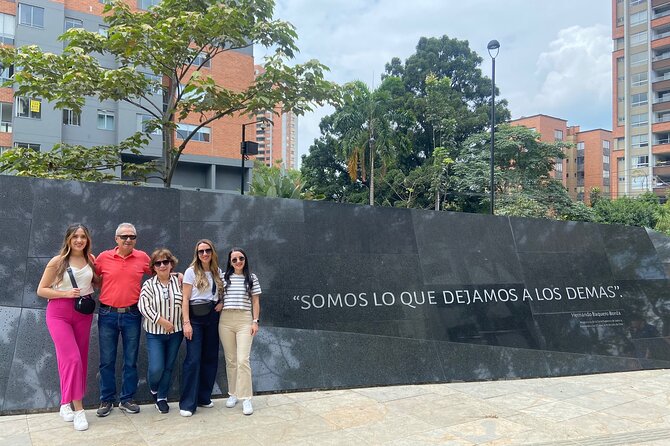
The first stop receives about an hour. Parque Memorial Inflexion was created in 2019 after the old Monaco building was replaced. The park honors victims of drug trafficking, and the guide uses this setting to introduce Escobar’s story through their experiences.
That framing is the strongest reason to book this tour rather than simply visit a famous grave. You still learn about Escobar, but the attention does not rest only on his wealth, escapes, or public image. The memorial places the consequences of the drug trade at the center.
I would give this stop your full attention. It establishes the tone for everything that follows. Listen for how the guide connects Escobar’s personal story to the wider damage caused by trafficking and violence. The supplied tour details do not promise a formal museum exhibition or a particular set of displays at the park, so the explanation from your guide is an important part of what you are paying for.
The stop is free to enter, but free admission does not mean it lacks value. A memorial can be more meaningful than another preserved building, especially when the subject is surrounded by myth. This is also where you can decide if the tour’s serious tone suits you.
Jardines Montesacro and the grave of Pablo Escobar
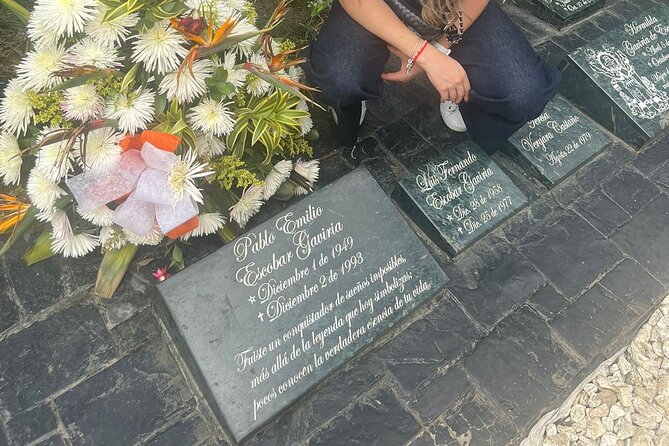
After the memorial, the group travels to Cementerio Jardines Montesacro. The tour allows about an hour at the cemetery, with roughly 30 minutes set aside for transportation to the site.
This is where Escobar’s tomb is located, along with the graves of some associates and relatives. The cemetery stop gives you a physical sense of the people connected to his life, rather than presenting his story as an isolated biography.
A cemetery visit requires a little restraint. The point is not simply to find a famous name and take a quick picture. Your guide can help explain who is buried nearby and how those relationships fit into the story. The comments about the tour specifically praise the use of photographs involving family members and people connected to Escobar. That suggests this part may include personal material that gives the story more human detail.
The stop can also feel emotionally complicated. Seeing a grave may seem to give too much attention to Escobar, especially after beginning at a victims’ memorial. I see that tension as part of the value, provided the guide keeps the context clear. The tour works best when the cemetery is treated as one piece of a larger account, not as a shrine.
More Pablo Escobar history tours:
- Museo Pablo Escobar
★ 5.0 · 7,242 reviews - Medellín: The Real Pablo Escobar Tour
★ 4.8 · 3,205 reviews - Pablo Escobar Shared Tour of Medellin
★ 5.0 · 1,560 reviews - Medellín: Pablo Escobar Tour with beer included
★ 4.7 · 612 reviews
Los Olivos and the final place Escobar hid
The next stop is Los Olivos, a neighborhood associated with the last place Escobar used to hide from police and the location where he died. About 50 minutes is planned at the site, with around 40 minutes used for transportation.
This stop changes the focus from memory to the final stage of the manhunt. You are visiting a place tied to the end of Escobar’s life, but the experience is not presented as an action scene. The strength comes from hearing how the location fits into the broader story.
You should expect this part to be more about explanation than a large attraction with extensive visitor facilities. The supplied details do not identify a ticketed museum, major exhibit, or special entry area at Los Olivos. The address and the guide’s account are the important elements.
That makes the quality of interpretation especially important. A guide who simply points out a location gives you very little. A guide who explains the setting, the hiding period, and the final events makes the stop worthwhile. The positive comments about Alexis repeatedly focus on his ability to tell the story thoroughly and provide substantial information.
The travel time also gives you a chance to ask questions. Since the tour is private, you do not have to wait for a large group to move on before raising a point. If you are interested in how public stories differ from family accounts or photographs, this is a good moment to ask.
Barrio Pablo Escobar and the complicated legacy
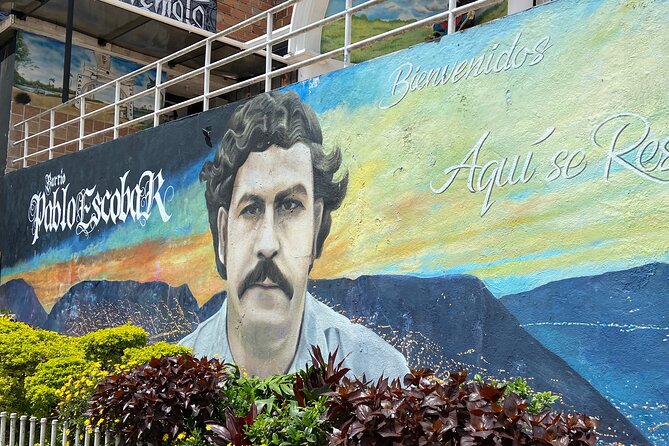
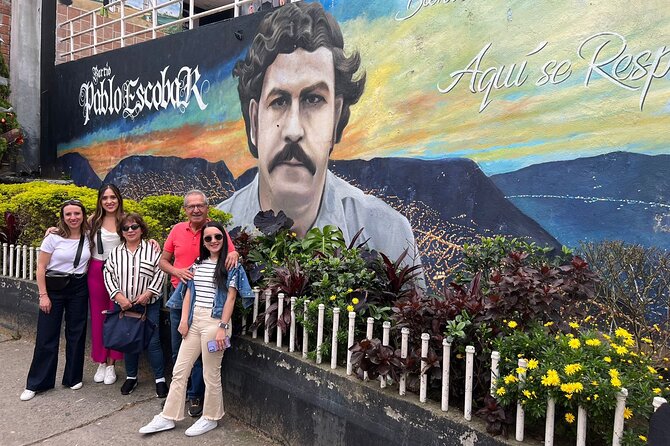
The final stop is Barrio Pablo Escobar, where Escobar helped build housing for some of Medellín’s poorest residents. The visit lasts about one hour and 20 minutes, including time to see a mural honoring him and a small photographic museum. About 30 minutes is used for the journey there.
This is probably the most complicated stop of the day. Escobar’s support for poor residents is part of his public image, but it does not erase the violence connected to his criminal organization. Seeing a neighborhood he helped build lets you examine that contradiction instead of receiving a simple hero or villain story.
The mural is likely to raise questions about memory and loyalty. Why would some residents honor a man associated with so much violence? What did his help mean to people who lacked other support? The tour’s value lies in giving you room to consider those questions without pretending the answers are easy.
The small photographic museum adds a personal angle. The comments about family photographs and people close to Escobar fit especially well with this stop, although the exact exhibits can vary. Do not expect a large national museum. Think of it as a compact collection that supports the guide’s story.
The neighborhood also brings the subject out of the past. You are not only looking at a grave or memorial. You are seeing a community linked to a still-sensitive public memory. Be respectful with photographs and with local residents. The tour details do not promise a performance or staged encounter, so approach the area as a lived neighborhood rather than a film set.
What the guide adds to the experience
A historical tour like this succeeds or fails on its guide. The route itself is clear, but the sites need explanation. A cemetery, a neighborhood, and a former hiding place do not automatically tell their own stories.
Alexis is the guide named most often in the available comments. He is described as professional, approachable, and especially good at explaining Escobar’s history in detail. The comments also mention meeting people close to Escobar, along with seeing many photographs of family members and associated figures. Those details suggest a tour that goes beyond a memorized timeline.
I would book this experience with questions in mind. You might ask how the memorial presents victims, how the neighborhood remembers Escobar, or how family photographs change the public story. A private setting makes those questions easier to discuss.
The tour is listed in English, so it suits English-speaking visitors who want a guided account without handling translation themselves. The strongest praise is directed at the guide’s personality and depth of explanation, not at luxury features. That is useful when deciding what kind of value you want.
Is $85.53 a fair price?
At $85.53 per person, this is not a bargain-priced city outing. The price needs to be judged against the full package: four to five hours, private participation, an air-conditioned vehicle, an English-speaking guide, transport among four locations, and accident insurance.
You are not paying for expensive admission tickets. The listed stops are free, except that admission is included at Barrio Pablo Escobar, and the tour does not include souvenirs. Your money mainly covers the guide’s time, transportation, organization, and interpretation.
For a private group, the price can make sense, particularly if several people share the experience and group discounts apply. You receive a focused route without spending time negotiating taxis between sites. The cost is less attractive if you are mainly interested in seeing locations quickly or if you prefer exploring independently.
I would compare the price with your priorities. If you want a guide who can explain photographs, family connections, victims, and the conflicting legacy of Escobar, the service has a clear purpose. If you only want a picture at the cemetery, you can likely find cheaper ways to see individual locations, though you would lose the organized context.
Who should book this Medellín experience?
I think this tour suits you if you have already seen Medellín’s main neighborhoods and want to understand a difficult part of the city’s recent past. It also works well for visitors who prefer a focused private outing rather than a large group schedule.
History-minded visitors should appreciate the four-part structure. The route moves from victims, to the grave, to the final hiding place, and then to the neighborhood shaped by Escobar’s money. That sequence gives the day a clear arc.
It may also suit you if you want to discuss the difference between public memory and historical responsibility. The memorial and the neighborhood do not tell the same story, and that contrast is worth examining.
I would hesitate to recommend it for young children or anyone seeking a carefree afternoon. The tour deals with drug trafficking, death, and violence, even though the supplied information does not set a specific minimum age. It is also not the best match for someone who dislikes visiting places connected to notorious figures.
The tour is accessible to most participants according to the available details, and service animals are allowed. Still, the itinerary includes several vehicle transfers and time at a cemetery and neighborhood, so ask the operator directly if you have specific mobility needs that are not covered by the general information.
Booking flexibility and practical details
You receive confirmation at booking, and the tour begins and ends at Parque de El Poblado. It is near public transportation, which makes the start easier to reach.
Free cancellation is available if you cancel at least 24 hours before the local start time. A cancellation made less than 24 hours before departure is not refunded, and changes within that period are not accepted.
Bring an attentive attitude more than extra equipment. Souvenirs are not included, and admission is free at the memorial, cemetery, and Los Olivos. The included accident insurance adds a modest layer of reassurance during the organized outing.
Final verdict: book it for context, not celebrity
I recommend the Knowing the History of Pablo Escobar Tour if you want a serious, guide-led account that refuses to treat Escobar as a glamorous character. The victim-centered memorial, private format, and four-stop route give the experience more substance than a quick visit to a grave.
The tour is worth the $85.53 when you value explanation, transport, and personal discussion. Alexis receives especially strong praise for being friendly and thorough, which is important because the sites themselves need interpretation.
Book it if you want to examine Medellín’s painful past with care. Skip it if you are looking for a light city tour, a broad introduction to Colombian culture, or an attraction built mainly for entertainment.
FAQ
Where does the tour begin?
The tour begins at Parque de El Poblado in Medellín, Antioquia, Colombia.
Where does the tour end?
The activity ends back at the meeting point at Parque de El Poblado.
How long does the tour last?
The tour lasts approximately four to five hours.
Is the tour private?
Yes. Only your group participates in the activity.
Is the tour offered in English?
Yes. The tour is offered in English.
What transportation is included?
An air-conditioned vehicle is included. The itinerary also sets aside travel time between the different stops.
Is admission included?
Admission is free at Parque Memorial Inflexion, Cementerio Jardines Montesacro, and Los Olivos. Admission is included at Barrio Pablo Escobar.
Can I cancel for a full refund?
Yes, if you cancel at least 24 hours before the experience start time. Cancellations made less than 24 hours in advance are not refunded.
Just added in Medellin
- Walking Tour, Cable Car & Fruit Tasting★ 5.0 · 1 review
- Pablo Escobar and Griselda Blanco Tour★ 5.0 · 1 review
- City tour, Commune 13, Metro Cable, Botero Park and more. Private★ 5.0 · 34 reviews
- comuna 13 tour★ 3.5 · 6 reviews
- 3 days private mountain tour, nature and culture near Medellin★ 5.0 · 22 reviews
- commune thirteen transformation story★ 4.5 · 14 reviews
- fruits tour★ 5.0 · 2 reviews
- Paragliding and hammocks zipline over waterfalls private tour★ 5.0 · 6 reviews