
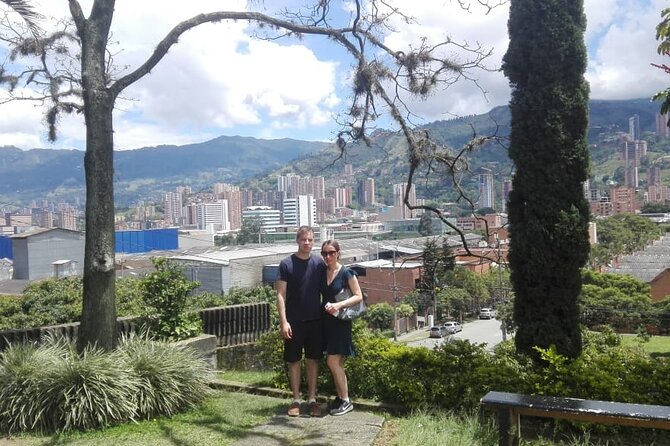
REVIEW · PABLO ESCOBAR HISTORY TOURS
Full day Pablo escobar tour
The past is never far away in Medellín. This private, six to seven-hour tour connects Pablo Escobar’s grave, the site of his death, memorials, and public transport projects to explain how violence shaped the city, and how Medellín rebuilt itself. I like the historical balance here: Escobar is treated as a criminal figure, not a folk hero. I also like the chance to ask questions throughout the day, especially with Juan Camilo, whose strong English and clear explanations earned special praise. The main drawback is the subject itself. If you want a light sightseeing day, this tour is serious, sometimes grim, and focused on Colombia’s painful recent past.
You pay $140 per person for a private experience, with pickup from your accommodation at 9:00 a.m. That price makes more sense for a small group that values conversation and door-to-door service than for a solo visitor seeking the cheapest possible outing. The mix of difficult history and civic recovery gives the day more purpose than a simple tour of Escobar-related sites.
In This Review
- Key points to know before booking
- Why this tour is more than a Pablo Escobar photo stop
- Starting at Jardines Montesacro and Escobar’s grave
- Facing Medellín’s painful past at Casa de la Memoria
- Spending two hours in Medellín’s neighborhoods
- Visiting La América, where Escobar died
- Seeing urban change at Juan XXIII Metrocable
- Remembering victims at Inflexión Memorial Park
- What $140 per person really buys
- Timing, pickup, and the shape of the day
- Who will get the most from this experience
- Should you book the Pablo Escobar tour?
- FAQ
- How long does the Pablo Escobar tour last?
- What time does the tour start?
- Where does pickup take place?
- Is this a private tour?
- Is the tour offered in English?
- How much does the tour cost?
- Are admission tickets included at the stops?
- Can I cancel for a full refund?
Key points to know before booking
- Juan Camilo may be your guide: His English was praised, along with his ability to answer questions about both Escobar and Colombia more broadly.
- It is a private tour: Only your group participates, so the pace and questions are more personal than on a large bus outing.
- The tour looks beyond Escobar: Medellín’s victims, political violence, urban projects, and public transport receive major attention.
- Six stops create a full historical arc: You move from Escobar’s grave to a memorial for victims, then to places linked with the city’s transformation.
- Pickup is included: You are collected where you are staying, with a listed 9:00 a.m. start.
- The mood is serious: This is best for people ready to discuss narcoterrorism, armed conflict, and the human cost behind the headlines.
Why this tour is more than a Pablo Escobar photo stop
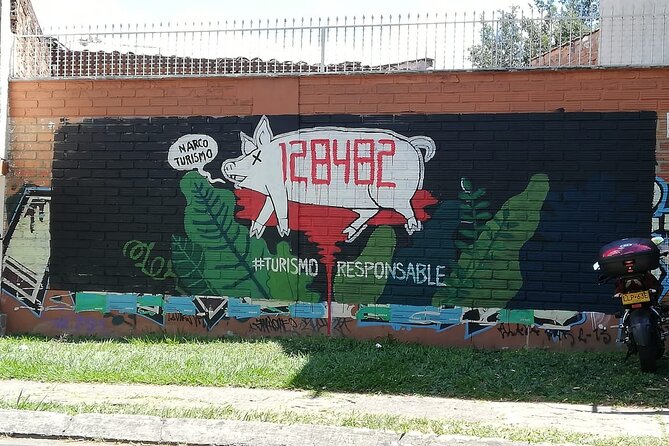
A tour built around Pablo Escobar can easily become sensational. Medellín has spent years pushing back against the idea that one drug lord defines the city, and this route makes a real effort to do the same.
You still visit the places most people associate with Escobar, including his grave and the location where he died. But the guide also explains the wider setting: Colombia’s armed conflict, drug trafficking, social divisions, political pressure, and the public projects that helped change Medellín.
That wider frame matters. Escobar did not appear out of nowhere, and his story cannot explain every part of Colombia’s past. At the same time, understanding context should never soften responsibility. The tour’s most important message is that Escobar was not a hero. His money and influence came through fear, violence, and organized crime.
Because the tour is private, you can ask direct questions without worrying about slowing down a bus full of strangers. That is especially useful when discussing disputed events, including the different accounts of Escobar’s death.
More Pablo Escobar history tours:
- Museo Pablo Escobar
★ 5.0 · 7,242 reviews - Medellín: The Real Pablo Escobar Tour
★ 4.8 · 3,205 reviews - Pablo Escobar Shared Tour of Medellin
★ 5.0 · 1,560 reviews
Starting at Jardines Montesacro and Escobar’s grave
The first stop is Cementerio Jardines Montesacro, where Pablo Escobar is buried. You have about 30 minutes here, and admission is free.
The cemetery is not presented simply as a place to admire a famous grave. Instead, the guide uses it to introduce several views of Escobar’s life and rise. You discuss the social conditions around Medellín and Colombia, the setting in which he grew powerful, and the reasons his influence reached so far.
This is a good opening because it gives you a warning about the rest of the day: the tour will ask you to think, not just collect dramatic photographs. You may hear competing explanations or different points of view, but that does not mean every version carries equal weight. A good guide should help you separate public myth from the known human cost.
The stop is short, so do not expect a long cemetery visit or a detailed study of every person connected to Escobar. Its purpose is to establish the central question: how could one man become so powerful, and what did that power mean for ordinary people?
I would approach this stop with respect. The grave is part of a real burial place, not a stage set. The experience is strongest when you treat it as a doorway into Colombia’s history rather than as a fan pilgrimage.
Facing Medellín’s painful past at Casa de la Memoria
Museo Casa de la Memoria shifts the focus away from one individual. You have roughly 30 minutes at this free museum, which is dedicated to understanding Medellín’s violent past and the city’s effort to move forward.
This stop is one of the tour’s most valuable choices. Escobar’s story can dominate popular culture, but the museum points toward the people and communities affected by drug trafficking, armed conflict, and narcoterrorism. It helps place violence in human terms rather than reducing it to gangsters, money, and famous names.
Thirty minutes is not enough for a full museum visit. You will need to accept an introduction rather than a complete reading of every display. If you are someone who likes to study exhibitions at length, you may want to return on your own, if your schedule allows. Still, as part of this route, the museum gives the day a needed moral center.
I especially like the contrast between the cemetery and the museum. The first stop centers on the man who gained power. The second asks you to consider the many people who suffered because of the system around him. That change in focus keeps the tour from becoming a biography dressed up as sightseeing.
Spending two hours in Medellín’s neighborhoods
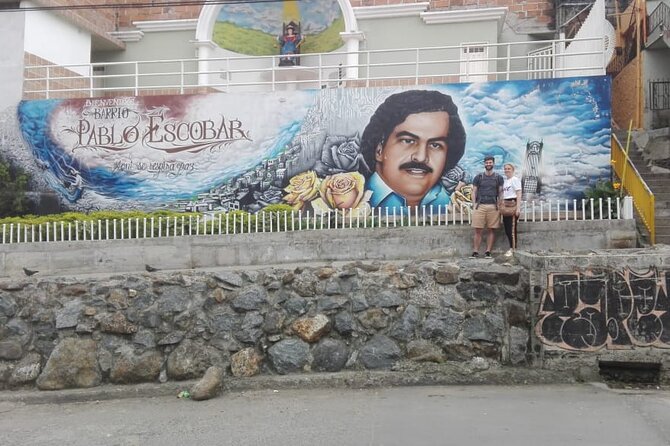
The longest stop is at Cra. 26cc # 38A-82, with about two hours devoted to the surrounding neighborhood and its historical setting. The address is specific, but the description makes clear that the goal is broader than one building or one photograph.
Here, your guide discusses the major forces that shaped Medellín and Colombia in recent decades. You look at how drug trafficking, violence, social conditions, and political events left marks on the city. The neighborhood becomes a practical setting for understanding those changes.
This longer block is likely where the private format matters most. You have time to ask about details that interest you, from the city’s past to Colombia today. One especially useful feature of Juan Camilo’s guiding style is his willingness to answer questions beyond the narrow Escobar story. That can turn the tour into a wider introduction to the country.
The supplied information does not promise a specific landmark inside the neighborhood, a meal, or a special activity, so I would not book this expecting a conventional attraction. Think of it as a guided discussion on location. You will get more from it if you listen closely and ask questions.
The two-hour duration may feel long to someone interested only in famous Escobar sites. For anyone who wants context, though, it is probably the heart of the day. Medellín’s story is not just a chain of crime scenes. It is also a story of residents, institutions, and communities trying to live with the consequences and create something better.
More things to do in Medellin:
- Medellin: Comuna 13 Graffiti Tour, Cable Car & Street Food
★ 4.8 · 9,046 reviews - Comuna 13 Graffiti Tour with Street Food
★ 5.0 · 7,503 reviews - Guatapé Tour: Piedra del Peñol with Boat Tour, Breakfast, Lunch
★ 5.0 · 7,035 reviews - Day Trip To Guatapé with ,Breakfast, Lunch and Boat Ride
★ 5.0 · 2,996 reviews
Visiting La América, where Escobar died
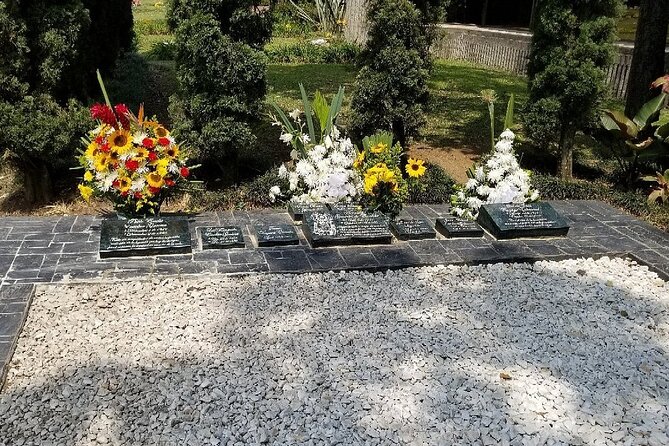
At La América, you visit the place associated with Pablo Escobar’s death. The stop lasts about 30 minutes, and admission is free.
The site itself is less important than the meaning attached to it. Escobar became one of the wealthiest and most powerful men in the world, yet his life ended in an ordinary human condition: death. That simple point can sound obvious, but it cuts through the glamour that often surrounds his name.
You also discuss the fact that different versions of his death still circulate. A responsible tour should present those accounts as competing narratives rather than pretending that every mystery has been solved. I would listen for clear distinctions between established facts, local stories, and speculation.
The discussion then widens again to drug trafficking and the armed conflict. You consider how those forces affected Colombia’s culture, politics, society, and physical development. The stop is not only about the final moments of Escobar’s life. It is about what his era left behind.
Do not expect an elaborate monument or a major attraction at this address. The value comes from the guide’s explanation and the way the location connects to the rest of the route. If you prefer museums and formal exhibits, this may feel spare. If you like place-based storytelling, it can be powerful.
Seeing urban change at Juan XXIII Metrocable
The visit to Estación Metrocable Juan XXIII introduces one of Medellín’s clearest symbols of recovery. You spend about 30 minutes at the station, and the stop is included without a separate admission fee.
Medellín was once described as the world’s most violent city during 1989 to 1991. The tour uses the Metro and public transport system to show how infrastructure became part of the city’s response. The cable car connects communities with the wider city, including areas that might otherwise have had fewer practical ways to move around.
This is an important change of subject. After graves, violence, and memorials, you see a public project aimed at access and connection. The Metrocable is not presented as a magic fix. It is an example of investment in urban and social projects, and of the effort to make separated communities part of the same city.
The description promises a visit to the station and an explanation of its role. It does not clearly promise a full cable-car ride, so I would ask the provider before booking if riding the line is essential to you. That small distinction matters. Seeing the system and traveling on it are different experiences.
Even without a confirmed ride, this stop adds needed balance. You begin to see Medellín not only as a place marked by violence, but also as a city working on mobility, access, and public life. It helps explain why the city is now often discussed for its innovation and urban progress.
Remembering victims at Inflexión Memorial Park
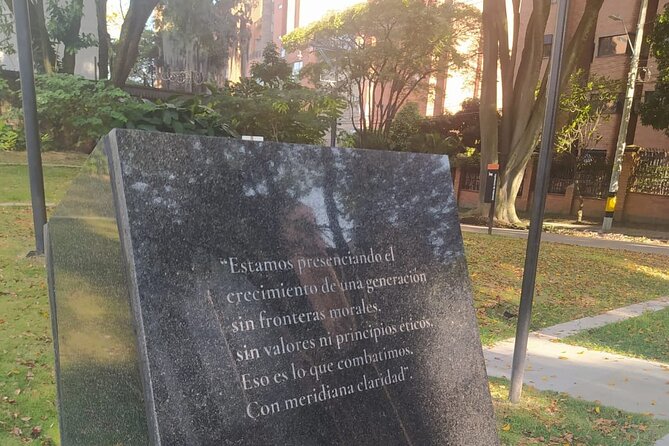
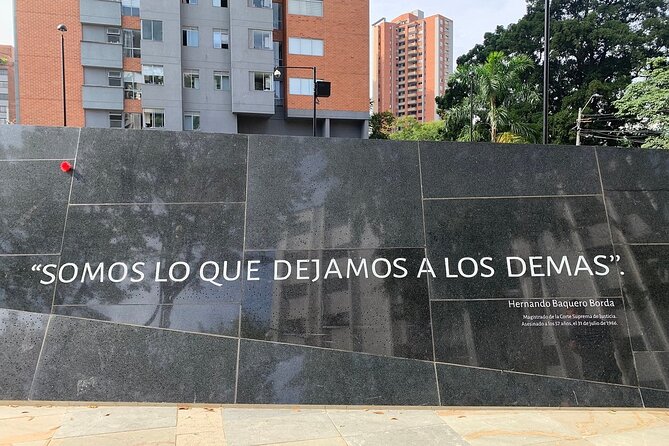
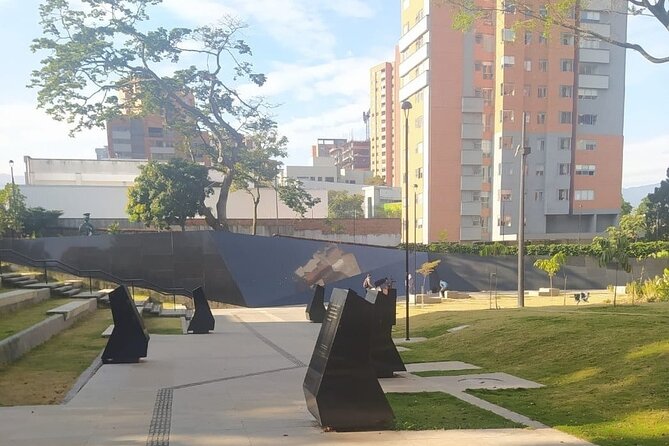
The final stop is Inflexión Memorial Park, a memorial honoring more than 46,000 victims. You have around 30 minutes here, with no admission charge.
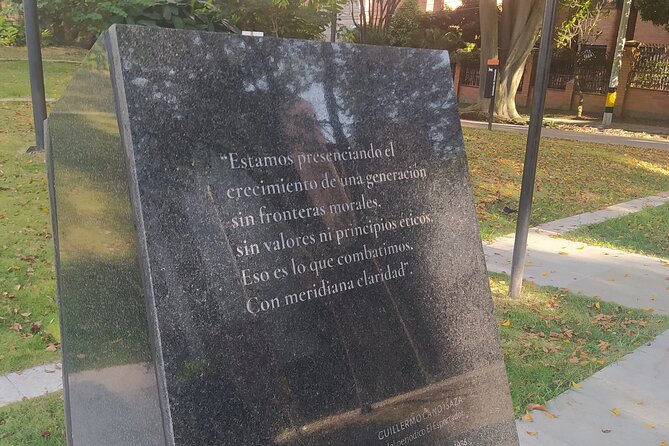
This is where the tour’s central argument comes into sharp focus. Escobar’s story is only one part of a much larger tragedy. The memorial gives space to names, numbers, details, and quotations connected to the impact of drug trafficking and narcoterrorism in Colombia.
Numbers can become abstract, especially after a long day of difficult material. The memorial’s quotations and details help bring the human side back into view. I would take your time here, even within the short scheduled visit, and let the stop counterbalance the attention given to Escobar himself.
Ending at a victim memorial is a thoughtful choice. The day begins with the grave of the person at the center of the story and ends by honoring those harmed by the era. That order makes it harder to leave with a glamorous image of Escobar.
The 30-minute visit is still brief. You may want more time to read everything, but the memorial works well as a closing reflection before pickup or the end of the tour.
What $140 per person really buys
The price is $140 per person. All six stops list free admission, so your payment is mainly for the private guide service, transportation connected with pickup and the route, and the time spent interpreting the sites. The supplied details do not specify meals, paid entries, or other inclusions, so you should not assume those are covered.
For a solo visitor, the price is high compared with joining a standard group outing. For two or more people sharing a private booking, the value becomes easier to judge. You are paying for a dedicated guide, a full day of coverage, accommodation pickup, and the freedom to ask questions at each stop.
The private format is especially useful for this topic. Escobar’s story is full of sensitive issues and disputed accounts. You may want to pause, ask for clarification, or shift the discussion toward Medellín today. A private group allows more room for that than a fixed group schedule.
Group discounts are offered, though the exact terms are not provided. Ask how the discount works before you pay. The tour is offered in English, and Juan Camilo’s English was specifically praised, which is useful if you want a detailed discussion rather than a basic translation of place names.
Timing, pickup, and the shape of the day
The listed start time is 9:00 a.m., and pickup is offered at the place where you are staying. That removes the need to reach a central meeting point, a practical benefit in an unfamiliar city.
The tour lasts approximately six to seven hours. The stated stop times add up to four hours, so the rest of the day includes driving, transitions, and the movement between locations. The exact length may depend on traffic and how much discussion your group has at each stop.
This is not a quick half-day outing, despite the fact that several individual stops last only 30 minutes. Plan for a sustained day of listening and moving around. Wear something comfortable and be ready for a serious subject that may require mental space as much as physical energy.
Because pickup is included, you should provide the correct accommodation details at booking. The tour confirms your reservation at the time of booking, and free cancellation is available if you cancel at least 24 hours before the start time. Changes or cancellations made within 24 hours are not accepted for a refund.
Service animals are allowed, and most people can participate. Since the tour includes several city stops and a Metrocable station, anyone with specific mobility concerns should ask the provider for details before booking rather than relying only on the general participation statement.
Who will get the most from this experience
I would recommend this tour to you if you want more than a collection of Escobar locations. It suits people who are curious about Colombia’s recent political and social history, and who want to understand Medellín’s recovery through public projects and memorials.
It is also a good fit if you value conversation. Juan Camilo was praised for clear English, a strong grasp of the story, and his willingness to discuss other parts of Colombia. That matters because the best questions may have little to do with Escobar himself.
You may want a different activity if you prefer cheerful sightseeing, shopping, food, or scenery. The day includes serious subjects, victims of violence, and difficult questions about power and responsibility. It is not designed to make Escobar look glamorous, and that is one of its strengths.
Should you book the Pablo Escobar tour?
Book it if you want a private, English-language introduction to Medellín’s violent past and its efforts to rebuild. The strongest parts are the full arc from Escobar’s grave to the victims’ memorial, the time allowed in the neighborhood, the urban perspective at Juan XXIII, and the chance to question a guide such as Juan Camilo.
Before booking, confirm whether the Metrocable stop includes an actual ride, and ask what the group discount covers. Also make sure you are comfortable paying $140 per person for interpretation and private transport rather than for paid attractions.
I would choose this tour for a first serious look at Medellín’s recent past, especially if you want the city’s progress discussed alongside its suffering. I would skip it only if the subject feels too heavy or if you are mainly looking for a short, inexpensive sightseeing trip.
FAQ
How long does the Pablo Escobar tour last?
The experience lasts approximately six to seven hours.
What time does the tour start?
Pickup begins at 9:00 a.m.
Where does pickup take place?
The provider picks you up at the place where you are staying.
Is this a private tour?
Yes. Only your group participates in the activity.
Is the tour offered in English?
Yes. The tour is offered in English.
How much does the tour cost?
The listed price is $140 per person.
Are admission tickets included at the stops?
Each listed stop has free admission, so no separate admission charge is specified for those locations.
Can I cancel for a full refund?
Yes, if you cancel at least 24 hours before the experience’s start time. Cancellations or changes made less than 24 hours before the start time are not accepted for a refund.
Just added in Medellin
- Walking Tour, Cable Car & Fruit Tasting★ 5.0 · 1 review
- Pablo Escobar and Griselda Blanco Tour★ 5.0 · 1 review
- City tour, Commune 13, Metro Cable, Botero Park and more. Private★ 5.0 · 34 reviews
- comuna 13 tour★ 3.5 · 6 reviews
- 3 days private mountain tour, nature and culture near Medellin★ 5.0 · 22 reviews
- commune thirteen transformation story★ 4.5 · 14 reviews
- fruits tour★ 5.0 · 2 reviews
- Paragliding and hammocks zipline over waterfalls private tour★ 5.0 · 6 reviews